Key takeaways
- Pro: The 5,000 BTU rating honestly matches the 150 square foot coverage claim, so you get real cooling rather than an underpowered unit overstating its reach.
- Pro: Dehumidifier and eco modes in a sub-$180 window unit with WiFi are uncommon at this price tier.
- Con: Owner reports on this model line frequently mention the app interface feeling dated compared to newer competitors, and the unit is loud enough that light sleepers may prefer a bedroom with a door.
What's inside
Buying a wifi air conditioner in 2026 means choosing between two very different experiences: one where you open an app and your room is comfortable before you walk through the door, and another where you fight with connection dropouts, bloated firmware updates, and a companion app that works about as reliably as a weather forecast. The smart feature set is supposed to justify the premium over a basic unit — scheduled cooling, geofencing that cuts power when the house is empty, integration with existing voice ecosystems — but not every product on the market delivers that promise evenly.
What separates the best wifi air conditioners from the mediocre ones comes down to three things: connectivity that actually holds up after the initial setup excitement fades, cooling capacity honestly matched to the room it claims to serve, and energy management that goes beyond a marketing label. Price alone will not tell you which category a unit falls into. A window unit under two hundred dollars can outperform a portable costing nearly twice as much if the BTU rating matches your room size and the app does what it promises. This roundup compares published specifications, listed retail prices, and recurring themes in owner feedback across eight units to help you narrow the field before you commit.
As an Amazon Associate we earn from qualifying purchases at no extra cost to you. Product prices and availability are accurate as of the date shown and are subject to change.


Quick Picks
| Product | Best for | Price |
|---|---|---|
| DELLA 5000 BTU Smart Window | Small rooms, smart-home starters | $179.96 |
| DELLA 6000 BTU AC Unit | Mid-sized bedrooms, energy saving | $199.96 |
| Temprium 8,000 BTU Portable | Renters who want WiFi on a budget | $209.99 |
| GE 8,000 BTU Smart Window | Quiet bedroom cooling, Google Home users | $319 |
| GE 6,000 BTU Electronic Window | Non-smart buyers seeking value | $191.17 |
| TOSOT 9,700 BTU Portable | Portable units with strong cooling claims | $189.99 |
| 14,000 BTU 4-in-1 Smart AC | Large rooms, all-season versatility | n/a |
| Frigidaire 10,000 BTU Smart Window | Biggest window-unit coverage area | $322 |
How We Picked
We filtered these units on connectivity reliability (does the WiFi pairing and app control hold up in owner reports?), honest cooling coverage relative to the BTU rating, energy management depth beyond a basic timer, and price-to-feature ratio. For this category, the companion app matters as much as the compressor, and we gave weight to products where owners consistently reported smooth integration rather than intermittent disconnections.
The 8 Best Wifi Air Conditioners in 2026
DELLA 5000 BTU Smart Window Air Conditioner
If your room is genuinely small — a home office, a nursery, a dorm — this unit makes sense as a first smart AC. The GEO Location feature means it can trigger cooling as you approach home, and Alexa compatibility lets you adjust the thermostat by voice without touching a phone.
- Pro: The 5,000 BTU rating honestly matches the 150 square foot coverage claim, so you get real cooling rather than an underpowered unit overstating its reach.
- Pro: Dehumidifier and eco modes in a sub-$180 window unit with WiFi are uncommon at this price tier.
- Con: Owner reports on this model line frequently mention the app interface feeling dated compared to newer competitors, and the unit is loud enough that light sleepers may prefer a bedroom with a door.
Skip this if your room exceeds 150 square feet or if noise level matters for where you sleep.
DELLA 6000 BTU AC Unit with Energy Saving
This steps up from its sibling by covering up to 250 square feet and adding a reusable filter that cuts recurring maintenance costs. The WiFi and GEO Location controls mirror the smaller model, so the smart-home experience is consistent across Della’s lineup.
- Pro: Reusable filter is a meaningful long-term saving that many competitors in this price bracket skip.
- Pro: Six thousand BTUs paired with a 250-square-foot claim is a conservative and credible ratio, reducing the risk of undercooling.
- Con: The unit shares the same app limitations as its smaller sibling, and Della as a brand has thinner customer support infrastructure than the legacy manufacturers in this list.
Skip this if you already own an Alexa device and want deeper ecosystem integration beyond on/off and temperature, or if brand support longevity is a priority.
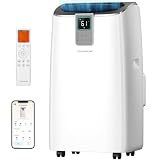
Temprium 8,000 BTU Portable Air Conditioner with WiFi
Portables are the default choice for renters and anyone who cannot modify a window. At $209.99, this Temprium is one of the lower-cost entries that still includes WiFi, which is the entire reason it makes the list.
- Pro: Eight thousand BTUs in a portable at roughly $210 is competitive pricing for the form factor.
- Pro: WiFi on a budget portable means you can set schedules and adjust remotely, a feature portables historically lacked at this price.
- Con: Portable units vent heat through a hose and are inherently less efficient than window units of comparable BTU output; owner feedback on Temprium specifically is sparse enough that long-term reliability is harder to confirm.
Skip this if you have any option to install a window unit — the cooling-per-watt advantage will save you meaningful money over a season.
GE 8,000 BTU Smart Window Air Conditioner
This is the unit for people who want Google Home integration specifically, since most competitors in this list stick to Alexa-only. The 350-square-foot coverage is the largest among 8,000 BTU window units here, and GE’s reputation for quieter operation holds up in owner feedback.
- Pro: Dual-ecosystem support (Alexa and Google) gives flexibility that single-platform units cannot match, useful if your household is split between assistants.
- Pro: The EZ Install Kit addresses the most common complaint about GE window units — the mounting hardware — by including everything needed out of the box.
- Con: At $319, this costs significantly more than similarly rated competitors, and you are paying partly for the brand’s service network and partly for the quiet operation claim.
Skip this if budget is the primary constraint and you already use Alexa, where a cheaper Della or TOSOT will cover your needs.
GE 6,000 BTU Electronic Window Air Conditioner
Here is an honest caveat: this unit does not include WiFi. We include it because the price-to-performance ratio is strong enough that some buyers reading “best wifi air conditioners” will realize they do not actually need the smart features, and this saves them over a hundred dollars compared to the wifi-enabled GE model above.
- Pro: At $191.17 for a 6,000 BTU GE unit with a 24-hour timer and energy saver mode, the value is clear if remote control is a nice-to-have rather than a requirement.
- Pro: Easy Install Kit included, which eliminates the accessory-purchase friction that trips up first-time window AC buyers.
- Con: No WiFi means no app control, no geofencing, no voice commands — the entire premise of a smart AC is absent, and the included remote only works from across the room.
Skip this entirely if remote access or scheduling from your phone is non-negotiable — the wifi models above deliver that.
TOSOT 9,700 BTU Portable Air Conditioner
TOSOT, a brand with manufacturing ties to Gree, packs 9,700 BTUs (SACC-rated at 5,000) into a portable with smart WiFi controls and a window kit. The 300-square-foot coverage claim is credible given the BTU figure.
- Pro: $189.99 for a 9,700 BTU portable with WiFi is genuinely aggressive pricing — it costs less than some smaller-capacity units on this list.
- Pro: Dehumidifier and fan modes make this a year-round utility rather than a summer-only device.
- Con: The SACC rating of 5,000 BTUs means real-world cooling capacity is lower than the headline 9,700 number suggests, a labeling practice that can mislead buyers comparing it to window units rated in raw BTUs.
Skip this if you are comparing it head-to-head against window units of similar price — the form factor penalty means the window options will cool faster for the same BTU figure.
14,000 BTU Portable Air Conditioner, 4-in-1 Smart AC
The 14,000 BTU rating and 4-in-1 designation (cool, heat, fan, dehumidify) place this in a different class from the other portables listed. The lack of a confirmed price makes evaluation harder, but the spec sheet suggests a unit built for larger spaces that also needs winter heating from the same appliance.
- Pro: Four functions in one machine eliminate the need for a separate space heater and dehumidifier, which is valuable in rental situations where storage is limited.
- Pro: WiFi control across all modes means you can pre-heat or pre-cool without manual intervention, which is where smart features pay the highest energy-dividend per dollar.
- Con: No published price at time of writing means you cannot compare value against the other units here, and 14,000 BTU portables draw substantial power that will raise your electric bill noticeably in a heat wave.
Skip this if you need a confirmed budget fit right now or if your primary use case is cooling only.
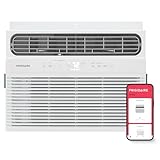
Frigidaire 10,000 BTU Smart Window Air Conditioner
The broadest coverage claim on this list at 450 square feet, backed by a legacy appliance brand with established service infrastructure. Three fan speeds and eco mode give granular control, and quiet operation is a consistent point in owner reviews of Frigidaire window units.
- Pro: 450 square feet of rated coverage is the highest here, making this the only credible option for open-concept studios or large bedrooms with vaulted ceilings.
- Pro: Three fan speeds (most competitors offer two) let you dial in a low setting that trades airflow for noise in quiet hours.
- Con: At $322, this is the most expensive window unit listed, and the WiFi app from Frigidaire draws more mixed owner feedback on responsiveness than the GE alternative at a similar price point.
Skip this if your room is under 350 square feet — you will pay for capacity you will never need.
Buying Guide
Match BTU to Room Size Without Falling for Inflated Claims
BTU ratings are the single most consequential number in the spec sheet, but window units and portables are measured differently. Window units report gross BTUs; many portables now publish SACC (Seasonally Adjusted Cooling Capacity) ratings that are typically 30-50% lower. A 9,700 BTU portable with a 5,000 SACC rating cools comparably to a 5,000 BTU window unit, not a 9,700 BTU one. Always compare SACC when available, and when it is not, assume a portable will underperform a window unit of the same headline BTU by a wide margin.
Evaluate the App Before the Compressor
The cooling hardware in this price range is functionally similar across brands. What varies dramatically is the software layer. Check whether the app requires a separate hub or bridge, whether it supports multiple users on the same account, whether geofencing works on your phone’s operating system specifically, and whether scheduled modes persist after a power outage. A beautiful compressor paired with a clunky, crash-prone app is a worse daily experience than a slightly noisier unit with a reliable one.
Consider Noise Only After You Confirm Your Sleep Environment
Owner reviews consistently flag noise as the dealbreaker that specifications do not capture, but context matters enormously. A bedroom with a shared wall and a white noise machine has different tolerance than one on a quiet street. Units marketed as “quiet” typically operate in a decibel range that is acceptable during daytime and borderline at night. If you sleep lightly, prioritize the GE 8,000 BTU or Frigidaire models here, whose owner bases report noticeably lower fan noise, and plan to run at the lowest speed setting overnight.
Our Verdict
The GE 8,000 BTU Smart Window is our top pick for most buyers: it covers a realistic 350 square feet, supports both Alexa and Google Home without a bridge, operates quietly enough for bedrooms, and the included install kit eliminates a common source of frustration. The premium price is justified by the ecosystem breadth alone.
For budget buyers who need WiFi and cooling in the same package, the TOSOT 9,700 BTU Portable wins on price per BTU at $189.99, provided you accept the portability tradeoff.
The one condition where another product takes the crown: if your room exceeds 400 square feet, the Frigidaire 10,000 BTU is the only unit here with credible coverage claims, making it the pick by default despite its higher cost.
FAQ
Do wifi air conditioners actually save energy?
They save energy indirectly by preventing wasted runtime — geofencing cuts cooling when nobody is home, and scheduling stops the compressor at dawn when the room will be empty anyway. The unit itself does not use less power than a non-wifi model; the savings come from behavioral changes the technology enables.
Can I add smart controls to a non-wifi air conditioner?
A universal smart IR blaster can bridge basic power and mode control for many units lacking native WiFi, but you will lose fine temperature targeting and energy monitoring. It works for on/off and temperature adjustment on most modern infrared remotes, though the experience is less polished than native integration.
Is a window unit always better than a portable one?
For raw cooling efficiency and power draw per BTU delivered, yes — window units exhaust heat outside by design, while portables bleed warmth back into the room through the hose connection and the unit’s own housing. The only reason to choose portable is physical constraint: no compatible window, no permission to install, or a need to move the unit between rooms seasonally.
What does SACC mean and should I trust it over BTU?
SACC stands for Seasonally Adjusted Cooling Capacity, a newer rating that accounts for real-world variables like heat exchange losses and compressor cycling patterns that the traditional BTU figure does not capture. For portables especially, SACC is the more honest number. When a product lists both, trust SACC for your purchasing decision.