Key takeaways
- Compare the best guitar amps for home practice and small gigs, with combo modeling and tube picks, wattage, speaker sizes, and effects notes inside.
As an Amazon Associate we earn from qualifying purchases.
Most guitarists need one amp to do two very different jobs: behave at living-room volume on a weeknight, then hold its own next to a drummer in a rehearsal room or a small venue. The five amps in this guide are split by role rather than ranked against each other: a small modeling combo built for practice, a compact all-tube combo for genuine tube response, a 50-watt combo with headroom for small gigs, a dedicated acoustic amplifier with a microphone channel, and a desktop amp for the desk, the shelf, and headphones. Every wattage, speaker size, channel layout, and effect below comes from the maker’s own product information and the corresponding Amazon listing.

Disclosure: This article contains affiliate links. If you make a purchase through these links, we may earn a commission at no extra cost to you.
How to Choose a Guitar Amp for Home and Small Gigs
Start with wattage, but read it in context. Wattage figures are not directly comparable across amp types. A 10-watt tube amp, like the Vox below, is far louder in a room than its number suggests, because tube power sections are usually run where they begin to saturate. A 20-watt modeling combo is voiced to sound complete at low volume instead. For small gigs with a drummer, a 50-watt combo with a 12-inch speaker is the traditional safe point, and several amps here add power scaling — the Katana-50 MkII drops to 25 or 0.5 watts — so the same amp can come home without losing its feel.
Match the speaker to the room and the job. Speaker size shapes the low end more than wattage does. An 8-inch speaker in a practice combo keeps things focused and tidy at home. A 10-inch speaker in a small tube combo gives a tighter, more vintage-leaning voice. A 12-inch speaker moves enough air for rehearsals and small stages and keeps bass notes intact under gain. Desktop amps take the opposite approach: two small full-range speakers in stereo, tuned for near-field listening.
Decide how you want to change sounds. A single-channel tube combo changes character with its gain knob and your guitar’s volume control, and that simplicity is the appeal. Modeling and stage combos instead store complete sounds: the Spider V 20 MkII carries 16 presets on board, the Katana-50 MkII saves four Tone Settings across two banks, and the THR10II holds five user memories. If your band jumps between clean, crunch, and lead sounds mid-set, stored settings matter; if you play one or two core tones, they matter much less.
Check the effects and editing you will actually use. Onboard effects remove the need for a pedalboard at home. Line 6, Boss, and Yamaha all pair their amps with free editor apps — Spider V Remote, BOSS Tone Studio, and THR Remote — that unlock far more amp models and effect settings than the front panels show. Count what runs at once: the Spider V runs up to three effects plus reverb, while the Katana runs five independent effect sections simultaneously. Acoustic players should look instead for feedback control, which on the Fishman below takes the form of a phase switch on the instrument channel.
Plan for quiet practice and simple recording. Every amp here has a headphone output, which is the single most useful home feature on any of them. Aux inputs and Bluetooth playback let you play along with tracks at matched volume. USB connections on the Spider V, the Katana, and the THR10II double as recording interfaces for a computer. For acoustic performers, the equivalent feature is a D.I. output, which sends the amp’s sound straight to a PA while the amp works as a personal monitor.
1. Line 6 Spider V 20 MkII — Best Practice Modeling Combo
The Spider V 20 MkII is Line 6’s entry point into its Spider V modeling range: 20 watts into a single custom 8-inch speaker, in a cabinet light enough to move from room to room at 11 pounds. Sixteen presets are loaded on board, covering clean, crunch, and high-gain ground, and each preset can run up to three effects at once alongside an independent reverb. A built-in tuner and tap tempo button sit on the front panel, and a Classic Speaker mode switches the output from full-range voicing to a more traditional guitar-speaker response when you want the amp to behave like a conventional combo.
The deeper library lives in the free Spider V Remote app, which opens up more than 200 amp, cab, and effect models in total, including the 78 amp models, 24 cab models, and over 100 effects models in the amp’s own specification. The micro-USB port connects the amp to a computer, phone, or tablet for editing and also works as a recording interface, with Cubase LE software included according to Line 6. For a first amp or a dedicated practice corner, it covers the most ground per feature in this guide; its ceiling is volume, since 20 watts through an 8-inch speaker is a home tool, not a band amp.
Specs
- Power: 20 watts
- Speaker: 1 × 8″ custom speaker
- Channels: Single channel, 16 onboard presets
- Modeling: 78 amp models, 24 cab models, 4 mic models; 200+ amps, cabs, and effects via the Spider V Remote app
- Effects: 100+ effects models; up to 3 simultaneous effects plus independent reverb
- Connectivity: Micro-USB for app editing and recording; 1/8″ headphone output
- Extras: Built-in tuner, tap tempo, Classic Speaker mode
- Weight: 11 lb (5 kg)
2. Vox AC10C1 Custom — Best Small Tube Combo
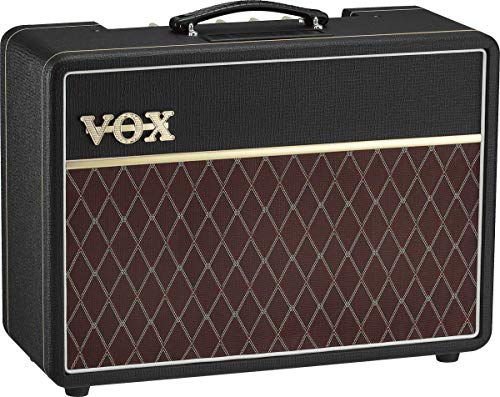
The AC10C1 revives one of the first amplifiers to carry the Vox name, sized for modern homes and studios. It is an all-tube design — two 12AX7 tubes in the preamp and two EL84 tubes in the power amp — producing 10 watts through a single 10-inch Celestion VX10 speaker. The circuit includes Vox’s Top Boost design, the feature behind the bright, chime-leaning clean tones and edged breakup the brand is known for, and a master volume lets you push the gain stage at volumes a living room can tolerate.
Controls are deliberately simple: gain, treble, bass, reverb, and volume on a single channel, with a custom Vox digital reverb standing in for the spring tanks of larger models. There is no channel switching, no effects loop, and no preset memory, and that is the point — one sound, shaped by the gain knob and the guitar. An external speaker output (16 ohms) lets the combo drive a larger cabinet when needed, effectively turning it into a small tube head. Players who want authentic tube response and touch sensitivity at home volume, and who are happy to build the rest of their sound with pedals later, are the audience here.
Specs
- Power: 10 watts, all-tube
- Speaker: 1 × 10″ Celestion VX10
- Tubes: 2 × 12AX7 preamp, 2 × EL84 power amp
- Channels: Single channel with Top Boost circuitry
- Controls: Gain, Treble, Bass, Reverb, Volume
- Reverb: Custom Vox digital reverb
- Output: External speaker jack, 16 ohms
3. Boss Katana-50 MkII — Best Gig-Ready Combo
The Katana-50 MkII is the amp in this guide built to leave the house. Its listing describes a stage-ready 50-watt combo with a custom 12-inch speaker, and Boss adds a Power Control that steps the output down to 25 watts, 0.5 watts, or standby, so the same amp that covers a rehearsal or small stage can be played at home without choking it down with the master volume alone. Five amp characters — Clean, Crunch, Lead, Brown, and Acoustic — each come with a variation, doubling the core voices on tap.
Effects are handled by five independent sections (booster, modulation, FX, delay, and reverb) that can run simultaneously, with deeper editing, additional effect types, and signal-chain control available in the free BOSS Tone Studio software. Four Tone Settings can be stored across two banks and recalled from the panel or an optional footswitch, which is enough for a clean, a rhythm, a lead, and a spare. USB and a headphone/record output cover home recording and silent practice, and an aux input handles backing tracks. It is the largest amp here, but also the only one of the five that covers practice, rehearsal, recording, and a small gig with no compromises on headroom.
Specs
- Power: 50 watts; Power Control settings of 0.5W, 25W, 50W, and Standby
- Speaker: 1 × 12″ custom speaker
- Amp characters: 5 (Clean, Crunch, Lead, Brown, Acoustic), each with a variation
- Effects: 5 independent sections (Booster, Mod, FX, Delay, Reverb), usable simultaneously; expanded editing in BOSS Tone Studio
- Memories: 4 Tone Settings (2 channels × 2 banks)
- Connectivity: USB, headphone/record output, aux input
4. Fishman Loudbox Mini Bluetooth — Best Acoustic Guitar Amp
The Loudbox Mini is Fishman’s smallest full-featured acoustic amplifier, and the current version (model PRO-LBT-600) adds Bluetooth audio streaming to the formula. It produces 60 watts of bi-amped power through a 6.5-inch woofer and a 1-inch soft-dome tweeter, a two-way arrangement that suits acoustic guitar because the instrument’s detail lives in the high frequencies a single guitar speaker tends to soften. Fishman voices the amp for faithful, uncolored reproduction rather than the mid-forward push of an electric guitar combo.
Two channels cover the singer-songwriter setup completely. The instrument channel has a three-band EQ, a phase switch for fighting feedback in live rooms, and both reverb and chorus. The microphone channel takes an XLR or 1/4-inch input with its own two-band EQ and reverb, so a voice and a guitar run through one small box. An XLR D.I. output sends the mix to a PA or recording interface while the amp serves as a stage monitor, Bluetooth handles backing tracks and break music, and an aux input covers wired playback. For coffeehouse sets, small ceremonies, and home recording, it replaces a small PA rather than competing with the electric amps above.
Specs
- Power: 60 watts, bi-amped
- Speakers: 6.5″ woofer and 1″ soft-dome tweeter
- Channels: 2 (Instrument and Microphone)
- Instrument channel: 3-band EQ, phase switch, reverb and chorus
- Mic channel: XLR/1/4″ combo input, 2-band EQ, reverb
- Connectivity: Bluetooth audio input, 1/8″ aux input, XLR D.I. output
- Model: PRO-LBT-600
5. Yamaha THR10II — Best Desktop and Headphone Practice Amp
Yamaha created the desktop amp category with the original THR, and the THR10II is its current standard model. The Amazon listing’s own product information gives an output wattage of 20 watts, delivered as a stereo pair of 3-inch speakers in a cabinet measuring 14.49 × 5.5 × 7.2 inches — small enough to live on a desk or bookshelf permanently. Yamaha’s Virtual Circuitry Modeling provides 15 guitar amp models, plus bass amp models, mic models for acoustic-electric guitars, and flat voicings for other sources, with eight built-in effects and five user memory slots for sounds you build yourself.
The desktop brief shapes every other feature. Bluetooth streams music from a phone for play-along practice and connects to the THR Remote editor app, the speakers are tuned with hi-fi audio technology so playback sounds like a small stereo system rather than a guitar amp, and Extended Stereo Technology widens the sound field beyond the cabinet’s physical size. USB turns it into a recording interface, and the headphone output makes it the natural late-night pick in this guide. This wired model runs from its AC adapter only; the rechargeable battery and built-in wireless receiver belong to the THR10II Wireless, a separate model in the range.
Specs
- Output wattage: 20 watts (stereo), per the listing’s product information
- Speakers: 2 × 3″ full-range
- Amp models: 15 guitar amp models, plus bass amp models, mic models for acoustic-electrics, and flat voicings
- Effects and memories: 8 built-in effects; 5 user memory slots
- Connectivity: Bluetooth for audio playback and the THR Remote app; USB audio interface; headphone output; aux input
- Dimensions: 14.49 × 5.5 × 7.2 inches, per the listing
- Power source: Corded electric (AC adapter); no built-in battery on this model
- Model number: THR10II
Frequently Asked Questions
How many watts do I need for home practice and small gigs?
For home practice alone, anything in this guide works, including the 10-watt tube Vox, which is louder than its figure suggests. For rehearsals and small gigs with a drummer, plan on the 50-watt class with a 12-inch speaker, represented here by the Katana-50 MkII. Power scaling changes the calculation: an amp that can drop to 0.5 watts for home and open up to 50 watts for the stage covers both jobs in one cabinet.
Is a tube amp or a modeling amp better for home use?
They solve different problems. A small tube combo like the AC10C1 gives one excellent sound with natural touch response, and it takes pedals well, but it has no presets and no built-in recording output. Modeling amps like the Spider V 20 MkII and THR10II trade that single-sound purity for presets, effects, headphone practice, and USB recording in one box. Choose based on whether you want depth in one tone or breadth across many.
Can I play an acoustic-electric guitar through a regular guitar amp?
You can plug in and get sound, and the Katana-50 MkII even includes a dedicated Acoustic amp character for the purpose. A purpose-built acoustic amp like the Loudbox Mini still does the job better: its two-way speaker system reproduces the high-frequency detail of an acoustic pickup more faithfully, its phase switch manages feedback, and its second channel takes a microphone. If acoustic playing is your main focus, buy the acoustic amp; if it is an occasional detour, the Katana’s Acoustic character is a reasonable bridge.
How do I practice silently with a combo amp?
Use the headphone output, which every amp in this guide provides; on the Spider V 20 MkII the headphone jack is frequency-corrected so the sound stays close to what the speaker produces. Low-power modes help before you reach for headphones: the Katana’s 0.5-watt setting keeps its response at conversation level. The THR10II is designed around this use entirely, with its near-field stereo speakers and headphone output sized for a desk in a shared room.
Conclusion
Match the amp to the chair it will sit next to. The Line 6 Spider V 20 MkII is the practice-corner pick, with the deepest model library per feature and a recording output for a first home studio. The Vox AC10C1 Custom is the choice for genuine tube response at home volume, one channel and no distractions. The Boss Katana-50 MkII is the one-amp answer for players who rehearse and play small gigs, with power scaling that brings it home again. The Fishman Loudbox Mini Bluetooth serves acoustic players and singing performers, doubling as a compact PA. And the Yamaha THR10II owns the desktop, built for daily practice, play-along streaming, and headphones after hours.
More from Amazon
Programs that pair well with the guide above. Offers and eligibility are set by Amazon and may change.
Free shipping on eligible items, Prime Video and more. Eligible new members can start with a free trial.
Start a Prime free trialAd-free music streaming. Eligible new subscribers can start with a free trial.
Try Music Unlimited freeA Prime membership for ages 18-24 with a trial period. Eligibility is set by Amazon.
See Prime for Young AdultsAudiobooks and podcasts to listen to on the go. Eligible new members can start with a free trial.
Try Audible freeAs an Amazon Associate we earn from qualifying purchases.