Key takeaways
- For most home NAS builds, the best NAS hard drive is the WD Red Plus 10TB (WD100EFGX). It uses CMR recording, which is what you want in a RAID array, spins at 7200 RPM with a 512MB cache, and offers…
For most home NAS builds, the best NAS hard drive is the WD Red Plus 10TB (WD100EFGX). It uses CMR recording, which is what you want in a RAID array, spins at 7200 RPM with a 512MB cache, and offers a sweet-spot capacity for a 2- or 4-bay NAS. It usually costs around $380–$420, which is a reasonable price per terabyte for a NAS-rated drive.
If you are on a tighter budget or building a quiet 2-bay setup for backups, the Seagate IronWolf 4TB and WD Red Plus 4TB are both CMR, 5400 RPM drives that run cooler and quieter. If you need maximum capacity for a media library or small business server, the WD Red Pro 16TB and 20TB are the high-capacity picks, and the Seagate IronWolf 8TB sits neatly in the middle.
Our top picks


As an Amazon Associate we earn from qualifying purchases at no extra cost to you. Ratings are shown as listed on Amazon.
NAS Hard Drive Comparison
| Drive | Capacity | RPM | Cache | Recording | Typical Price | Approx. $/TB |
|---|---|---|---|---|---|---|
| WD Red Plus WD100EFGX | 10TB | 7200 | 512MB | CMR | $380–$420 | ~$40 |
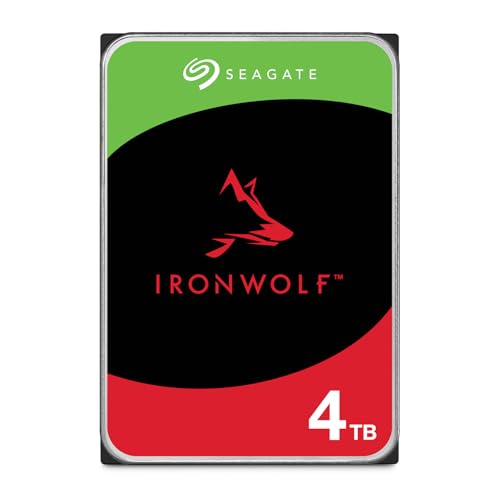
| Seagate IronWolf ST4000VNZ06 | 4TB | 5400 | 64MB | CMR | $170–$200 | ~$46 |
| WD Red Plus WD40EFZZ | 4TB | 5400 | 128MB | CMR | $180–$200 | ~$48 |
| Seagate IronWolf ST8000VNZ04 | 8TB | Check listing | Check listing | CMR (IronWolf line) | $310–$340 | ~$41 |
| WD Red Pro WD161KFGX | 16TB | 7200 | 512MB | CMR | $630–$690 | ~$41 |
| WD Red Pro WD202KFGX | 20TB | 7200 | 512MB | CMR | $840–$900 | ~$44 |
All six are 3.5-inch SATA 6Gb/s drives. Prices per terabyte are approximate and shift often; compare current prices before buying.
The Best NAS Drives in Detail
WD Red Plus 10TB (WD100EFGX) – Best Overall
Best for: 2- to 4-bay home NAS units used for backups, photo libraries and Plex or Jellyfin media servers.
Ten terabytes per drive gives you about 10TB usable in a two-drive mirror or about 30TB usable in a four-drive RAID 5, enough for most households. The 7200 RPM speed and 512MB cache improve sequential transfers and responsiveness compared with 5400 RPM drives. Red Plus drives are designed for NAS systems with up to 8 bays.
Trade-offs: 7200 RPM drives run a little warmer and louder than 5400 RPM models, which can matter if the NAS sits in a living room or bedroom.
Seagate IronWolf 4TB (ST4000VNZ06) – Best Budget Pick
Best for: first NAS builds, 2-bay backup boxes and quiet setups.
A 5400 RPM, CMR drive with a 64MB cache, it is tuned for RAID use and runs cool and quiet. Seagate also bundles Rescue data recovery services with many IronWolf models, which is a useful safety net.
Trade-offs: 4TB fills quickly if you store 4K video, and the cost per terabyte is higher than larger drives.
WD Red Plus 4TB (WD40EFZZ) – Best Quiet 4TB Alternative
Best for: buyers who prefer WD or want to match existing Red Plus drives.
Like the IronWolf 4TB, it is a 5400 RPM CMR drive, but with a larger 128MB cache. In practice, the two are close; choose based on price and which brand your NAS already uses.
Trade-offs: same capacity limits as any 4TB drive.
Seagate IronWolf 8TB (ST8000VNZ04) – Best Mid-Capacity
Best for: users who want more space than 4TB without paying for 10TB or more.
Eight terabytes in a two-drive mirror gives you a comfortable 8TB of protected storage. The IronWolf line is designed for multi-bay NAS use with vibration tolerance features. Check the listing for its spindle speed and cache, since IronWolf models vary by capacity.
WD Red Pro 16TB (WD161KFGX) – Best for Larger Arrays
Best for: 4- to 8-bay setups, small businesses and heavy media libraries.
Red Pro drives are built for larger, busier NAS systems than Red Plus, with a higher workload rating and longer warranty coverage. At 7200 RPM with a 512MB cache, they offer strong sustained transfers. Sixteen terabytes per drive lets a four-bay NAS hold about 48TB usable in RAID 5.
Trade-offs: louder and warmer than 5400 RPM drives, and rebuilding a failed 16TB drive takes many hours, so consider RAID 6 or SHR-2 in larger arrays.
WD Red Pro 20TB (WD202KFGX) – Maximum Capacity
Best for: power users who want the most storage per bay.
The 20TB model maximizes density and makes sense when bays are limited. It shares the 7200 RPM and 512MB cache of the 16TB model. Cost per terabyte is slightly higher at this size right now, so buy it for bay efficiency rather than value.
How to Choose a NAS Hard Drive
Insist on CMR
CMR (conventional magnetic recording) drives handle the constant rewrites and RAID rebuilds of NAS use far better than SMR drives. All six drives here are CMR, which is why they are on the list.
Match the drive to bay count and workload
| NAS size / use | Recommended class |
|---|---|
| 1–2 bays, backups, light use | 5400 RPM NAS drives (IronWolf, Red Plus 4TB) |
| 2–4 bays, media server, family use | Red Plus 10TB or IronWolf 8TB |
| 4–8+ bays, business or heavy use | Red Pro 16TB or 20TB |
RPM: speed vs. noise
7200 RPM drives transfer faster but are noisier and warmer. If your network is gigabit, a single 5400 RPM drive already comes close to saturating it for large files, so speed matters most on 2.5GbE or 10GbE networks.
Plan capacity for growth
Estimate your storage needs and double them. It is easier to buy bigger drives now than to replace an entire array later.
RAID is not a backup
RAID protects against drive failure, not deletion, ransomware or fire. Keep an off-site or cloud backup of important data.
FAQ
Can I mix Seagate and WD drives in one NAS?
Yes, most NAS systems allow it, but matching capacity and speed within an array gives the most predictable performance.
Are NAS drives worth it over desktop drives?
Yes. They are designed for 24/7 operation and RAID environments, and include vibration tolerance that desktop drives may lack.
How many drives should I buy?
At least two for a mirror. For four-bay systems, start with three or four for RAID 5 or SHR.