Key takeaways
- Compare the best mechanic creepers for garage work, with wheel size, ground clearance, padding, weight capacity, and low-profile frames for tight spaces.
As an Amazon Associate we earn from qualifying purchases.
Working under a vehicle on bare concrete is a fast way to end a job early: cold floors sap body heat, grit grinds into your shoulders, and every reach for a wrench becomes a small workout. A good mechanic creeper fixes all of that. It lifts you just off the floor on smooth casters, supports your head and back, and lets you roll from one end of the job to the other without getting up. The catch is that creepers differ a lot in height, caster size, deck construction, and capacity, and the wrong pick can leave you stuck on a floor crack or too tall to fit under a lowered car. This guide explains the trade-offs that matter, then compares five well-regarded models covering the main styles: a classic padded steel-frame creeper, an ultra-low plastic creeper, an oversized high-capacity model, a compact creeper that converts into a seat, and a heavy-duty folding design for tight storage.
Disclosure: This article contains affiliate links. If you make a purchase through these links, we may earn a commission at no extra cost to you.
How to Choose a Mechanic Creeper
Start with clearance, because it decides everything else. The space between the floor and the lowest point you need to reach, often the rocker panel or a subframe, has to fit the creeper deck plus your chest and head. Low-profile plastic creepers can sit with under an inch of floor clearance and decks around four inches tall overall, which makes them the safest pick for lowered cars. Padded steel-frame creepers ride higher, and folding Z-frame models sit higher still once the hinge and thicker cushions are counted. Measure the car first, at the point where you actually slide in, and leave room for your body rather than trusting a headline number.
Casters are the second half of the clearance trade-off. Small two-inch rollers keep a creeper low, but they stop dead on expansion joints, zip ties, dropped bolts, and the lip of a floor drain. Larger three-inch casters roll over those obstacles far more willingly, at the expense of deck height. Six casters spread your weight better than four and reduce the chance that one wheel drops into a crack and strands you mid-job. Material matters too: urethane rollers are quiet, resist corrosion, and are kind to coated floors, while hard plastic wheels roll easily on smooth concrete but can skid on dust. Sealed or shielded bearings keep grit out and are worth having in a busy shop.
Pick a deck style that matches how you work. A fully padded deck on a steel frame is the comfort choice for long sessions, with vinyl covering that wipes clean and a cushioned headrest to support your neck. A one-piece molded plastic deck gives up padding but shrugs off oil, coolant, and solvents, and it can be hosed down after a messy job. Molded decks often add tool trays at the sides and contoured shapes with lumbar support and shoulder cutouts, so your arms can drop and swing a wrench without the deck edge digging in. Look for dropped shoulder sections on any design if you spend time reaching overhead fasteners.
Match length and capacity to your body, honestly. A 36-inch creeper is easy to store and fine for shorter users, but taller mechanics will hang off the end of anything under 40 inches, and a 48-inch deck exists precisely for them. Capacity figures include you plus the tools on the deck, and the capacities in this guide run from 300 to 450 pounds, so heavier users should shop at the top of that range and prefer steel frames or reinforced molded bodies.
Consider a convertible if your garage does double duty. Z-frame creepers fold from a flat board into a rolling seat, which covers brake work, detailing, and anything at wheel height without a second stool. The compromise is extra height, extra weight, and a hinge that must lock positively before you trust it in either mode. Folding models also store flat against a wall, which matters in a one-car garage.
Finally, the safety basics are not optional. A creeper is a comfort tool, never a support: the vehicle belongs on a proper lift or on jack stands placed on solid ground, with the wheels chocked and the parking brake set. Work on a smooth, level surface, keep long hair and loose clothing away from casters, and check that folding mechanisms are locked before you roll under.
Performance Tool W85005 40-Inch Creeper

The W85005 is the classic padded creeper in its most familiar form: a powder-coated tubular steel frame carrying a fully padded deck, finished with a cushioned headrest that adjusts by lever action to three positions. That headrest is the headline feature, because holding your head up at an angle to see a fastener is what tires necks during long jobs, and a rest you can raise or flatten as the work changes genuinely helps. Six shielded swivel casters of 2-1/2 inches sit under the frame, a middle-ground size that rolls acceptably on decent concrete while keeping the deck at a workable height. The manufacturer’s catalog rates the creeper at 350 pounds maximum, which covers most users with tools in hand. There are no tool trays and no folding tricks here, and that simplicity is the appeal: it is a flat, comfortable board that does the core job, with padding thick enough for extended sessions on a cold floor. Taller users should note the 40-inch length is the standard size rather than an extended one.
Specs
- 40-inch fully padded deck on a powder-coated tubular steel frame
- Lever-action cushioned headrest adjusts to three positions
- Six shielded 2-1/2 inch swivel casters for 360-degree movement
- Maximum capacity 350 lb, per the manufacturer’s catalog
- Replacement caster assembly available as a separate part
Lisle 97102 Black Plastic Creeper

The Lisle 97102 is built around one idea: get as low as possible. Its one-piece body is blow-molded from high-density polyethylene with internal ribs for strength, and it manages a floor clearance of just 7/8 inch, low enough to roll over air hoses and cords that stop taller creepers. The body is contoured to the human frame with lumbar support and a padded headrest, and the surface resists solvents, greases, and fuels, so it wipes clean after the kind of job that would soak a padded deck. Six 2-inch urethane rollers run in steel bushings molded into the body, and they pop in and out by hand, which makes replacing a worn roller a quick job instead of a repair project. The trade-offs are honest ones: the small rollers are the most likely in this guide to catch on rough or cracked concrete, the 300-pound capacity is the joint lowest here, and at 38 inches long it suits average heights better than tall users. For lowered cars and messy fluid work, it remains the specialist pick.
Specs
- One-piece blow-molded high-density polyethylene body with molded-in ribs
- Dimensions: 38 in long x 17.5 in wide x 4 in high; 7/8 in floor clearance
- Six 2-inch urethane ball-bearing swivel rollers, pop-in replaceable
- Rollers run in steel bushings molded into the body
- 300 lb capacity; weighs about 11.5 lb; surface resists solvents, grease, and fuel
Pro-LifT C-6048 48-Inch Plastic Creeper

Where the Lisle optimizes for minimum height, the Pro-LifT C-6048 optimizes for room. Its one-piece blow-molded HDPE body stretches to 48 inches long and 23 inches wide, and it carries a 440-pound capacity, the highest of the flat creepers in this guide. That size makes it the natural pick for taller and larger mechanics who feel cramped on a standard 40-inch board, and the extra width adds stability when you are pulling hard on a breaker bar. Six 3-inch casters are the other half of the design: the larger wheels roll over floor seams, cords, and small debris that would stop two-inch rollers, which suits garages whose concrete has seen better days. A padded headrest softens the molded deck, and dual tool trays molded into the sides keep sockets and fasteners off the floor and within reach. At about 16 pounds it is still easy to carry or hang up, and the plastic body cleans up with a wipe or a hose. The cost of the big casters and deck is height, so measure low cars before choosing it.
Specs
- One-piece blow-molded HDPE body, 48 in long x 23 in wide
- 440 lb weight capacity
- Six 3-inch casters for rolling over seams and small debris
- Padded headrest and dual molded tool trays
- Weighs about 16 lb
Pro-Lift C-2036D 36-Inch Z-Creeper

The C-2036D answers a storage and versatility problem rather than a clearance one. Its steel frame folds in a Z shape, working flat as a 36-inch padded creeper for under-car jobs and then converting into a rolling mechanic seat for work at wheel and bench height. Thick padded vinyl cushions cover both the creeper bed and the seat, with a padded headrest in creeper mode, and six swivel casters keep it mobile in either configuration. Its capacity is 300 pounds including tools and personal items, per the owner’s manual, and the whole unit weighs only about 14 pounds, so it is easy to carry between bays or load into a vehicle for mobile work. The compromises follow from the format: 36 inches is short for tall users, a folding frame sits higher than a flat plastic creeper, and the hinge and lock pin deserve a quick check before each use, as the manual itself insists the lock pin be fully engaged. For a small garage that needs one tool to do two jobs, it is a tidy solution.
Specs
- 36-inch creeper folds into a Z-shape rolling mechanic seat
- 300 lb capacity, including user, tools, and personal items
- Six swivel casters for mobility in both modes
- Thick padded vinyl cushions with padded headrest; seat measures 12-5/8 x 11 in
- Heavy-duty steel frame; item weight about 14 lb
Omega 91000 40-Inch Foldable Z Creeper
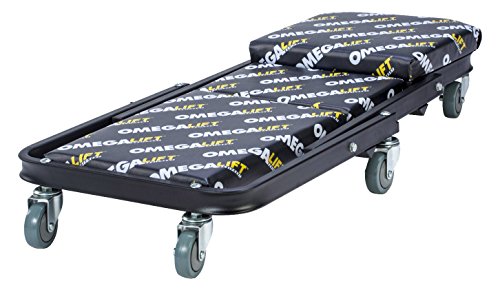
The Omega 91000 takes the convertible idea and builds it to a heavier standard. The steel frame folds between a flat 40-inch creeper and a Z-shaped seat, and it carries a 450-pound capacity, the highest in this guide, which makes it the convertible to choose for larger users or anyone who simply wants the sturdier frame. Six 3-inch casters are fitted, a size up from most folding designs, so it rolls over shop-floor imperfections more willingly than small-wheeled rivals. Thick padding covers both the seat and the headrest area, and the cushions are a step up from entry-level convertibles for longer sessions. It folds down for storage against a wall or in a corner, though at 23 pounds it is noticeably heavier to move than the lighter Z-creeper above, and like every folding design it rides higher than a flat low-profile board. Assembly and conversion are handled with a locking pin, and the same pre-use check applies: confirm the pin is seated before trusting either position. If you want one tool for under-car and seated work without giving up capacity, this is the heavy-duty route.
Specs
- 40-inch steel-frame creeper folds into a Z-shape seat and folds for storage
- 450 lb load capacity
- Six 3-inch swivel casters
- Thick padded seat and headrest cushions
- Product dimensions 40 x 18 x 7.5 in; item weight 23 lb
Frequently Asked Questions
How much clearance do I need between the creeper and the car?
Measure from the floor to the lowest point you slide under, then subtract the creeper’s deck height and the room your chest and head need. If the car sits low, raise it safely on a lift or stands first; a low-profile creeper like the Lisle, with 7/8 inch of floor clearance and a deck about four inches tall, buys back space that a padded or folding model spends on cushions and hinges.
Are bigger casters always better?
Bigger casters roll over cracks, cords, and debris instead of jamming on them, which is why the 3-inch wheels on the Pro-LifT C-6048 and Omega 91000 suit rougher floors. The trade-off is height: every step up in caster size raises the deck. On smooth, sealed concrete, smaller rollers are fine and keep you lower.
Can I work under a car that is only on a creeper and a jack?
No. A creeper supports you, never the vehicle. The car must rest on a proper lift or jack stands on solid, level ground, with wheels chocked, before anyone goes underneath. A floor jack alone is a lifting tool, not a support, and no creeper changes that.
Should I choose a plastic deck or a padded steel-frame deck?
Choose molded plastic if your work involves oil, coolant, or solvents and easy cleanup matters, or if you need the lowest possible profile. Choose a padded steel-frame deck if you spend long sessions underneath and comfort is the priority. Convertible Z-frame models split the difference and add a seat, at the cost of height and weight.
Conclusion
Match the creeper to the car and the floor, and every under-vehicle job gets easier. For the classic padded experience with an adjustable headrest, the Performance Tool W85005 is the straightforward pick. For lowered cars and messy fluid work, the Lisle 97102 sits lowest and cleans up fastest. Taller and larger mechanics should look at the Pro-LifT C-6048, whose 48-inch deck, 440-pound capacity, and 3-inch casters solve the fit and rough-floor problems together. If one tool must serve as both creeper and seat in a small garage, the Pro-Lift C-2036D is the compact, lighter convertible, while the Omega 91000 is the heavy-duty folding choice with the highest capacity here. Whichever you choose, measure your clearance first, respect the stated capacity, and keep the vehicle on stands: the creeper’s job is your comfort, and it does that job best when everything above it is properly supported.
More from Amazon
Programs that pair well with the guide above. Offers and eligibility are set by Amazon and may change.
Free shipping on eligible items, Prime Video and more. Eligible new members can start with a free trial.
Start a Prime free trialAd-free music streaming. Eligible new subscribers can start with a free trial.
Try Music Unlimited freeA Prime membership for ages 18-24 with a trial period. Eligibility is set by Amazon.
See Prime for Young AdultsAudiobooks and podcasts to listen to on the go. Eligible new members can start with a free trial.
Try Audible freeAs an Amazon Associate we earn from qualifying purchases.