Our Short List of 3

- Best for: Teachers and offices laminating wide sheets every week.
- Entry width: 12.5 inches
- Pouch thickness: 3 mil and 5 mil hot settings, plus a cold setting
- Warm-up time: 1 minute with InstaHeat technology
- Laminating speed: 12 inches per minute

- Best for: Home users who laminate in batches and want jam prevention.
- Maximum width: 9 inches
- 2 roller system with Never Jam technology
- Pouch thickness: 3 mil and 5 mil
- Laminating speed: 15 inches per minute

- Best for: Photos, certificates and everyday home documents.
- Maximum width: 9 inches
- 2 roller system for a professional finish
- Pouch thickness: 3 mil and 5 mil, suitable for use with photos
- Laminating speed: 15 inches per minute
All 4 Picks at a Glance
| Product | Specs | Action |
|---|---|---|
| Fellowes Saturn3i 125 Laminator |
| Check price on Amazon |
| Scotch PRO TL906 Thermal Laminator |
| Check price on Amazon |
| Scotch TL901X Thermal Laminator |
| Check price on Amazon |
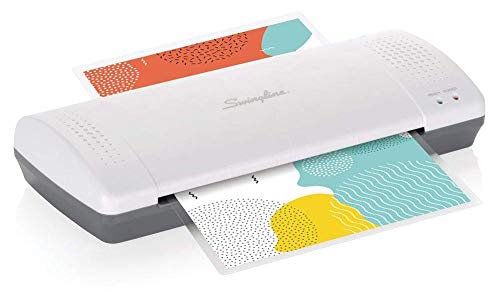 Swingline GBC Inspire Plus Thermal Laminator |
| Check price on Amazon |
Key takeaways
- Compare the best laminators for home, school and office: 9-inch and 12.5-inch thermal models with fast warm-up, jam release and 3 or 5 mil pouch support.
A laminator purchase usually starts with one job: classroom worksheets that need to survive a school year, ID cards and certificates that get handled daily, or photos and recipe cards that a spill would ruin. The machines look alike on the shelf, but the real decision is narrower than the marketing suggests. Entry width decides which sheets fit at all, pouch thickness decides how stiff the result feels, and warm-up time decides whether the machine gets used for one quick page or quietly avoided.
This guide is for home users protecting documents and photos, teachers and small offices laminating every week, and crafters working with scrapbook pages and reusable activity sheets. The five picks below are all thermal pouch laminators currently sold on Amazon, chosen from their listing specifications: feed width, supported pouch thickness, warm-up and speed figures, and jam handling features, so the differences that matter are easy to compare.
Quick Picks
As an Amazon Associate we earn from qualifying purchases
| Product | Best for | Key spec from title |
|---|---|---|
| Fellowes Saturn3i 125 | Wide sheets and daily classroom runs | 12.5-inch entry with 1-minute InstaHeat warm-up |
| Scotch PRO TL906 | Jam-prone stacks at home | Never Jam technology in a 9-inch 2-roller design |
| Scotch TL901X | Photos and mixed home documents | 2-roller system suitable for use with photos |
| Swingline GBC Inspire Plus | Small desks and light workloads | Compact 9-inch body with hot and cold settings |
| Amazon Basics 9-Inch | Simple everyday documents | 2 heat settings with a jam release lever |
How to Choose
Entry Width: 9 Inches or 12.5 Inches
Width is the first filter because it cannot be worked around later. A 9-inch machine takes letter and legal pages fed in portrait orientation, plus photos, cards and bookmarks, which covers most home and classroom jobs. A 12.5-inch machine such as the Saturn3i 125 also takes legal pages sideways, tabloid sheets and scrapbook pages up to 12 by 12 inches. Measure the widest item you genuinely laminate before buying: paying for width you never use buys a bigger footprint, while a too-narrow throat makes wide sheets impossible rather than merely awkward.
Pouch Thickness and Hot or Cold Settings
Pouch thickness is measured in mil and controls how rigid the finished piece feels. A 3 mil pouch stays flexible and suits ordinary documents; a 5 mil pouch gives cards, menus and worksheets a noticeably stiffer, more durable finish. Every machine in this guide handles both, so check the setting matches the pouch before feeding. Cold settings matter for heat-sensitive originals such as thermal prints or old photographs, because they seal self-adhesive pouches with pressure alone. If your work includes anything that heat could damage, a model with a cold mode, like the Saturn3i 125 or the Inspire Plus, is the safer shape of shortlist.
Warm-Up Time and Laminating Speed
Warm-up time ranges from about one minute on the Saturn3i 125 to five or six minutes on simpler home models, and that gap changes behaviour. A machine that is ready in a minute gets used for single pages; one that needs six minutes pushes you toward batching jobs, which is fine for a weekly classroom run and irritating for a single certificate. Speed, given in inches per minute, matters once the machine is hot: at 9 to 15 inches per minute, a letter sheet clears in roughly a minute either way, so speed only separates the picks when you laminate dozens of sheets back to back.
Jam Release Levers and Auto Shut-Off
Most laminating frustration comes from a pouch fed at a slight angle wrapping around the rollers. A jam release lever disengages the rollers so the pouch can be pulled free and re-centred instead of being cut out or forced, and it appears on most picks here. Auto shut-off, standard on the Saturn3i 125, cuts power after a period of inactivity, which limits overheating risk when a machine is left on in a busy classroom or office. Treat both as practical safety features rather than luxuries: one rescues a bad feed, the other covers a forgotten switch.
The 5 Best Options
Fellowes Saturn3i 125 Laminator
- Best for: Teachers and offices laminating wide sheets every week.
- Entry width: 12.5 inches
- Pouch thickness: 3 mil and 5 mil hot settings, plus a cold setting
- Warm-up time: 1 minute with InstaHeat technology
- Laminating speed: 12 inches per minute
Teachers and offices laminating wide sheets every week.
Confirm the listing is the 125 model; the smaller Saturn3i 95 shares the name with a 9-inch entry.
The Saturn3i 125 is the pick for anyone whose laminating is wide or frequent. Its 12.5-inch entry swallows legal and tabloid sheets that stop every 9-inch machine, and the InstaHeat warm-up of about one minute means it is ready before a stack of worksheets is squared up. Hot settings cover 3 and 5 mil pouches and a cold setting handles self-adhesive pouches for heat-sensitive originals. The jam release lever and auto shut-off suit shared spaces where it runs all day and nobody owns the off switch. It is the largest and heaviest machine here, so it belongs on a classroom or office counter, not in a drawer.
Scotch PRO TL906 Thermal Laminator
- Best for: Home users who laminate in batches and want jam prevention.
- Maximum width: 9 inches
- 2 roller system with Never Jam technology
- Pouch thickness: 3 mil and 5 mil
- Laminating speed: 15 inches per minute
Home users who laminate in batches and want jam prevention.
A bundle version with 100 pouches is sold under a separate listing; check you are buying the machine-only option if that is what you want.
The TL906 is built around the problem that ruins home laminating: the misfed pouch. Its Never Jam technology prevents misfed items from wrapping the rollers, which matters most when children or infrequent users feed pouches slightly crooked. The 2-roller system gives a smooth, professional finish on documents, photos and recipe cards up to 9 inches wide, and it handles both 3 and 5 mil pouches. Warm-up takes longer than the Fellowes, around five to six minutes, so it suits planned sessions rather than single urgent pages. At just over three pounds it stores easily and comes out when a batch is ready.
Scotch TL901X Thermal Laminator
- Best for: Photos, certificates and everyday home documents.
- Maximum width: 9 inches
- 2 roller system for a professional finish
- Pouch thickness: 3 mil and 5 mil, suitable for use with photos
- Laminating speed: 15 inches per minute
Photos, certificates and everyday home documents.
There is no cold lamination mode, so keep heat-sensitive items for a cold-capable machine.
The TL901X is the long-running home favourite from 3M, with clear priorities: a 2-roller system, a professional finish, and suitability for photos as well as documents. It laminates items up to 9 inches wide in 3 or 5 mil pouches at up to 15 inches per minute after a roughly five-minute warm-up. A jam release lever covers the occasional crooked feed. There is no cold setting, so heat-sensitive originals are better served by one of the cold-capable picks. For straightforward home, school and small-office documents it remains the simplest Scotch option, lighter than the PRO model and easy to tuck into a cupboard.
Swingline GBC Inspire Plus Thermal Laminator
- Best for: Small desks, light classroom use and occasional cold lamination.
- Maximum width: 9 inches
- Pouch thickness: 3 mil and 5 mil, plus a cold setting
- Warm-up time: 4 minutes
- Laminating speed: 9 inches per minute
Small desks, light classroom use and occasional cold lamination.
Several colour and size variants share the Inspire Plus name; check model 1701857 for the black 9-inch version.
The Inspire Plus is the compact option, a small 9-inch machine from GBC that adds a cold setting many budget models skip. It warms up in about four minutes, laminates at 9 inches per minute, and accepts 3 and 5 mil thermal pouches as well as cold self-adhesive pouches. A jam release lever handles misfeeds, and the box includes five letter-size pouches so the first jobs start immediately. The slower speed is the trade-off for the size and simplicity: fine for a handful of pages at a time, less ideal for a tall classroom stack. It suits a small desk where it stays out without dominating the surface.
Amazon Basics 9-Inch Thermal Laminator Machine
The Amazon Basics machine keeps controls to the minimum everyday jobs need: two heat settings for 3 mil and 5 mil pouches, a ready indicator light, and a jam release lever for the occasional crooked feed. It takes documents and photos up to 9 inches wide, including letter and legal pages in portrait orientation, and warms up in about five minutes. At under two and a half pounds it is the lightest pick here and moves between rooms and stores in a shallow drawer without complaint. With no cold setting and no auto shut-off, it is aimed squarely at supervised, occasional use at home or in a small office.
Specs
- Maximum width: 9 inches
- 2 heat settings for 3 mil and 5 mil pouches
- Jam release lever and ready indicator light
- Warm-up time: 5 minutes
- Dimensions: 13.94 x 4.41 x 2.64 inches; weight 2.47 pounds
- Sheet size: letter and legal in portrait orientation, plus photos
- Model number: VL203
Best for: Occasional documents and photos with the simplest controls.
Watch out for: An older Amazon Basics 9-inch listing with a different model number still circulates; check for VL203 to get the current version.
ASIN: B09RBHPLB7
Which One Fits Your Situation
A Teacher Preparing a Week of Classroom Materials
Choose the Fellowes Saturn3i 125. The one-minute warm-up and 12.5-inch entry handle a tall stack of worksheets, including oversized sheets, without turning prep into a second job. Auto shut-off covers the machine being left on between classes, and the jam release lever rescues the inevitable crooked feed without losing the pouch or the document inside it.
A Home Office That Laminates in Planned Batches
The Scotch PRO TL906 fits a desk that laminates in sessions: certificates, reference sheets and cards once a week or so. Never Jam technology protects the run when several pouches go through in a row, and the 2-roller finish looks clean on documents clients see. Its longer warm-up matters little when the session is planned in advance.
A Small Desk With No Room to Spare
Take the Swingline GBC Inspire Plus. It is the most compact machine here, quick enough for a few pages at a time, and the cold setting adds flexibility for heat-sensitive prints that similarly small rivals often lack. The five included pouches mean it works straight out of the box, and its footprint leaves room for the keyboard it shares the desk with.
Occasional Documents and Photos at Home
The Amazon Basics 9-Inch or the Scotch TL901X both suit a household that laminates a few times a month. The Amazon Basics model is the lighter, simpler option with two heat settings and a jam release. The TL901X adds a photo-friendly 2-roller finish and a slightly faster top speed, which suits families laminating pictures and school projects more than plain documents.
Common Mistakes
- Feeding a 5 mil pouch on the 3 mil setting, which leaves edges unsealed and the finish cloudy because the rollers never reach the temperature the thicker pouch needs.
- Buying a 9-inch machine for scrapbook pages or sideways legal sheets, then discovering the throat width is a hard limit that no setting can change.
- Laminating heat-sensitive originals such as thermal receipts or old photographs on a hot setting instead of choosing a machine with a cold mode.
- Pulling a jammed pouch harder instead of using the jam release lever, which can wrap the pouch tighter around the rollers and damage the document.
- Feeding the pouch folded-edge last; the sealed edge should enter first so air is pushed out rather than trapped as bubbles.
Frequently Asked Questions
Can a laminator handle photographs?
Yes, within limits. The Scotch TL901X lists suitability for photos, and photo paper laminates well in 3 or 5 mil pouches on the matching heat setting. Irreplaceable prints are different: heat can affect some older photographic papers, so test with a copy first or use a cold-setting machine like the Saturn3i 125 for originals you cannot replace.
What is the difference between 3 mil and 5 mil pouches?
The mil figure is pouch thickness, and it decides how stiff the finished item feels. A 3 mil pouch stays flexible, like a heavy page, and suits documents that will be filed or folded into folders. A 5 mil pouch sets noticeably rigid, suiting ID cards, menus, worksheets and anything handled daily. Match the machine setting to the pouch, because a thick pouch on the thin setting seals poorly.
Do laminators need heat, or is cold lamination enough?
Cold lamination uses pressure-sensitive adhesive pouches and no heat, which makes it safe for thermal paper, some photographs and heat-sensitive prints. The trade-off is that cold pouches cost more per sheet and the bond is usually less rigid than a hot seal. Most everyday documents are better served by a thermal machine, so cold mode works best as a second setting on a hot machine rather than the only method.
Why did my laminated sheet come out cloudy or wrinkled?
Cloudiness usually means the pouch was too thick for the selected setting, so the adhesive never fully melted; rerun the sheet once the machine is fully hot, or switch to the 5 mil setting for 5 mil pouches. Wrinkles and bubbles point to a crooked feed or the open edge entering first. Feed the sealed edge first, keep the pouch centred, and let the rollers pull it through without pushing.
More from Amazon
Programs that pair well with the guide above. Offers and eligibility are set by Amazon and may change.
Free shipping on eligible items, Prime Video and more. Eligible new members can start with a free trial.
Start a Prime free trialAd-free music streaming. Eligible new subscribers can start with a free trial.
Try Music Unlimited freeA Prime membership for ages 18-24 with a trial period. Eligibility is set by Amazon.
See Prime for Young AdultsAudiobooks and podcasts to listen to on the go. Eligible new members can start with a free trial.
Try Audible freeAs an Amazon Associate we earn from qualifying purchases.