Key takeaways
- Compare the best hex key sets: ball-end L-keys, T-handles and folding sets in metric and SAE, with steel hardness and coverage for bikes and furniture.
As an Amazon Associate we earn from qualifying purchases.
A hex key is about the simplest tool you can own: a bent bar of hexagonal steel. Yet the gap between a good set and a poor one only shows up under load: a soft key twists, its corners round over, and it starts chewing up the socket it was supposed to turn, leaving you with two problems instead of one. If you maintain a bike, assemble flat-pack furniture, or adjust small machinery, it is worth buying once and buying right.


This guide compares five sets across the three formats worth owning: L-keys, T-handles, and folding sets. Between them they cover metric and SAE sizes, bench work and pocket carry. The right choice depends less on brand than on matching the steel, the sizes, and the format to the fasteners you actually turn.
Disclosure: This article contains affiliate links. If you make a purchase through these links, we may earn a commission at no extra cost to you.
How to Choose a Hex Key Set
Steel hardness is the whole quality story
Everything else about a hex key set is convenience. Hardness is survival. Quality keys are cut from hardened alloy steels such as chrome-vanadium, S2 tool steel, or Bondhus’s Protanium, then heat treated so the six corners stay crisp under torque. A key that is too soft deforms first; once its corners lose their shape it no longer fills the socket, the load concentrates on what is left, and the socket walls start to round. A rounded socket turns a two-minute job into an extraction project.
Hardness matters most at the small end of the set. A 1.5 mm or 2 mm key has very little material to work with, and soft small keys either snap or twist into a spiral when they meet a threadlocked bolt. Fit matters too: undersized keys rock in the socket and wear both key and fastener. When a key starts to twist or its corners look rounded, replace it. A worn key is not a harmless old tool; it is a socket-damaging tool.
Ball ends are for spinning, not for final torque
A ball end on the long arm lets the key enter a socket at an angle, up to about 25 degrees off axis. That is genuinely useful: it lets you reach bolts hidden behind frame tubes, inside furniture cam housings, and under machinery guards, and it makes running a long bolt in or out much faster.
The trade-off is contact area. A ball engages the socket on a much smaller patch than a straight hex end, so it cannot carry full torque. Use the ball end to start a fastener and spin it down, then switch to the short arm for final tightening. Do the reverse when removing: break the bolt loose with the straight end, then spin it out with the ball. Using a ball end for breakaway or final torque is how ball tips shear off inside sockets, and fishing a broken tip out of a recessed bolt head is miserable work.
Metric first, SAE when your equipment demands it
Most modern hex fasteners are metric. On a bike, 4, 5, and 6 mm keys handle the great majority of bolts, including stems and seatposts, with 2, 2.5, and 3 mm covering small adjusters and 8 or 10 mm appearing on some crank and pedal fittings. Flat-pack furniture leans heavily on 4 and 5 mm, with 6 mm on larger frames. SAE sizes still matter for older American machinery and lawn equipment.
Beware of near sizes. A 5/32 inch key measures 3.97 mm, close enough to a 4 mm socket to feel seated, but the tiny slack lets it rock and rounds the socket under load. The same trap exists between 3/16 inch and 5 mm, and between 1/4 inch and 6 mm. If you own equipment from both worlds, a combined set removes the temptation to force a close-enough key.
Markings, sleeves, and holders decide how a set ages
Size markings are a weak point on many sets. Stamped sizes can be shallow, and printed markings wear off with handling and oil. Laser-etched markings tend to last longer. Color-coded sleeves, like Wera’s, make identification instant, but the sleeve adds diameter: a sleeved key will not pass through a counterbored hole or reach a socket at the bottom of a narrow recess.
Holders matter more than they look. A hinged case or a clip that presents the keys in size order keeps a set complete and makes a missing key obvious. T-handle sets need a stand or a rail; without one they consume bench space and roll into each other.
Match the format to the work
L-keys give the most leverage per size because the long arm is a proper lever, and they pack flat in a case. T-handles are the speed tools: the grip lets you spin fasteners quickly and comfortably, and they are kinder to stiff hands. They are bulky, though, and belong on a bench. Folding sets trade leverage for portability: nothing gets lost and the set rides in a pocket, but the pivot limits torque and develops play over time. Most home workshops are happiest with one good L-key set as the foundation, adding a format only when a real need shows up.
The Best Hex Key Sets
1. Bondhus 20199 Balldriver L-Wrench Double Pack: Best Overall
Bondhus is the benchmark name in hex keys, and the 20199 Double Pack shows why. It bundles two ball-end L-key sets in one color-coded Bondhex case: the 10999 metric set from 1.5 to 10 mm, and the 10937 inch set from 0.050 to 3/8 inch. For a household touching bikes, furniture, and American hardware, it covers nearly everything in one purchase.
The keys are made from Bondhus’s Protanium high-torque steel with a ProGuard finish that resists corrosion noticeably better than the plain black oxide on lesser sets, which matters in damp garages. Bondhus backs the set with a lifetime warranty and replaces broken keys. The honest downsides: the case is too bulky for a saddle bag, and there are no half sizes such as 3.5 or 4.5 mm, though those are rare in practice.
Specs
- Metric sizes: 1.5, 2, 2.5, 3, 4, 5, 6, 8, 10 mm (9 keys)
- SAE sizes: .050, 1/16, 5/64, 3/32, 7/64, 1/8, 9/64, 5/32, 3/16, 7/32, 1/4, 5/16, 3/8 in (13 keys)
- Steel: Protanium high-torque alloy steel
- Finish: ProGuard corrosion-resistant coating
- Ball end entry angle: up to 25 degrees
- Holder: Bondhex color-coded case
- Made in the USA with a lifetime warranty
See the Bondhus 20199 on Amazon
2. Wera 950 SPKL/9 SM N Multicolour L-Key Set: Best for Bikes
Wera’s 950 set is a metric-only collection of nine long-arm keys from 1.5 to 10 mm, built around two ideas: protect the fastener, and never hide the size. The Hex-Plus profile reshapes the key’s flats so they bear against the socket walls over a wider area instead of digging in at the corners, reducing the notching damage that rounds out socket heads. On a bike, where bolts are small and often threadlocked, that gentler engagement is worth having.
Each key wears a color-coded plastic sleeve with its size printed on it, so the 5 mm you need is the same color every time. Identification is the fastest of any set here. The trade-off is real, though: the sleeve makes each key thicker, and a sleeved key cannot reach a socket at the bottom of a deep counterbore where a bare key slides in. The keys get Wera’s BlackLaser surface treatment for corrosion protection, a ball end on the long arm, and a straight hex on the short arm. There is no SAE coverage, so owners of inch-based machinery will need a second set.
Specs
- Metric sizes: 1.5, 2, 2.5, 3, 4, 5, 6, 8, 10 mm (9 keys)
- Profile: Hex-Plus for a larger contact surface in the socket
- Sleeves: color-coded plastic with printed size markings
- Finish: BlackLaser surface treatment
- Ball end on the long arm, straight hex on the short arm
- Holder: wear-resistant two-component clip
- Wera part number 05073593001
See the Wera 950 SPKL/9 on Amazon
3. Bondhus 13190 Balldriver T-Handle Set with Stand: Best T-Handles

When the job involves dozens of fasteners rather than two or three, T-handles earn their bench space. The Bondhus 13190 set includes ten SAE T-handles from 3/32 to 3/8 inch with graduated shaft lengths, so the bigger sizes that need more leverage get longer shafts. The welded steel handles carry cushion grips, and their mass gives a flywheel effect that makes spinning fasteners genuinely quick.
Each tool is two-ended in practice: the long shaft finishes in a ball end for angled entry and fast spinning, while a straight hex tip at the handle end handles close-quarters work where the shaft cannot swing. The steel is the same Protanium used in Bondhus’s L-wrenches, and the included stand keeps the set upright on the bench. The limitations are format limitations: this is an SAE-only set (a metric sibling exists), T-handles are too bulky for a drawer, and without the stand they sprawl. As a dedicated bench set for inch-based machinery, though, it is the most comfortable option here.
Specs
- SAE sizes: 3/32, 7/64, 1/8, 9/64, 5/32, 3/16, 7/32, 1/4, 5/16, 3/8 in (10 handles)
- Shafts: graduated lengths matched to key size
- Ends: ball end on the long shaft, straight hex tip at the handle end
- Handles: welded steel with cushion grips
- Steel: Protanium high-torque alloy steel with ProGuard finish
- Bench stand included
- Made in the USA with a lifetime warranty
See the Bondhus 13190 on Amazon
4. Klein Tools 70543 Compact Folding Hex Key Set: Best Folding Set

A folding set solves a different problem: keeping a usable spread of sizes together, in a pocket or tool pouch, with nothing to lose. Klein’s 70543 goes further than most by bundling three separate folding tools, one each for SAE, metric, and Torx fasteners, for 25 keys in total. The Torx tool is a quiet bonus that pays off on appliances and machinery guards.
The keys are heat-treated alloy steel, and the folding handles are sturdier than the flimsy shells on no-name sets, so the handle doubles as a workable grip rather than a storage sleeve you tolerate. Sizes are marked on the handles, and three separate tools can live in three different kits. Be clear about the format’s ceiling: leverage is limited by the pivot and the short handle, there are no ball ends for angled access, and pivots loosen with years of use. For assembly, adjustment, and roadside fixes, that trade is fair. For breaking loose a seized bolt, reach for an L-key instead.
Specs
- 25 keys across three separate folding tools
- Systems covered: SAE (inch), metric, and Torx
- Steel: heat-treated alloy steel
- Format: compact folding handles sized for a pocket or tool pouch
- Keys fold out individually for use and fold back into the handle for storage
- Sizes marked on the handles
See the Klein Tools 70543 on Amazon
5. TEKTON 25282 Ball End Hex Key Wrench Set: Best Size Coverage
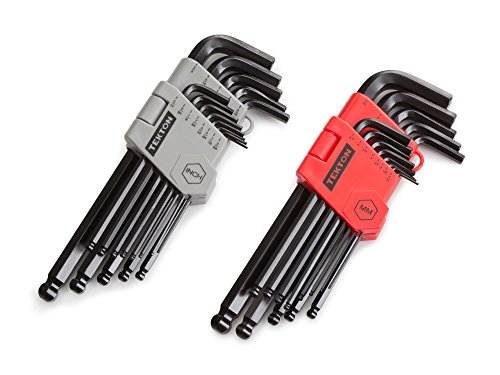
The TEKTON 25282 is the set to look at when coverage matters more than pedigree. Its 26 ball-end keys split into two hinged cases, one inch and one metric, and the metric case includes the half sizes, 3.5, 4.5, and 5.5 mm, that almost every other set skips. Those in-between sizes do appear on some bicycle components, European machinery, and electronics hardware. The inch case is equally thorough, starting down at 3/64 inch.
The keys are chrome-vanadium steel with a black-oxide finish, in a long-arm pattern that gives useful reach into recessed housings and real leverage. Ball ends allow entry at up to 25 degrees. Two honest notes: black oxide is a light corrosion barrier rather than a true protective coating, so a wipedown with an oily rag is wise in a damp shop, and the two cases are bulky. The steel is good, though buyers who routinely break small keys may prefer the harder Protanium keys in the Bondhus set above.
Specs
- Metric sizes: 1.27, 1.5, 2, 2.5, 3, 3.5, 4, 4.5, 5, 5.5, 6, 8, 10 mm (13 keys)
- Inch sizes: 3/64, 1/16, 5/64, 3/32, 7/64, 1/8, 9/64, 5/32, 3/16, 7/32, 1/4, 5/16, 3/8 in (13 keys)
- Pattern: long arm with ball end, up to 25-degree entry angle
- Steel: chrome-vanadium with a black-oxide finish
- Storage: two hinged cases with size markings
- Includes the hard-to-find 3.5, 4.5, and 5.5 mm half sizes
See the TEKTON 25282 on Amazon
Frequently Asked Questions
Should I buy metric or SAE first?
Buy for the fasteners you own. Bikes, flat-pack furniture, and most imported machinery are metric, and the 4, 5, and 6 mm sizes cover the bulk of home work. Older American machinery often needs SAE. Never substitute a near size: a 5/32 inch key in a 4 mm socket feels close but rocks under load and rounds the socket. If your household mixes both systems, a combined set like the Bondhus 20199 or TEKTON 25282 removes the guesswork.
Can I fully tighten a bolt with the ball end?
No. A ball end contacts the socket over a small area, which makes it great for spinning fasteners at an angle and poor at carrying torque. Break fasteners loose and apply final tightening with the straight short arm. Ball ends used for final torque can shear off inside the socket, and the broken tip is a pain to remove.
Why did my hex key twist instead of turning the bolt?
Either the key was too soft for the load, or it was slightly undersized for the socket and concentrated force on its corners. A twisted key should be replaced rather than straightened: once deformed, it fits poorly and starts damaging sockets. Hardened alloy steel keys, correctly sized, are the prevention.
Are folding hex key sets strong enough for furniture assembly?
Yes, for assembly and adjustment work. Their limits show up on seized or heavily threadlocked fasteners, where the short handle and pivot cannot deliver L-key leverage, and they offer no ball end for angled access. Treat a folding set as the portable option and keep a full-size L-key set at the bench for stubborn hardware.
Conclusion
The right set is the one whose steel survives your tightest bolt and whose sizes match your equipment. For a single set that handles a mixed household, the Bondhus 20199 Double Pack is the pick: hard Protanium keys, both measurement systems, and a lifetime warranty. Cyclists should look at the Wera 950 SPKL/9, whose color coding and fastener-friendly profile suit small metric bolts. For bench work on inch-based machinery, the Bondhus 13190 T-handles are the fastest, most comfortable option. For a tool bag or glove box, the Klein Tools 70543 folding set keeps 25 keys together and ready. And for the widest spread of sizes, the TEKTON 25282 is the coverage champion. Whichever you choose, use the ball end to spin and the straight end to tighten, and retire any key whose corners start to round.
More from Amazon
Programs that pair well with the guide above. Offers and eligibility are set by Amazon and may change.
Free shipping on eligible items, Prime Video and more. Eligible new members can start with a free trial.
Start a Prime free trialAd-free music streaming. Eligible new subscribers can start with a free trial.
Try Music Unlimited freeA Prime membership for ages 18-24 with a trial period. Eligibility is set by Amazon.
See Prime for Young AdultsAudiobooks and podcasts to listen to on the go. Eligible new members can start with a free trial.
Try Audible freeAs an Amazon Associate we earn from qualifying purchases.