Key takeaways
- Compare the best hamster wheels by size, bearing noise and surface, with guidance on correct diameter for Syrian and dwarf hamsters and safe solid wheels.
As an Amazon Associate we earn from qualifying purchases.
A hamster wheel is not an accessory in the decorative sense. Wild hamsters travel long distances each night foraging, and a pet hamster channels that drive into its wheel, running for hours after dark. That makes the wheel the hardest-working item in the enclosure, and the one where a poor choice does real harm: too small, and the hamster runs with an arched spine; built from wire or mesh rungs, and it can trap and injure small feet. The right wheel is big enough for a flat back, solid underfoot, and quiet enough that nobody resents the nightly marathon.
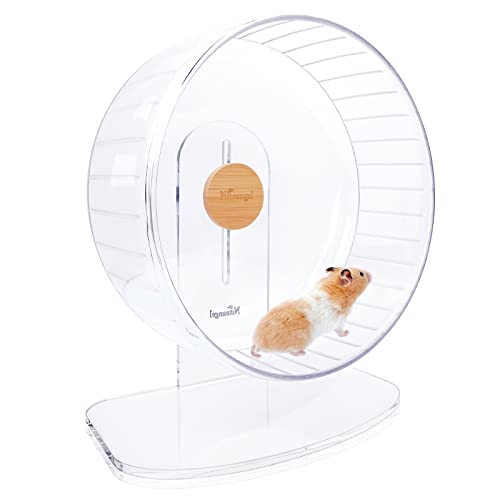
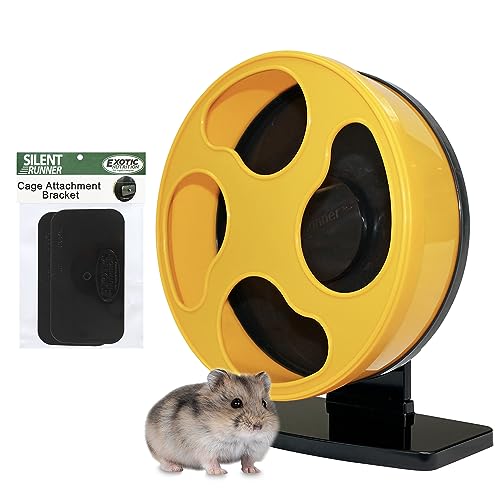
This guide compares five wheels matched to different animals and enclosures: an extra-large wheel for Syrian hamsters, a 9-inch wheel sized for dwarf species, a wooden wheel with a cork running track, a height-adjustable acrylic spinner for deep-bedding setups, and a flying saucer disc, with an honest explanation of why a disc supplements an upright wheel rather than replacing it. Every pick below runs on a solid surface: the first rule of wheel safety.
Disclosure: This article contains affiliate links. If you make a purchase through these links, we may earn a commission at no extra cost to you.
How to Choose the Right Hamster Wheel
Diameter Comes First: Match the Wheel to the Species
Diameter is the single most important decision: it decides your hamster’s posture at full speed. A hamster should run with a flat back and head held naturally, not with its spine curved upward to fit the arc. Current welfare guidance puts the minimum at roughly 8 inches for dwarf hamsters such as Roborovskis, Campbells and Winter Whites, and 11 to 12 inches or more for Syrians. An undersized wheel bends the spine on every stride, night after night, while an oversized one merely turns a little slower to push. If you are between sizes, size up.
Solid Running Surfaces Only
The running surface must be completely solid. Wire and mesh wheels, still sold widely, are never a safe choice: small toes and feet can slip between rungs at speed, causing fractures, torn nails and a painful foot condition caused by pressure and friction on uneven surfaces. Texture molded into a solid surface is fine and helps grip; gaps are the problem. Exposed central axles can also catch fur, so axle-free designs remove that hazard entirely.
Bearings Decide How Quiet the Night Gets
Noise is what turns a good wheel into a returned wheel: hamsters run while the household sleeps. The quiet designs use ball bearings at the hub, and dual ball bearings are the current benchmark: the wheel glides on the bearing instead of grinding around a plain bushing, so the spin stays smooth and near-silent far longer. Bearing-free spinners tend to develop squeaks and wobble as they wear. Placement matters too: a wheel on a platform stays quieter than one rattling against bedding, and bedding piled against a drum adds drag and noise.
Stand, Cage Attachment, or Both
Freestanding wheels sit on a base inside the enclosure: easy to position and remove for cleaning, but they need a level spot, ideally a platform, so the base does not sink unevenly into bedding. Cage-attached wheels bolt to the bars of a wire cage, saving floor space, but they cannot be used in tanks or barless enclosures. Some wheels offer both. Think about your enclosure first, then about bedding depth, because a wheel buried to its hub will not spin freely whatever its design.
A Word on Flying Saucers
Flying saucer discs spin on a tilted horizontal axis, so the hamster runs on a sloped disc rather than inside a drum. They are solid-surfaced and quiet, but they are not a substitute for an upright wheel: on a disc the spine bends sideways to follow the slope, and common sizes suit only dwarf hamsters and mice. Treat a saucer as a second running option alongside a correctly sized upright wheel.
Cleaning and Chewing
Wheels get soiled, because many hamsters toilet where they run. Smooth plastic and acrylic wheels wipe or rinse clean in minutes. Wooden wheels look better in naturalistic setups and are safe to gnaw, but wood and cork absorb moisture, so they need gentler cleaning and a replacement running strip over time. Whatever the material, check the wheel weekly: spin it by hand to feel for bearing roughness, and look for cracks or chew damage on the track.
Niteangel Super-Silent Hamster Exercise Wheel, Extra Large: The Syrian Pick
Syrian hamsters are the biggest common pet hamsters, and this extra-large version of Niteangel’s Super-Silent wheel is built around them. The running drum measures 12.8 inches across the inside, with a 4.5-inch-wide track, so even a large Syrian can run with a flat back and room to spare. The solid acrylic track is continuous, with no rungs or gaps for toes to catch in, and the drum turns on dual ball bearings, so it glides rather than grinds, keeping nighttime noise down to footfalls.
It stands on an adjustable stand, so it works in tanks and barred cages alike, with the height set to keep the drum clear of the bedding. The transparent drum shows at a glance when the track needs a wipe-down. Niteangel sells this wheel in sizes down to an 8-inch inner diameter for dwarfs, but for a Syrian, this extra-large size is the one that respects the 11-to-12-inch minimum with margin to spare.
Specs
- Running drum: 12.8-inch inner diameter with a 4.5-inch-wide solid track
- Bearings: dual ball bearings for a smooth, quiet spin
- Material: acrylic drum with a solid, continuous running surface
- Mounting: freestanding adjustable stand, suits tanks and barred cages
- Maker’s sizing: Extra Large, aimed at Syrian hamsters and similar-sized pets
Exotic Nutrition Silent Runner 9 Inch: The Dwarf Hamster Pick
Dwarf hamsters need a wheel scaled to them: big enough for a flat back, light enough to push easily. The 9-inch Silent Runner from Exotic Nutrition sits right in that window, above the roughly 8-inch minimum for dwarf species without being so large that a Roborovski struggles to get it moving. Its running surface is solid and textured for grip, and the enclosed design, with a solid back wall and shaped front openings, keeps the runner on the track.
The detail that sets this wheel apart is its axle-free construction: no central bar crosses the running space, removing the fur and tail entanglement risk that exposed axles create, and the drum turns on dual ball bearings for a quiet spin. Flexibility is the other strength: both a stand and a cage attachment are included, so it can bolt to cage bars or stand on its own in a tank. It comes apart for cleaning, and the maker specifies hand washing. For a dwarf hamster in any common enclosure, this is the most adaptable pick in the guide.
Specs
- Diameter: 9-inch wheel with a track about 3.75 inches wide
- Bearings: dual ball bearings; axle-free design with no center bar
- Surface: solid, textured running track with an enclosed front design
- Mounting: stand and cage attachment both included
- Care: disassembles for cleaning; hand wash only
Niteangel Wooden Hamster Exercise Wheel, Large: The Cork-Track Pick

For a naturalistic enclosure, Niteangel’s wooden wheel replaces plastic with birch and oak, and lines the running drum with cork. That cork track is the functional heart of the design: continuous and solid, so it meets the safety rule, while its soft, slightly yielding surface is gentle on paws, gives natural grip, and is kind to nails during exercise, as the maker notes. The large size measures 11.6 inches across the drum with a 3.7-inch-wide track, which puts it in Syrian territory and gives large dwarfs a generous option too.
The wheel turns on a dual ball bearing, and the maker puts operating noise at around 40 decibels, roughly a quiet room. A wide base keeps the drum stable at speed. The trade-offs are care-related: wood and cork absorb moisture, so this wheel cannot be soaked or rinsed like plastic, and a hamster that toilets while running will shorten the cork strip’s life. Niteangel sells replacement cork strips, and since the whole wheel is chewable wood, gnawing is a cosmetic issue rather than a safety one.
Specs
- Drum: 11.6-inch diameter with a 3.7-inch-wide running track (Large size)
- Running surface: continuous cork track over a wooden drum
- Materials: birch and oak wood, safe for hamsters to gnaw
- Bearings: dual ball bearing; maker states noise around 40 dB
- Base: wide freestanding base for stability
Niteangel Silent Hamster Exercise Wheel, Large Wider Version: The Adjustable-Height Pick

Deep bedding is good welfare, since hamsters are burrowers, but it swallows ordinary wheel stands. This acrylic wheel from Niteangel answers that problem directly: its stand adjusts in height from about 10.9 to 15.2 inches, so the drum can ride above a deep substrate layer instead of plowing through it. The running drum itself is 10.6 inches across with a track about 3.74 inches wide, a size the maker recommends for dwarf hamsters (Roborovski, Campbell, Chinese and Winter White), mice and small gerbils; smaller Syrians can use it too, though the biggest belong on the extra-large pick above.
The solid acrylic drum wipes clean in seconds and spins on dual ball bearings for quiet running. Because the drum is clear, soiling is visible immediately, so the wheel gets cleaned before it gets unpleasant. The stand adapts as your setup changes, making this the most flexible freestanding option here for anyone who regularly deepens the bedding.
Specs
- Drum: 10.6-inch running diameter with a track about 3.74 inches wide
- Stand: height adjustable from about 10.9 to 15.2 inches
- Bearings: dual ball bearings for quiet, smooth spinning
- Material: acrylic drum with a solid, smooth running surface
- Maker’s sizing: dwarf hamsters, mice and small gerbils (model HT-139)
ACEDIVA Hamster Flying Saucer: The Disc, With Its Caveat
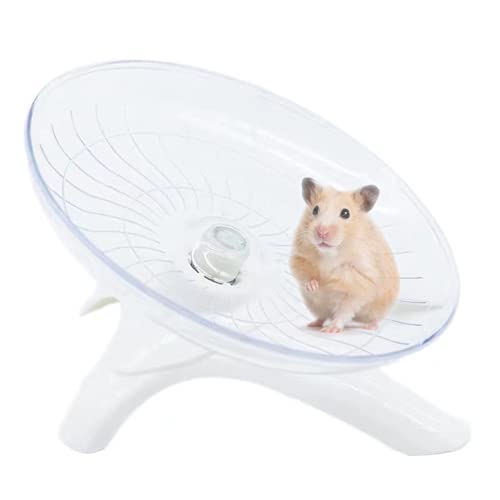
The flying saucer is the odd one out in this guide, included because owners ask about discs and dwarf hamsters often take to them happily, but it carries the clearest caveat of any pick here. Instead of a drum, the hamster runs on a sloped solid disc about 7 inches across, spinning on a low central hub. The solid disc has a textured run-up pattern for grip, the plastic is ABS, and the unit is light enough to drop into a corner of the enclosure or a playpen. The maker describes the spin as silent, and with no frame, there is little to rattle.
Now the caveat, stated as plainly as the welfare guidance requires: a disc this size is only suitable for dwarf hamsters and mice, never for a Syrian, and even for a dwarf it should not be the only running equipment in the enclosure. Running on a tilted disc bends the spine sideways rather than keeping it flat, so the upright wheel remains the primary exercise equipment and the saucer works best as a supplement, alongside a proper wheel or in a playpen. Watched with that understanding, it is a fun second option; relied on alone, it asks a small spine to work at an angle every night.
Specs
- Design: tilted flying saucer disc, about 7 inches across
- Material: ABS plastic with a solid, textured running surface
- Weight: about 110 g, low-profile base with no stand or frame
- Suitability: dwarf hamsters, mice and other small pets; not for Syrians
- Care: hand wash only
Frequently Asked Questions
What size wheel does my hamster actually need?
Work from the species, not the cage shelf label. Dwarf hamsters need at least an 8-inch diameter wheel, and 9 to 10 inches gives growing room and an easier push. Syrian hamsters need 11 to 12 inches at minimum, because the goal is a flat back at full speed. If your hamster’s back arches upward or its head tilts up while running, the wheel is too small regardless of what its packaging suggested. Wider tracks, around 3.5 to 4.5 inches, let the hamster run without brushing the sides.
Are wire or mesh wheels ever acceptable?
No. Wire and mesh surfaces let toes and feet slip through the gaps at running speed, and the injuries that follow, from torn nails and fractures to chronic foot inflammation, are well documented in small-pet care. Rungs and slats carry the same risk. A safe wheel has a continuous solid surface, whether plastic, acrylic, wood or cork-lined. If a wheel in a bundled cage kit turns out to be wire, replace the wheel and keep the rest of the kit.
Can a flying saucer replace an upright wheel?
It should not. A saucer’s tilted disc makes the hamster run with its spine bent sideways, a compromise posture for nightly, hours-long exercise, and common saucer sizes are too small for Syrians in any case. An upright wheel of the correct diameter keeps the back flat and remains the primary recommendation. A saucer is fine as an additional item for a dwarf hamster, in a playpen or beside the main wheel, provided the upright wheel does the main job.
How do I keep the wheel quiet and clean over time?
Start with bearings: dual ball bearing wheels stay quiet longest, and a wheel that grows noisy usually just needs its hub cleaned of bedding dust. Set freestanding wheels on a platform so bedding cannot drag against the drum, and use an adjustable-height stand with deep bedding. For cleaning, smooth plastic and acrylic wheels wipe or rinse clean; wooden and cork wheels should be spot-cleaned and kept dry, with the cork strip replaced when it becomes soiled. A quick weekly spin by hand tells you whether everything still turns freely.
Conclusion: Which Wheel for Which Hamster
For a Syrian hamster, the Niteangel Super-Silent in Extra Large is the straightforward first choice: a 12.8-inch solid drum on dual bearings leaves nothing to argue about on size or noise. Dwarf hamsters are best served by the Exotic Nutrition Silent Runner 9 Inch, whose axle-free design and stand-or-cage mounting fit almost any setup. If your enclosure is built around natural materials, the Niteangel Wooden wheel pairs an 11.6-inch drum with a paw-friendly cork track, in exchange for gentler cleaning duties. Deep-bedding enclosures point to the height-adjustable Niteangel Silent acrylic wheel, which keeps its 10.6-inch drum clear of the substrate. And the ACEDIVA flying saucer earns its place only as a dwarf hamster’s second toy, never as the main wheel. Whichever you choose, hold the line on the two rules that matter: solid surface, and a diameter that keeps the back flat.
More from Amazon
Programs that pair well with the guide above. Offers and eligibility are set by Amazon and may change.
Free shipping on eligible items, Prime Video and more. Eligible new members can start with a free trial.
Start a Prime free trialAd-free music streaming. Eligible new subscribers can start with a free trial.
Try Music Unlimited freeA Prime membership for ages 18-24 with a trial period. Eligibility is set by Amazon.
See Prime for Young AdultsAudiobooks and podcasts to listen to on the go. Eligible new members can start with a free trial.
Try Audible freeAs an Amazon Associate we earn from qualifying purchases.