Key takeaways
- Compare the best cutting mats by size, self-healing surface and grid markings, with guidance on rotary cutting mats for sewing, quilting and paper crafts.
As an Amazon Associate we earn from qualifying purchases.
A cutting mat does three jobs at once: it protects the table underneath, it gives the blade a surface that grips fabric or paper just enough for a clean cut, and its printed grid turns measuring and cutting into a single step. The differences between mats look minor on a listing page — size, thickness, grid style, one side or two — but they decide how the mat behaves every day. A mat that is too small forces you to fold and shift fabric mid-cut, and a surface that grooves quickly will start steering your cutter off line.
This guide compares five mats across the main roles: a large 24 by 36 inch mat for full fabric widths, a mid-size 18 by 24 inch rotary mat, a compact 12 by 18 inch mat for small desks and paper crafts, a rotating square mat for trimming quilt blocks, and a double-sided mat with a different color and grid on each face. Every pick is drawn from the maker’s own published information on dimensions, construction, grid markings, and care.
Disclosure: This article contains affiliate links. If you make a purchase through these links, we may earn a commission at no extra cost to you.
How to Choose
Start with size, because it is the one feature you cannot work around later. A 24 by 36 inch mat accepts the full folded width of standard quilting cotton, so long strips can be cut in one pass with a ruler. An 18 by 24 inch mat suits fat quarters, garment pattern pieces, and most general sewing. A 12 by 18 inch mat is a secondary surface: paper crafts, trimming small pieces, and work beside the sewing machine. Measure your table before ordering, and leave a margin around the mat so the ruler and your hand have room. A mat that overhangs the table edge will flex at the overhang and eventually crack or warp there.
Next, read the grid. Most rotary mats print a one inch grid with finer subdivisions, plus diagonal lines at 30, 45, and 60 degrees for bias cuts and quilt angles. If you work from patterns written in centimeters, look for a mat with metric markings — Dahle screens inch, metric, and angled guides onto its Vantage mats, and WORKLION prints both unit systems across its double-sided range. Treat the mat grid as a measuring aid, not a replacement for a ruler: most makers intend final measurements to be taken against an acrylic ruler, with the grid used for quick alignment.
Thickness and layer count shape how the surface heals and how long it lasts. Makers describe construction in layers or plies: OLFA’s rotary mats use a triple-layer heat-welded build at 1.5 mm thick, while Dahle and WORKLION use five-layer builds around 3 mm. More layers generally mean the blade sinks into softer material that closes behind it. Self-healing is real but limited. The surface closes light cuts so the next cut runs smooth, yet repeated cutting along the same line carves a groove that no mat can close. Rotate your work area, turn the mat end for end, and flip to the second side when one face is worn, and a mat lasts far longer.
Care is mostly about heat and flat storage. Store a mat flat, away from direct sunlight and heat sources; a mat left leaning against a wall or stored in a hot car can warp, and a warped mat rarely flattens again. Never iron on a cutting mat, and keep hot glue and heat guns off the surface. Clean with a damp cloth and mild soap, and lift lint and fibers from the grid lines with a soft brush or a lint roller so cuts stay visible.
Finally, safety. A mat protects the table, not your fingers. Use a rotary cutter with a guard or retractable blade and close it between every cut — most makers build the guard to be flicked shut one-handed. Cut away from your body, keep your free hand behind the ruler’s edge rather than in the blade’s path, and use a non-slip ruler grip for long cuts. Keep cutters closed and stored out of children’s reach. Also match the tool to the mat: OLFA states plainly that its rotary mats are designed for rotary cutters and not for fixed-blade knives, whose point pressure concentrates force and gouges the surface. If your work is mostly craft-knife cutting on card and board, choose a mat whose maker rates it for knife work, such as the Dahle below.
Fiskars Self-Healing Rotary Cutting Mat, 24 x 36

The Fiskars 24 by 36 is the classic large mat for a dedicated cutting table. Its surface takes the full folded width of quilting cotton, so yardage can be squared and stripped without refolding or shifting it halfway through a cut. For quilters who batch-cut pieces for a whole project, that single-pass capacity is the reason to give a mat this much table space.
The mat is two-sided, with high-contrast grid colors so the lines stay readable under both light and dark fabric — a detail that matters more than it sounds, because a grid that disappears under black cotton is a grid you stop using. Printed bias lines at 30, 45, and 60 degrees support angle cuts, and there is a hanging hole for wall storage, though flat storage remains the safer habit for a mat this size. Fiskars positions this line for rotary cutters and general craft cutting, and backs it with a limited lifetime warranty as stated by the maker.
Specs
- Cutting surface: 24 x 36 in, model 12-83727097J
- Two-sided design with high-contrast grid colors for light or dark fabric
- Printed grid with 30, 45, and 60 degree bias lines
- Self-healing surface made for rotary cutting and craft work
- Hanging hole for storage; flat storage recommended
- Limited lifetime warranty, as stated by the maker
OLFA Self-Healing Rotary Cutting Mat, 18 x 24 (RM-SG)
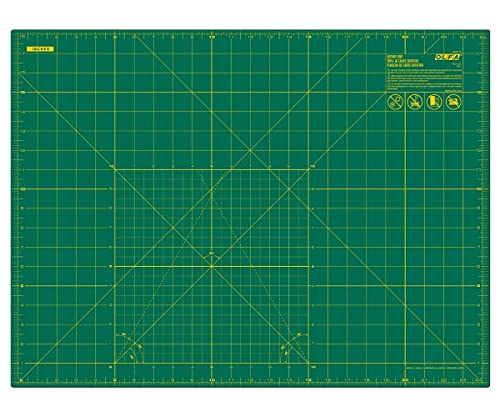
The OLFA RM-SG is the mid-size reference point for rotary cutting. At 18 by 24 inches it handles fat quarters, pattern tissue, and most garment pieces, and it is light enough to move between a dining table and a sewing desk. OLFA builds it with a triple-layer, heat-welded construction at 1.5 mm thick, and describes the surface as resealing cuts so the cutting area stays smooth.
It is a genuinely double-sided mat with two different faces. One side carries yellow grid lines on the dark green base, marked in 1/8 inch increments with multiple angle lines, for detailed measuring and cutting. The reverse is solid green with no grid, for general cutting where the lines would be a distraction. OLFA is explicit about the tool match: this mat is designed for rotary cutters only, and the maker directs users not to cut on it with fixed-blade knives. The maker’s storage guidance is equally plain — keep it flat and out of direct sunlight to prevent warping.
Specs
- Cutting surface: 18 x 24 in, model RM-SG (9881)
- Triple-layer heat-welded construction, 1.5 mm thick
- Double-sided: yellow grid on green for detailed cutting, solid green reverse for general cutting
- Grid lines in 1/8 inch increments with multiple angle lines
- Designed for rotary cutters only, per the maker
- Store flat and out of direct sunlight, per the maker
Dahle Vantage 10671 Premium Self-Healing Cutting Mat, 12 x 18

The Dahle Vantage 10671 is the compact pick, at 12 by 18 inches in black. That footprint fits a small desk, a tray table, or the space beside a sewing machine, and it suits paper crafts, photo trimming, and small fabric pieces. Dahle builds the Vantage line with a five-layer construction, which the maker credits for the surface’s ability to reseal cuts and protect blades from dulling.
The top surface is screened with a 1/2 inch grid plus inch, metric, and angled guides, so it serves patterns and craft measurements in either unit system. For versatility, Dahle states the mat can be used on both sides: the guided top for measured trimming, and the plain reverse for freehand work. Because Dahle rates the Vantage line for general cutting work including craft knives — the line was designed around protecting blades during trimming and cropping — this is the mat in this guide aimed at readers whose cutting is mostly knife-and-ruler work on paper and board rather than rotary cutting of fabric.
Specs
- Cutting surface: 12 x 18 in, model 10671, black
- Five-layer construction for maximum self-healing, per the maker
- 1/2 inch grid with screened inch, metric, and angled guides
- Usable on both sides: guided top, plain reverse for freehand work
- Surface material protects blades from becoming dull, per the maker
- Suited to sewing, crafting, rotary cutting, and photo cropping
OLFA Self-Healing Rotating Rotary Mat, 12 Inch

A rotating mat solves a specific quilting problem: squaring up blocks and trimming small pieces that need cuts on all four sides. With a fixed mat, each new side means lifting and turning the fabric. The OLFA rotating mat instead turns the work for you. It is a two-piece design — a stationary base with a non-slip underside that grips the table, and a 12 inch square top that rotates a full 360 degrees on it — so the fabric stays put while the surface spins.
The top carries OLFA’s green self-healing surface with yellow measuring lines, an inch grid, and angle markings at 30, 45, 60, and 90 degrees, which covers the angles used in block trimming. Twelve inches accommodates most unfinished quilt blocks, though very large blocks will overhang and are better trimmed on a full-size mat. As with OLFA’s flat mats, the maker designs this surface for rotary cutters and advises against fixed-blade knives, whose points can damage the top. Used within that scope, it pairs well with a 28 mm or 45 mm cutter for controlled, short cuts.
Specs
- 12 inch square rotating top on a stationary base
- Two-piece design; top rotates 360 degrees while the base stays fixed
- Non-slip base underside holds the mat on the table
- Inch grid lines with 30, 45, 60, and 90 degree angle markings
- Self-healing green surface with yellow measuring lines
- Designed for rotary cutters, per the maker
WORKLION Self-Healing Cutting Mat, 24 x 36 (Green/Black)

The WORKLION 24 by 36 is the double-sided option for anyone who wants a full grid on both faces, in two colorways. One side is green and the other is black, and each face carries its own printed grid, so flipping the mat changes both the background contrast against your material and the working side — useful when one face develops wear along your usual cutting lines. The maker prints both inch and metric gridlines, with angle guides at 30, 45, and 90 degrees.
Construction is five-layer PVC at 3 mm thick, noticeably thicker than the 1.5 mm rotary mats above, with an overall mat size of about 36.8 by 24.8 inches around the 36 by 24 inch grid. WORKLION describes the surface as self-healing and non-slip, and positions the mat across sewing, quilting, scrapbooking, and general craft cutting, with rotary cutters and straight knives both in its stated use cases. The black face is a practical choice for light-colored fabric and paper, where a green grid can be hard to read; the green face does the same job under dark material.
Specs
- Grid size: 36 x 24 in; overall mat about 36.8 x 24.8 in
- Five-layer PVC construction, 3 mm thick
- Double-sided: green face and black face, each with a printed grid
- Inch and metric gridlines with 30, 45, and 90 degree angle guides
- Self-healing, non-slip surface, per the maker
- For sewing, quilting, scrapbooking, and general craft cutting
FAQ
What size cutting mat should I buy?
Match the mat to the widest material you cut in one pass and to your table. A 24 by 36 inch mat covers the folded width of standard quilting cotton and is the comfortable choice for yardage and batch cutting. An 18 by 24 inch mat fits most sewing projects and smaller tables. A 12 by 18 inch mat works as a secondary surface for paper crafts and small pieces. Measure the table first and leave working room around the mat for the ruler and your hands.
Can I use a craft knife on a rotary cutting mat?
Follow the maker of your mat. OLFA states that its rotary mats are designed for rotary cutters and not for fixed-blade knives, because a knife point concentrates pressure and gouges the surface. Other lines, such as Dahle’s Vantage mats, are made for general cutting and trimming work. Whichever mat you own, repeated knife cuts along one line will groove any self-healing surface, so vary your cutting position.
How do I stop a cutting mat from warping?
Store it flat, out of direct sunlight and away from heat sources such as radiators, sunny windows, and hot cars. Do not lean it against a wall for long periods, roll it tightly, or leave heavy objects stacked on one corner. Never iron on a mat or use it under a heat gun. A mat that has warped from heat rarely returns fully flat, so storage habits matter more than any fix after the fact.
How long does a self-healing mat last, and when should I replace it?
There is no fixed lifespan; it depends on how often you cut and whether you spread the wear. Rotate the mat, turn it end for end, and use both faces if it has them, so cuts do not concentrate in one band. Replace the mat when grooves start catching the blade or steering a cut, when the grid has worn away in your main work area, or when the mat no longer lies flat.
Conclusion
For a dedicated cutting table and full-width fabric, the Fiskars 24 by 36 gives the most single-pass room. For everyday sewing on a smaller table, the OLFA RM-SG 18 by 24 is the balanced pick, with a detailed grid on one face and a plain face on the reverse. For paper crafts, photo trimming, and knife work, the Dahle Vantage 10671 brings a five-layer build and dual-unit guides to a 12 by 18 footprint. For trimming quilt blocks without disturbing the fabric, the OLFA rotating mat turns the work instead. And for two full grids in two colors on one thick mat, the WORKLION Green/Black covers both contrast needs. Whichever size you choose, store it flat, keep heat away from it, close the cutter guard between cuts, and let the ruler — not the printed grid — make your final measurements.
More from Amazon
Programs that pair well with the guide above. Offers and eligibility are set by Amazon and may change.
Free shipping on eligible items, Prime Video and more. Eligible new members can start with a free trial.
Start a Prime free trialAd-free music streaming. Eligible new subscribers can start with a free trial.
Try Music Unlimited freeA Prime membership for ages 18-24 with a trial period. Eligibility is set by Amazon.
See Prime for Young AdultsAudiobooks and podcasts to listen to on the go. Eligible new members can start with a free trial.
Try Audible freeAs an Amazon Associate we earn from qualifying purchases.