Key takeaways
- The best closet organizers turn wasted vertical space into working storage. Compare hanging shelves, shoe racks and shelf dividers by fit and load.
As an Amazon Associate we earn from qualifying purchases.
Most closets fail in the same few places. The rod is packed tight, the single shelf up top holds a leaning tower of sweaters, and the floor has vanished under a drift of shoes. That is rarely a space problem. It is a structure problem: the closet has height and depth that nothing is using, and everything you own competes for the same rod and the same patch of floor.
The five organizers in this guide each claim a different piece of that wasted volume. A hanging shelf unit turns a short run of rod into folded-clothes storage. A low shoe rack lines pairs up in the dead zone under hanging shirts. Shelf dividers keep stacks of knits and linens standing upright instead of sliding into one heap. Fabric cubes slide in and out of cube shelving like drawers, and an under-shelf basket hangs in the empty air beneath a shelf.
Before the picks, the How to Choose section covers the measuring and load honesty that decide whether an organizer works in your closet: rod and shelf dimensions, honest fabric-shelf loads, shoe capacity by the pair, and divider fit by shelf thickness.
Disclosure: This article contains affiliate links. If you make a purchase through these links, we may earn a commission at no extra cost to you.
How to Choose the Right Closet Organizer
Measure the rod and shelf layout first. Every organizer here hangs from, slides onto, or stands inside a structure that already exists, so its dimensions have to match yours. Note the rod height from the floor: a hanging organizer that drops 35 inches can collide with a shoe rack below it. Measure shelf depth front to back — many closet shelves are 12 inches deep, while linen shelves often run 16 inches — and check shelf thickness with a ruler if you plan to add dividers. Finally, count the rod space you can surrender: an 11-inch-wide hanging unit takes that much hanging room away, a good trade for folded knits and a poor one in a closet already short on hanging space.
Be honest about what hanging shelves can carry. Hanging organizers are fabric shelves suspended from two hooks. Plain canvas or nonwoven shelves with no internal support bow in the middle under anything dense, so a shelf loaded with jeans or books sags within weeks. Shelves built over a metal frame, or with a rigid panel sewn into each shelf, hold their shape far longer. The realistic load for one fabric shelf is a stack of folded sweaters or T-shirts — a few pounds spread across the shelf, not a single heavy pile in the center. Put the heaviest folded items on the bottom shelf, where sag matters least, and keep the top shelves for scarves, hats, and workout clothes.
Do the shoe math by the pair. Rack capacity claims assume slim shoes placed heel to toe. A pair of men’s running shoes takes up roughly 8 to 9 inches of shelf width side by side, so a tier about 26 inches wide holds three honest pairs, not the four or five a listing might imply. Length matters too: larger sizes run 12 inches or more from heel to toe, which overhangs a shallow 10-inch rack. Height between tiers decides whether ankle boots and high-tops fit or get crushed, and tall boots need a floor spot of their own regardless. Count your pairs and buy the rack that fits the count you have.
Match dividers to your shelf thickness. Slide-on dividers grip the front edge of a solid shelf, and the grip only works within a thickness range — the common designs fit shelves up to about 7/8 inch thick. Thicker built-in shelves, and shelves with a rounded front edge, leave the divider loose enough to tip when a stack leans on it. Wire shelving is a different problem entirely: a divider made for a solid shelf has nothing to clamp, so wire closets need dividers designed to hook onto the wires themselves. Measure before ordering. Dividers earn their keep at or below eye level; on a high shelf, bins do the job better.
Renters and dorm rooms: nothing here needs a drill. Every pick in this guide installs by hanging, sliding, or standing. Hanging shelves hook over the rod, dividers slide onto a shelf edge, the shoe rack snaps together, fabric cubes fold flat, and the under-shelf basket slips on and off in seconds. When you move, the whole system leaves with you and the closet looks as it did on move-in day. Screw-in systems belong to a different project: fine for owners renovating, overkill on a lease.
Whitmor 5 Section Closet Organizer

The Whitmor 5 Section is the classic answer to a closet with too much rod and not enough shelving. Two chromed hooks drop over a standard closet rod, and below them hang five open fabric shelves, each about 10 inches deep and 10.75 inches wide, in a 35-inch column. There is no assembly: unfold it, hang it, and the column is ready to load.
The shelves are polyester fabric built over a sturdy metal frame, which is the detail that separates this design from the flimsiest hanging organizers. The frame keeps the column square instead of twisting under uneven loads, and the breathable fabric keeps folded clothes from picking up a stale smell. Each shelf comfortably holds a stack of folded sweaters, a row of T-shirts, or a couple of handbags. Respect the limits above — knits, tees, and accessories, not denim bricks or books — and the shelves stay level. At about a pound it is easy to pull down and move when you rearrange. For dorm rooms and kids’ closets, this is the simplest upgrade in the guide.
Specs
- Dimensions: 10.75″ W x 10″ D x 35″ H
- Shelves: 5 open fabric sections
- Material: Polyester fabric with a steel frame and chromed hooks
- Installation: Hangs from a closet rod or garment rack; no assembly
- Item weight: About 1 lb
Simple Houseware 3-Tier Stackable Shoe Rack, Bronze

Closet floors turn into shoe piles because shoes have nowhere assigned to go. This Simple Houseware rack fixes the floor zone: three metal tiers, each about 26 inches wide and 10.6 inches deep, standing just over 19 inches tall — low enough to slide under a row of hanging shirts without touching the hems. Following the shoe math above, each tier takes about three pairs of everyday shoes, for roughly nine pairs per rack, with sandals tucked underneath.
The frame snaps together by hand in minutes with no tools, and the design is modular in both directions: units stack vertically when floor space runs out, and they connect side by side to run along a longer wall. Each shelf supports up to 30 pounds — far beyond what three pairs of shoes ask of it — so the tiers stay flat instead of bowing. The bronze finish reads warmer than bare chrome. At 4.3 pounds the whole rack lifts with one hand, which makes it easy to pull out, sweep behind, and push back. If your shoe count outgrows it, stack a second unit rather than cramming pairs two deep.
Specs
- Dimensions: 26″ W x 10.6″ D x 19.1″ H
- Capacity: About 9 pairs; up to 30 lb per shelf
- Material: Metal frame with a bronze finish
- Assembly: Tool-free snap-together; stacks vertically and connects side by side
- Item weight: 4.3 lb
LYNK Professional Home Vela Shelf Dividers, Set of 2
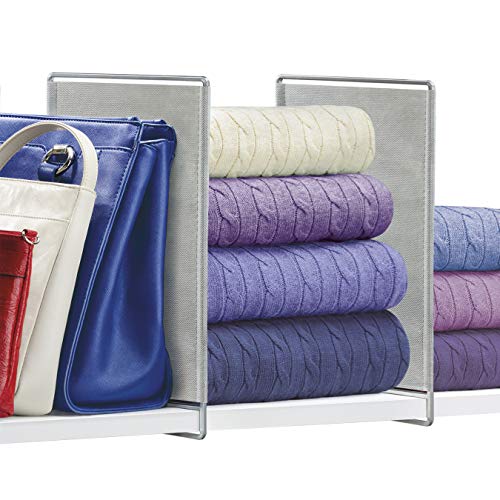
A wide closet shelf with no divisions becomes a single sliding pile within a week of folding laundry. These LYNK Vela dividers attack that specific failure. Each one is a panel of non-woven polymer fabric stretched over an epoxy-coated steel frame, standing 13 inches tall and reaching about 8.4 inches back across the shelf. The base slides over the front edge of a solid shelf and adjusts to grip it, with no tools or hardware.
Thirteen inches of height matches a full stack of folded sweaters or towels, so the divider supports the whole pile, not just its bottom half. Use a pair to carve a long shelf into zones — sweaters in one bay, jeans in the next, linens at the end — and stacks stop sliding into each other. The fabric panel is gentler on knits than bare wire dividers, which can snag loops of yarn. The limits are the ones covered above: these fit solid shelves up to 7/8 inch thick, they do not work on wire shelving, and a two-count set organizes one shelf, so a full linen closet may want two sets. Within those limits, this is the fastest tidy-up in the guide — slide them on, refold once, and the shelf stays divided.
Specs
- Dimensions: 2.1″ W x 8.4″ D x 13″ H each
- Fit: Solid shelves up to 7/8″ thick
- Material: Non-woven polymer fabric over an epoxy-coated steel frame
- Count: Set of 2 dividers
- Assembly: None; slides on and adjusts by hand
Amazon Basics Collapsible Fabric Storage Cube Bins, 13-Inch, Pack of 6

Cube shelving only works as closet storage if the cubes themselves behave like drawers, and that is the job these Amazon Basics bins are built for. Each bin is a true 13-inch cube — 13 inches on every side, with about 2,197 cubic inches of room inside — sized to fill the large openings of standard cube organizer furniture. Six bins come in the pack, enough to outfit a full column of a cubby unit in one go.
The bins are open-topped fabric with sewn-in handles, so a full bin pulls out of its cubby, carries to the bed for sorting, and slides back in like a drawer. That pull-out access keeps off-season clothes, spare linens, and accessories reachable instead of stacked in front of each other. The breathable fabric suits stored clothing better than sealed plastic, and the beige color keeps a set looking calm behind an open closet door. When a bin is not in use it collapses flat, so spares store in a drawer. One caution: fabric bins hold their shape best when reasonably full, and the walls lean if a half-empty bin is crammed between two packed ones.
Specs
- Dimensions: 13″ L x 13″ W x 13″ H each
- Count: Pack of 6 bins
- Material: Fabric with sewn-in handles
- Capacity: 2,197 cubic inches per bin
- Design: Open top; collapses flat when empty
Whitmor Wire Under the Shelf Basket, Black

Every shelf in your closet has a second, unused surface: the underside. This Whitmor basket claims it. Two flat arms slide over the top of an existing shelf, and the wire basket hangs below it — 16 inches wide, 10 inches deep, and 7 inches tall — turning dead air under a shelf into a working compartment. It slides on and off in seconds, with no tools and no marks.
The basket is powder-coated metal wire in black, light at just over a pound yet rigid enough to hold its shape when loaded. Seven inches of height suits the things that clutter closet shelves in loose piles: folded T-shirts, scarves and gloves, belts, small handbags, or spare linens that never stack neatly. It steals none of the shelf’s own surface, and works just as well in a linen closet or laundry room. Two honest limits: it needs open space beneath the shelf, so it will not fit where clothes hang tight below one, and the wire grid means tiny items like loose jewelry belong in a pouch first. For squeezing one more compartment out of a full closet, it is the cleverest piece here.
Specs
- Dimensions: 16″ W x 10″ D x 7″ H
- Material: Metal wire with a powder-coated black finish
- Installation: Slides onto an existing shelf; no tools or hardware
- Item weight: 1.18 lb
- Model: 6898-4212
Frequently Asked Questions
How much weight can a hanging closet organizer really hold?
Less than the tidy product photos suggest. A fabric shelf is happiest with a few pounds of folded clothing spread across it — a stack of sweaters or T-shirts is ideal. Dense loads like jeans, books, or shoe boxes bow the shelf and strain the hooks over time. Keep heavy folded items on the lowest shelf and spread weight toward the sides, where the frame supports it.
How many pairs of shoes fit on a 26-inch shoe rack?
About three pairs per tier for everyday men’s and women’s shoes, or nine pairs on a three-tier rack. Flats pack tighter; bulky boots and larger sizes take more room. Measure your longest pair against the rack depth before ordering.
Will shelf dividers work on wire closet shelving?
No — slide-on dividers like the LYNK Vela set need a solid shelf edge to grip, up to about 7/8 inch thick. Wire shelving uses dividers that hook or clip directly onto the wires. Check your shelf type before ordering; the two designs are not interchangeable.
What can I organize in a rental closet without drilling or screws?
Everything in this guide: hanging shelves hook over the rod, dividers slide onto shelf edges, the shoe rack snaps together by hand, fabric cubes sit in existing cubbies, and the under-shelf basket slips on and off in seconds. The whole setup moves out with you and leaves no holes or marks behind.
Conclusion
The right organizer depends on which part of your closet is failing. For most people, the Whitmor 5 Section Closet Organizer is the best first move: it converts a spare foot of rod into five shelves of folded storage, with zero installation. If the floor is the disaster zone, the Simple Houseware 3-Tier Shoe Rack lines up about nine pairs under your hanging shirts. Shelves that will not stay tidy belong to the LYNK Vela Shelf Dividers, which keep sweater and linen stacks standing in their own bays. Closets with cube shelving are the natural home of the Amazon Basics Fabric Storage Cubes, used as pull-out drawers. And when every surface seems spoken for, the Whitmor Wire Under the Shelf Basket finds one more compartment under a shelf. Measure first, respect the honest load limits, and one or two of these will make the closet feel twice its size.
More from Amazon
Programs that pair well with the guide above. Offers and eligibility are set by Amazon and may change.
Free shipping on eligible items, Prime Video and more. Eligible new members can start with a free trial.
Start a Prime free trialAd-free music streaming. Eligible new subscribers can start with a free trial.
Try Music Unlimited freeA Prime membership for ages 18-24 with a trial period. Eligibility is set by Amazon.
See Prime for Young AdultsAudiobooks and podcasts to listen to on the go. Eligible new members can start with a free trial.
Try Audible freeAs an Amazon Associate we earn from qualifying purchases.