Our Short List of 3

- Best for: first-time tent growers who want one dimmable panel sized for a 2×2 ft tent.
- Power draw: 100W
- Diodes: Samsung LM301H EVO
- Spectrum: full spectrum
- Dimming: yes, dimmable output

- Best for: small-tent growers who want 150W output now and smart control from the same box.
- Power draw: 150W
- LEDs: 354 chips
- Output: PPF 343 µmol/s, PPE 2.3 µmol/J (maker figures)
- Reflector: patented hood with 120 degree refraction angle

- Best for: tent growers who value even corner coverage and may link a second panel later.
- Average power draw: 150W
- Spectrum: 3000K and 5000K white, 660nm red, 730nm infrared
- Daisy chain: up to 20 lights with unified dimming
- Lens: new-generation optical lens design
All 5 Picks at a Glance
| Product | Specs | Action |
|---|---|---|
| Spider Farmer SF1000 100W LED Grow Light |
| Check price on Amazon |
| MARS HYDRO TS1000 150W LED Grow Light with iConnectu Controller |
| Check price on Amazon |
| VIPARSPECTRA XS1500 Pro LED Grow Light |
| Check price on Amazon |
 Barrina T5 Grow Lights for Indoor Plants, 2FT, 4-Pack |
| Check price on Amazon |
 GE Grow LED Light Bulb, BR30 Floodlight, 2 Pack |
| Check price on Amazon |
Key takeaways
- Compare five grow lights for tents, shelves and single pots, from dimmable LED panels and linkable T5 strips to a screw-in BR30 bulb, with coverage notes.
The real decision with a grow light is not which brand claims the brightest output, but which fixture shape matches the space you actually grow in. A hanging panel suits a small tent with a defined canopy, flat strips suit shelving stacked with seed trays, and a screw-in bulb suits one pot beside a lamp you already own. Buying the wrong format wastes money no matter how capable the diodes are, because coverage, mounting and controls all follow the shape of the fixture.
This guide serves three groups: first-time tent growers choosing a dimmable panel, seed starters lighting tiered shelves, and houseplant owners topping up light for a pot or two. Every pick comes from a current Amazon listing, chosen for its stated coverage, spectrum and control options, with each maker’s figures kept attached to its own model.
Quick Picks
As an Amazon Associate we earn from qualifying purchases
| Product | Best for | Key spec from title |
|---|---|---|
| Spider Farmer SF1000 100W LED Grow Light | A first 2×2 ft grow tent | 100W dimmable full spectrum panel |
| MARS HYDRO TS1000 150W LED Grow Light with iConnectu Controller | A small tent with app-ready control | 150W panel with daisy chain dimming |
| VIPARSPECTRA XS1500 Pro LED Grow Light | Even coverage across a 2×2 to 3×3 tent | 150W lens panel, daisy chain up to 20 |
| Barrina T5 Grow Lights for Indoor Plants, 2FT, 4-Pack | Shelves of seed trays and herbs | Four 2 ft 5000K linkable strips |
| GE Grow LED Light Bulb, BR30 Floodlight, 2 Pack | One or two pots in an existing lamp | 9W BR30 bulb with E26 base |
How to Choose
Start With the Space You Are Lighting
Form factor follows space, so measure your growing area before comparing any figures. A tent or a single defined corner points to a hanging panel that concentrates light on one canopy. Tiered shelves and cabinets point to flat strips that mount underneath each level, close above the trays. A single plant on a counter points to a bulb in an ordinary lamp. Choosing the shape first removes most of the catalogue from contention and makes the remaining comparison honest, because panels, strips and bulbs are built for different jobs.
Match Stated Coverage to Your Growing Area
Every maker scopes its light to an area, and that stated coverage is the figure to compare, not headline wattage. The panels below are claimed for 2×2 and 3×3 ft tents at very different wattages, the strip set spreads modest power across four shelves, and the bulb covers one small spot. Wattage does not rank lights across formats, and equivalence claims against old lamp types are marketing shorthand. Match the maker’s coverage to your footprint, then compare output figures only between lights of the same type and size class.
Check Dimming and Linking Before You Buy
Dimming matters most for seedlings, which need gentler light than mature plants, so a panel with a dimmer can run one fixture through every growth stage. A daisy chain matters if you expect to add panels later, because linked lights share one dimming control and one timer. For strips, the linking limit decides how many shelves run from a single cord, and a separate switch per run adds flexibility. Decide which of these controls your setup will actually use, since they separate otherwise similar listings more than small output differences do.
Plan Mounting, Distance and a Daily Schedule
A light only works at the distance its maker directs, so plan the hanging hardware, shelf clearance or lamp position before ordering. Panels hang above a canopy and need room to rise as plants grow, while strips sit a short distance above trays and must be raised or remounted over time. None of these fixtures includes your schedule, so add a timer for consistent daily hours rather than relying on memory. Fanless designs run silently, which suits living spaces, but still need air around them to shed heat.
The 5 Best Options
Spider Farmer SF1000 100W LED Grow Light
- Best for: first-time tent growers who want one dimmable panel sized for a 2×2 ft tent.
- Power draw: 100W
- Diodes: Samsung LM301H EVO
- Spectrum: full spectrum
- Dimming: yes, dimmable output
first-time tent growers who want one dimmable panel sized for a 2×2 ft tent.
the SF1000D two-pack is a different listing with a different code, so confirm you are ordering the single SF1000 described here.
The SF1000 is the straightforward first panel for a small tent. Its listing scopes it to seed starting, vegetables and bloom in 2×2 and 3×3 ft grow tents, and the dimmer lets you soften output for young starts before raising it as the canopy fills in. The fanless board runs silently, which suits a tent in a spare room or closet. Spider Farmer sells several near relations, including a two-pack of the SF1000D, so treat this single 100W unit as its own listing and compare it only against panels of the same class.
MARS HYDRO TS1000 150W LED Grow Light with iConnectu Controller
- Best for: small-tent growers who want 150W output now and smart control from the same box.
- Power draw: 150W
- LEDs: 354 chips
- Output: PPF 343 µmol/s, PPE 2.3 µmol/J (maker figures)
- Reflector: patented hood with 120 degree refraction angle
small-tent growers who want 150W output now and smart control from the same box.
Mars Hydro sells the TS1000 in several configurations, including bare-light and kit versions, so confirm this listing’s controller bundle matches what you intend to buy.
This listing pairs the TS1000 panel with Mars Hydro’s iConnectu controller, the maker’s smart-control add-on for its newer lights. The panel itself steps up to 150W with a patented white reflector hood, dimming and a daisy chain connection, scoped by the listing to 2×2 and 3×3 ft tents. That suits a grower who wants more output than a 100W board plus a route into app-based control later. Because Mars Hydro sells the TS series in several configurations, the controller bundle is part of what this particular code buys, not an accessory to assume with every TS1000 offer.
VIPARSPECTRA XS1500 Pro LED Grow Light
- Best for: tent growers who value even corner coverage and may link a second panel later.
- Average power draw: 150W
- Spectrum: 3000K and 5000K white, 660nm red, 730nm infrared
- Daisy chain: up to 20 lights with unified dimming
- Lens: new-generation optical lens design
tent growers who value even corner coverage and may link a second panel later.
the fixture has no power switch of its own, so plan on a timer or a switched outlet from the start.
The XS1500 Pro is the most fully documented panel in this guide. Its listing describes an optical lens design that concentrates light for more uniform coverage at the corners of the canopy, a dimming daisy chain that links up to 20 lights under one control, and a fanless aluminium heatsink. The spectrum mixes warm and cool white with deep red and infrared, positioned for every stage from seed starting to flower. Growers planning a second panel later get the clearest expansion path here, since unified dimming across linked fixtures is the feature multi-light tents actually use day to day.
Barrina T5 Grow Lights for Indoor Plants, 2FT, 4-Pack
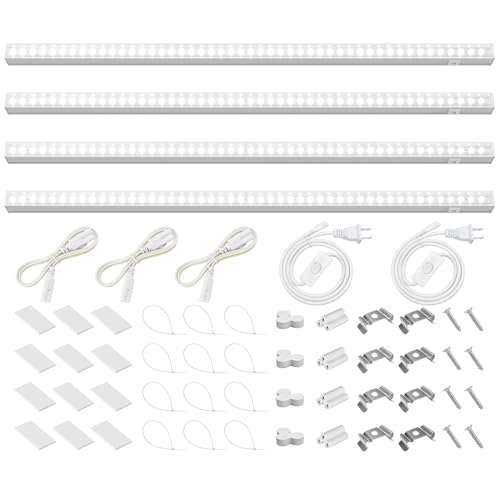
- Best for: seed starters and herb growers lighting tiered shelves or under-cabinet runs.
- Pack: 4 strips, 2 ft each (23.6 in per strip)
- Power: 10W per strip, 40W total
- Spectrum: 5000K full spectrum
- Beam angle: 120 degrees
seed starters and herb growers lighting tiered shelves or under-cabinet runs.
Barrina sells many near-identical T5 packs in other sizes, counts and cover colours, so check the pack size and 5000K white-cover description on the listing before ordering.
The Barrina set changes format entirely: four slim 2 ft strips that mount under shelves and cabinets instead of hanging over a tent. Each strip draws 10W, and the 5000K full spectrum suits shelves of seed trays, herbs and young plants that need light close above them. The strips link in series, up to 16 lamps on one run, so a whole shelving unit can share a single cord and switch arrangement. For seed starting across several levels, this is the only format in the guide built for the job, and the low profile leaves headroom for trays and domes.
GE Grow LED Light Bulb, BR30 Floodlight, 2 Pack
- Best for: houseplant owners adding light to one or two pots through an existing lamp.
- Power draw: 9W per bulb
- Shape: BR30 floodlight
- Base: E26 medium base
- Spectrum: balanced light spectrum for seeds and greens
houseplant owners adding light to one or two pots through an existing lamp.
GE sells a separate Flowers and Fruit version of this BR30 with an advanced red spectrum under a different listing, so check the variant name matches the seeds and greens bulb described here.
The GE bulb is the lowest-effort option here: a BR30 floodlight with a standard E26 medium base that screws into a lamp, desk light or clamp fixture you already own, sold as a two-pack. Its balanced spectrum is tuned for seeds and greens, and the light appears white to the eye rather than purple, which suits living spaces. Output is modest by design, enough for one or two pots or a small herb cluster rather than a shelf or tent. For a single plant stretching on a windowsill, this is the proportionate fix, and the second bulb covers another pot or a spare.
Which One Fits Your Situation
Your First 2×2 Tent
Start with the Spider Farmer SF1000. Its 100W dimmable board is scoped by its listing to exactly this tent size, the dimmer covers seedlings through bloom without swapping fixtures, and the fanless design keeps a bedroom or closet setup quiet. Move to the VIPARSPECTRA XS1500 Pro instead if you already know the tent will hold light-hungry fruiting plants and you want the stronger, lens-focused output from day one.
A Tent You Plan to Expand
Choose between the two daisy chain panels. The MARS HYDRO TS1000 bundle adds the iConnectu controller for a path into app-based control, while the VIPARSPECTRA XS1500 Pro links up to 20 fixtures under unified dimming, the larger expansion ceiling. Either way, buy the first panel with its linking system in mind, because daisy chain standards are not shared between brands and a mixed second panel would need its own control.
Shelves of Seed Trays and Herbs
Take the Barrina T5 four-pack. Panels hang too high above shallow trays and waste light between shelf levels, while these strips mount under each shelf, close to the seedlings where modest wattage still delivers useful intensity. One linked run of up to 16 strips can serve several levels from a single cord, and the 5000K spectrum is the daylight-style light that starts and leafy herbs are usually grown under.
One or Two Pots on a Counter
Use the GE BR30 bulbs in a lamp you already own. A panel would overwhelm a single pot in cost, heat management and mounting effort, while the bulb screws into an E26 socket in seconds and its white-looking balanced spectrum suits a kitchen or living room. The two-pack lets you light a second pot or keep a spare, and a simple plug-in timer completes the setup.
Common Mistakes
- Comparing lights by headline wattage or equivalence claims instead of each maker’s stated coverage for the exact listing.
- Ordering a near-identical variant by mistake, such as the wrong Barrina pack size, the GE Flowers and Fruit bulb, or a different TS1000 configuration.
- Hanging a panel at a guessed height and never adjusting it as the canopy grows toward the fixture.
- Running seedlings at full panel output from day one instead of dimming and raising intensity gradually.
- Leaving lights on an irregular manual schedule rather than fitting a timer for consistent daily hours.
Frequently Asked Questions
How many hours a day should a grow light stay on?
Follow the guidance supplied with your light and the needs of what you are growing, then hold the schedule steady with a timer. Seedlings and leafy herbs are commonly grown on long daily schedules, while flowering plants often need a defined dark period. The exact hours are a growing decision rather than a fixture specification, and none of the listings here states one required schedule for every plant.
Can one grow light handle both seedlings and flowering plants?
A dimmable full spectrum panel is the flexible route, because the dimmer runs gentle output for seedlings and stronger output later in the cycle. The Spider Farmer and VIPARSPECTRA listings both scope their panels from seed starting to bloom. The Barrina strips and the GE bulb are better treated as specialist tools for shelves and single pots than as full-cycle lights for a flowering tent.
Do LED grow lights need a fan or extra ventilation?
All three panels and the strip set here use fanless designs, so the fixtures themselves run silently and have no fan to maintain. They still shed heat into the space around them, and a closed tent concentrates that warmth, so normal tent ventilation for the plants remains part of the setup. Keep air moving around any fanless fixture rather than enclosing it tightly against a surface.
How close should the light be to the plants?
Place the fixture at the distance its maker directs for that model, since the right gap differs between a focused panel, a wide strip and a floodlight bulb. Strips are designed to sit a short distance above trays, while panels hang higher above a canopy. Watch the plants over the following days: stretched, pale growth suggests moving the light closer or raising output, while leaves curling away suggests the opposite.
More from Amazon
Programs that pair well with the guide above. Offers and eligibility are set by Amazon and may change.
Free shipping on eligible items, Prime Video and more. Eligible new members can start with a free trial.
Start a Prime free trialAd-free music streaming. Eligible new subscribers can start with a free trial.
Try Music Unlimited freeA Prime membership for ages 18-24 with a trial period. Eligibility is set by Amazon.
See Prime for Young AdultsAudiobooks and podcasts to listen to on the go. Eligible new members can start with a free trial.
Try Audible freeAs an Amazon Associate we earn from qualifying purchases.