Our Short List of 3

- Best for: Studio and live racks that need filtered power, isolated banks and working lights in one rack space.
- 9 total outlets: 8 rear panel, 1 front convenience outlet
- 2 isolated outlet banks; 3 rear outlets widely spaced for wall warts
- 15-amp rating with high-inrush magnetic circuit breaker
- SMP surge protection, clamping at 188 VAC peak
- Best for: First-time rack owners and small home studios that need basic conditioning at the lowest cost per outlet.
- 9 outlets: 8 switched rear panel, 1 front convenience outlet
- 15-amp maximum load, 120 volts
- AC noise filtering reduces RFI and EMI, rated above 23 dB from 200 kHz to 10 MHz
- 3 rear outlets spaced for bulky wall-wart adapters

- Best for: A PC workstation, point-of-sale setup or small theater corner on a circuit with chronic sags and brownouts.
- 1200W capacity, 10-amp rating
- Automatic voltage regulation corrects 89 to 147 volt input to 120 volt nominal output
- 4 NEMA 5-15R outlets
- 1200-joule surge suppression
All 4 Picks at a Glance
| Product | Specs | Action |
|---|---|---|
| Furman PL-8C 15 Amp Power Conditioner |
| Check price on Amazon |
| Furman M-8×2 Merit Series Power Conditioner |
| Check price on Amazon |
| Tripp Lite LC1200 Line Conditioner |
| Check price on Amazon |
 Furman PST-8D Power Station |
| Check price on Amazon |
Key takeaways
- The best power conditioners for racks, home theaters and PCs, compared on surge protection, noise filtering, voltage regulation and outlet layout.
Your audio interface hums, your PC reboots when the refrigerator compressor kicks on, and the strip under the desk only promises to clamp one big spike before it is spent. A power conditioner is the step up from that strip: it filters noise off the line, manages surges, and on some models corrects voltage that drifts. The catch is that the word conditioner covers three different machines — rackmount filters, home theater power managers, and automatic voltage regulation boxes — and buying the wrong type leaves your actual problem untouched.
This guide is built for three kinds of buyers: home studio and rack owners who need filtered, switched outlets in a single rack space, home theater owners who want one protection point for a whole stack of components, and PC users whose rooms suffer sags and brownouts. Every pick is sold on Amazon now and was chosen from its listing specs: outlet layout, filtering and surge design, voltage handling, and form factor.
Quick Picks
As an Amazon Associate we earn from qualifying purchases
| Product | Best for | Key spec from title |
|---|---|---|
| Furman PL-8C | Full studio and live racks | 9 outlets with SMP, EVS and LiFT |
| Furman M-8×2 | A first rack on a tight budget | Merit Series rackmount, 15-amp rating |
| Panamax MR4300 | Home theater stacks | 9 outlets with Automatic Voltage Monitoring |
| Tripp Lite LC1200 | Rooms with sagging voltage | 1200W AVR with 4 outlets |
| Furman PST-8D | Consoles and desks with no rack | 8 outlets in isolated banks |
How to Choose
Filtering and surge protection do different jobs
A surge protector only reacts to spikes, clamping a sudden voltage surge before it reaches your gear. A conditioner adds a filtering stage that continuously scrubs radio and electromagnetic interference off the line, the noise that shows up as hum in recordings, buzzing in speakers, or faint lines in a picture. Better designs go further: Furman’s SMP protection is built to absorb repeated spikes without wearing out, and its LiFT filtering works across the whole frequency range instead of one narrow band. Decide which problem you actually have, because a basic clamp does nothing for noisy power.
Decide whether you need real voltage regulation
Most conditioners protect against brief events and then either pass power through or shut down. Shutdown designs such as Furman’s EVS and Panamax’s AVM disconnect your equipment when voltage leaves the safe range, which prevents damage but still interrupts whatever you were doing. True regulation is different: an AVR unit like the Tripp Lite LC1200 actively corrects input between 89 and 147 volts back to a steady 120 volts, so a computer keeps running through a brownout instead of rebooting. If your lights dim when appliances start, regulation is the feature that matters most.
Count outlets, banks and total load
List everything you plan to plug in before choosing. Rack conditioners here offer nine outlets, the LC1200 only four, and every unit has a hard ceiling — 15 amps on the rack models, 1200 watts on the LC1200 — that the whole stack shares. Layout matters as much as count: isolated outlet banks keep noisy digital gear from contaminating analog equipment, widely spaced sockets fit bulky wall-wart adapters without blocking neighbours, and home theater units reserve high-current outlets for receivers and power amplifiers that should never share a filtered bank with low-draw sources.
Match the form factor to where it will live
A 1U rackmount conditioner only makes sense if your gear already lives in a rack; measure depth as well as height, since the PL-8C chassis runs 10.5 inches deep. Theater power managers are wide shelf components with front displays and controls. The PST-8D’s flat station design suits a media console or desk with no rack at all, while the LC1200 is a small tower that sits beside a PC. Cord length decides placement too: these units ship with cords from seven to ten feet, and a conditioner should plug straight into the wall outlet.
The 5 Best Options
Furman PL-8C 15 Amp Power Conditioner
- Best for: Studio and live racks that need filtered power, isolated banks and working lights in one rack space.
- 9 total outlets: 8 rear panel, 1 front convenience outlet
- 2 isolated outlet banks; 3 rear outlets widely spaced for wall warts
- 15-amp rating with high-inrush magnetic circuit breaker
- SMP surge protection, clamping at 188 VAC peak
Studio and live racks that need filtered power, isolated banks and working lights in one rack space.
It does not regulate voltage — EVS shuts the rack down during a brownout rather than correcting it, and the 10.5-inch-deep chassis needs a rack with real depth.
The PL-8C is the reference rackmount conditioner for home studios, project racks and small live rigs. Its nine outlets sit in two isolated banks, so a noisy digital processor can be kept away from sensitive preamps, and three rear outlets are spaced widely enough for wall-wart power supplies. Furman’s SMP protection is built to survive repeated spikes rather than sacrifice itself on the first one, LiFT filtering scrubs line noise across a wide band, and the pull-out LED lamps light the rack below it in dark rooms. If your gear already lives in a rack, this is the default shortlist starter.
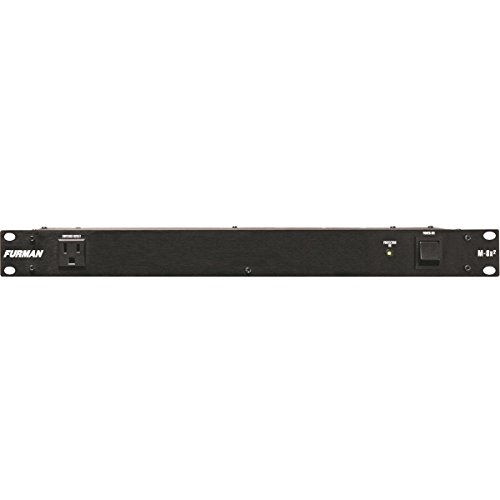
Furman M-8×2 Merit Series Power Conditioner
- Best for: First-time rack owners and small home studios that need basic conditioning at the lowest cost per outlet.
- 9 outlets: 8 switched rear panel, 1 front convenience outlet
- 15-amp maximum load, 120 volts
- AC noise filtering reduces RFI and EMI, rated above 23 dB from 200 kHz to 10 MHz
- 3 rear outlets spaced for bulky wall-wart adapters
First-time rack owners and small home studios that need basic conditioning at the lowest cost per outlet.
Several look-alike listings bundle this unit with extension cables under a different listing — check exactly what the listing you open contains before ordering.
The M-8×2 is the conditioner to buy when a rack needs switched, filtered power and the budget is spoken for elsewhere. Eight switched outlets on the rear and a convenience outlet on the front cover a typical small rig, three rear outlets are spaced for bulky adapters, and the noise filter targets the RFI and EMI that sneak into recordings and video feeds. What you give up versus the Classic Series above is the advanced protection circuitry: the Merit line uses standard surge suppression and offers no voltage shutdown or monitoring beyond a Protection OK indicator light.
Panamax MR4300 Power Management System
The MR4300 is built for a theater stack rather than a rack of studio gear: nine filtered outlets, two of them high-current sockets for a receiver or power amp, plus protection for the coax, network and phone lines entering the system. Its Automatic Voltage Monitoring watches the line continuously and disconnects the system during brownouts or overvoltage, reconnecting when power is safe again, while Protect or Disconnect technology cuts the connection entirely in a catastrophic surge. Level 3 filtration keeps the two isolated banks quiet, and a front USB port charges a phone or tablet.
Specs
- 9 protected and filtered outlets, including a front outlet and USB charging port
- Automatic Voltage Monitoring (AVM) disconnects on overvoltage or brownout
- Protect or Disconnect technology for catastrophic surge events
- Level 3 noise filtration across 2 isolated banks, with 2 high-current outlets
- Protection for 2 pairs of coax/satellite lines, RJ45 network and RJ11 phone lines
- 8 ft power cord with low-profile plug
- 17-inch-wide chassis, 6.5 lb; rack mounting hardware included
Best for: Home theater owners who want one unit guarding every component and every incoming signal line.
Watch out for: The listing record marks this model as discontinued by the manufacturer even though sellers still offer it — confirm the seller and the warranty terms on the listing before buying.
Tripp Lite LC1200 Line Conditioner
- Best for: A PC workstation, point-of-sale setup or small theater corner on a circuit with chronic sags and brownouts.
- 1200W capacity, 10-amp rating
- Automatic voltage regulation corrects 89 to 147 volt input to 120 volt nominal output
- 4 NEMA 5-15R outlets
- 1200-joule surge suppression
A PC workstation, point-of-sale setup or small theater corner on a circuit with chronic sags and brownouts.
Only four outlets and a 1200-watt ceiling — add up the draw of everything you plan to connect, because this is a single-desk solution, not whole-rack power.
The LC1200 solves a different problem from everything else here: voltage that will not sit still. Its automatic voltage regulation corrects input anywhere from 89 to 147 volts back to a nominal 120 volts, so a PC, printer or theater component keeps running through brownouts that would reboot it on a filter-only unit. Four outlets and a 1200-watt ceiling suit a single desk or workstation rather than a whole rack, and seven front LEDs report incoming voltage, surge status and line faults at a glance. It also filters EMI and RFI noise and suppresses surges.
Furman PST-8D Power Station
- Best for: Media consoles, living-room systems and desks that need rack-grade conditioning without a rack.
- 8 outlets arranged in isolated outlet banks
- SMP surge protection with EVS extreme voltage shutdown
- LiFT linear filtering technology
- 15-amp capacity
Media consoles, living-room systems and desks that need rack-grade conditioning without a rack.
The flat chassis still needs shelf depth and ventilation clearance, and the two banks group your gear for you — plan which devices belong on each bank before cabling.
The PST-8D brings the PL-8C’s protection recipe — SMP surge protection, LiFT filtering and EVS voltage shutdown — to rooms with no rack to mount it in. Eight outlets are split into isolated banks inside a flat aluminum chassis that slides onto a media console shelf or behind a desk, and the banks keep digital sources separated from analog gear just as they do in the rackmount models. It is the natural pick for a living-room system or a desk setup that needs genuine conditioning in a station-style body rather than another basic power strip with a new label.
Which One Fits Your Situation
Your rack gear hums, buzzes or picks up noise
Start with the Furman PL-8C: its LiFT filtering and isolated banks are aimed squarely at noise that leaks between components, and the rack lights are a genuine quality-of-life bonus in dark rooms. If the rig is small and the budget is tight, the Furman M-8×2 covers the same rack space with basic filtering and switched outlets, accepting simpler surge circuitry in exchange for the lower cost of entry.
One protection point for a whole home theater
The Panamax MR4300 was designed for exactly this stack: filtered banks for sources, high-current outlets for the receiver, and protection on the coax and network lines that most surge strips ignore. Its voltage monitoring also guards against the slow brownouts that wear out theater gear. Where no rack or cabinet shelf is available, the Furman PST-8D covers the same components from a flat station on the console.
Lights dim and equipment reboots on weak circuits
Only one pick here actually fixes sagging voltage: the Tripp Lite LC1200 regulates input from 89 to 147 volts back to a steady 120, so a workstation or a small theater corner rides through brownouts instead of restarting. Shutdown-style conditioners protect hardware in the same conditions but still cut power, so choose regulation when the real symptom is reboots and flicker rather than storm damage.
No rack, just a desk or media console
The Furman PST-8D is the fit: rack-grade SMP protection and filtering in a flat aluminum body that sits where a power strip would, with isolated banks a strip never offers. For a single PC desk on a weak circuit, pair the decision the other way and take the LC1200’s regulation in its small tower cabinet instead.
Common Mistakes
- Buying a plain surge strip and calling it conditioning — without a filtering stage, line noise passes straight through to your gear.
- Ignoring the shared ceiling: a 15-amp rack unit or the LC1200’s 1200-watt limit covers everything plugged into it at once, not each outlet separately.
- Plugging a power amplifier into a standard filtered bank when the unit provides dedicated high-current outlets for exactly that load.
- Daisy-chaining conditioners, or plugging one conditioner into another power strip, which defeats the protection design and can overload the first unit.
- Expecting a conditioner to keep equipment running in an outage — none of these units contains a battery; that job belongs to a UPS.
Frequently Asked Questions
Is a power conditioner the same thing as a surge protector?
No. A surge protector only clamps brief voltage spikes. A conditioner adds continuous noise filtering on top of surge protection, and higher models add isolated outlet banks, voltage monitoring with automatic shutdown, or full voltage regulation. Every unit in this guide conditions as well as protects, which is the distinction that separates the category from the strip in a bargain bin.
Can a power conditioner fix brownouts?
Only a model with automatic voltage regulation can. The Tripp Lite LC1200 corrects input between 89 and 147 volts back to a nominal 120 volts, so equipment keeps running. Filter-only and shutdown-style conditioners such as the Furman and Panamax units protect gear during a brownout by disconnecting it, but they do not keep it powered.
Do I still need a UPS if I buy a power conditioner?
For a computer, usually yes. A conditioner cleans and protects the power but stores none of it, so an outage still shuts everything down instantly. A UPS adds battery runtime for a graceful shutdown. Many setups run both: the conditioner handles noise and everyday surges, and the UPS handles outages and the deepest sags.
Can I plug a power strip into a power conditioner?
It is a poor idea. Adding a strip downstream multiplies outlets beyond the layout the filtering banks were designed around, can overload a single bank, and a cheap strip’s own protection parts can interfere with the conditioner’s. Use the conditioner’s outlets directly, keep high-draw gear on the outlets meant for it, and size the unit to your device count instead.
More from Amazon
Programs that pair well with the guide above. Offers and eligibility are set by Amazon and may change.
Free shipping on eligible items, Prime Video and more. Eligible new members can start with a free trial.
Start a Prime free trialAd-free music streaming. Eligible new subscribers can start with a free trial.
Try Music Unlimited freeA Prime membership for ages 18-24 with a trial period. Eligibility is set by Amazon.
See Prime for Young AdultsAudiobooks and podcasts to listen to on the go. Eligible new members can start with a free trial.
Try Audible freeAs an Amazon Associate we earn from qualifying purchases.