Key takeaways
- Compare the best posture correctors by brace design, adjustability, sizing range and wear comfort, with honest usage notes for desk workers and drivers.
As an Amazon Associate we earn from qualifying purchases.
Spend six or more hours a day at a desk or behind a wheel and your shoulders will drift forward, no matter how good your chair is. A posture corrector is a simple response: a brace or garment that pulls your shoulders gently back and makes slouching obvious enough that you correct it yourself. Used as a reminder worn for short stretches, it can be a sensible training aid. Used as a harness you lean on all day, it does the opposite of what you want.


That distinction shapes this whole guide. None of the five products below will cure back pain, repair a spinal condition, or permanently reshape how you sit, and listings that promise otherwise are overselling fabric and strapping. What these designs can do is cue better alignment while you build the habits — movement breaks, a sane workstation setup, basic strengthening — that hold posture up over time. The picks cover the main design families: figure-8, neoprene clavicle, full back with support rods, padded cross-back, and a posture shirt.
Disclosure: This article contains affiliate links. If you make a purchase through these links, we may earn a commission at no extra cost to you.
How to Choose
Understand what a corrector actually does. A posture corrector does not hold your spine in place the way a cast holds a bone. It applies gentle tension across your shoulders or back, and that tension becomes noticeable the moment you round forward. The product is the feedback, not the fix. Once you take it off, your posture is whatever your muscles and habits make it — which is why reputable makers pair their braces with gradual wear schedules rather than all-day wear.
Figure-8 and clavicle braces. The most common design loops straps around both shoulders and crosses them behind the upper back. These braces target rounded shoulders and upper-back slouching only — nothing below that. They are light, easy to hide under a shirt, and the easiest type to over-tighten, so padded straps and modest tension matter. If your problem area is the lumbar region, this design family is the wrong tool.
Full back braces with stays. These add a back panel, a waist belt, and usually removable support rods or stays running down the spine. The belt anchors the brace so the shoulder straps are not doing all the work, and the rods give a firmer reminder when you fold forward. The trade-offs are bulk at the waist, more warmth, and visible lines under fitted clothing. They suit people who want full coverage and mostly work from home, where discretion matters less.
Posture shirts. Shirts from makers such as AlignMed build elastic tension panels into a fitted garment, so the cue comes from the clothing rather than straps. There is nothing to adjust once it is on, it disappears under a work shirt, and it is the easiest format for a full morning. The limits are real: tension is milder than a strap brace, sizing follows clothing sizes rather than a tape measurement, and it needs laundering like any garment.
Fit and sizing decide whether you will wear it. Every maker sizes differently. Most strap braces are sold by chest circumference; belted full-back models are often sized by waist instead. Measure with a soft tape over a thin shirt, use the maker’s own chart rather than your clothing size, and if you land between sizes, follow the maker’s guidance — most say to size up, because a brace that digs into your armpits ends up in a drawer. Straps should feel snug enough to notice when you slouch, never tight enough to tingle or pinch.
Build wear time gradually. Maker schedules differ in detail but agree in shape: begin with short daily sessions of 15 to 45 minutes, and add time over one to three weeks until you reach one to a few hours a day. More is not better. A brace worn all day lets your postural muscles off the hook, and first-week soreness usually means you advanced too fast or tightened too hard, not that the product is working extra well.
The brace is the smallest part of the plan. What changes posture over months is unglamorous: a screen at eye level, feet supported, a supportive chair, a standing break every half hour, and simple strengthening for the upper back and core. Treat the corrector as the nudge that reminds you to do those things and it earns its place; treat it as a substitute and it will disappoint you.
Know when to skip the brace and see a professional. Persistent back or neck pain, pain that travels into an arm or leg, numbness or tingling, a visible spinal curve, a recent injury, or any diagnosed condition such as scoliosis or kyphosis calls for a clinician or physical therapist first — before buying anything, and certainly instead of reaching for a stronger brace. The same applies to children and anyone recovering from surgery. A consumer corrector is a comfort and habit aid for healthy adults with ordinary desk slouch, and it should stay in that lane.
The 5 Best Posture Correctors
1. ComfyBrace Posture Corrector — Classic Figure-8 Pick
The ComfyBrace is the reference design for this category: a figure-8 brace whose two adjustable shoulder straps cross behind the upper back and draw the shoulders rearward whenever you start to round forward. It uses a breathable polyester mesh rather than solid neoprene, making it one of the cooler options under a work shirt, and it weighs very little — the listing specification puts it at about 0.13 kg. Fit is by chest measurement (30 to 43 inches), and the hook-and-loop straps adjust on both sides so you can even out the tension.
Because it is all strap and no panel, it is genuinely discreet: under a button-down or sweater it reads as nothing at all. The trade-off is the known weakness of the type — tension concentrates where the straps pass the armpits, so the maker’s gradual schedule matters. ComfyBrace advises starting with short daily sessions and building up, and backs the brace with a lifetime warranty — unusually long coverage for this category. For a first corrector for a desk routine, this is the straightforward pick.
Specs
- Design: figure-8 upper-back brace with dual adjustable shoulder straps
- Fit range: chest 30 to 43 inches
- Material: breathable polyester mesh construction
- Closure: hook-and-loop, adjustable on both sides
- Weight: about 0.13 kg per the listing specification
- Maker coverage: lifetime warranty stated by ComfyBrace
2. MARAKYM Posture Corrector — Widest Fit Range
MARAKYM’s corrector is a clavicle-style brace built from lightweight neoprene, and its headline specification is range: the straps adjust to fit chest circumferences from 28 to 48 inches, which covers bodies outside the narrower bands many competitors stop at. Neoprene gives the brace a softer, more cushioned feel against the shoulders than mesh designs, and the flat profile sits comfortably under or over clothing, so it suits a workday at home and a commute equally well.
The package is a little more complete than most: MARAKYM includes a carrying bag and kinesiology tape, and the maker offers a money-back guarantee if the fit does not work out. As with any neoprene brace, expect more warmth than a mesh model during long sessions, which is another reason to respect the short-session schedule rather than wearing it through an entire shift. If you fall between sizes on other brands, or want the softest strap material in this guide, start here.
Specs
- Design: clavicle-style upper-back brace
- Fit range: chest 28 to 48 inches
- Material: lightweight, breathable neoprene
- Straps: hook-and-loop, fully adjustable
- Included: carrying bag and kinesiology tape
- Maker coverage: money-back guarantee
3. Fit Geno Back Brace Posture Corrector — Full Back Brace with Stays
The Fit Geno is the most structured option here. It combines shoulder loops with a full back panel and a waist belt, and the panel carries four removable fiberglass support rods. The rods stiffen the brace’s reminder: folding forward against them is immediately obvious, and because they come out, you can soften the brace as your routine settles in. Shoulder straps and belt tension adjust independently, and a breathable mesh section keeps the panel from feeling like a solid sheet of fabric.
Sizing is by waist rather than chest — Small covers 25 to 33 inches, Medium/Large 33 to 40, and Large/X-Large 41 to 48 — so measure the right thing before ordering. Fit Geno’s wear guidance follows the standard gradual pattern, beginning at 20 to 45 minutes a day and building over the first weeks. The belt makes it the bulkiest pick under fitted office clothing, so it suits home desks, driving, and standing work better than a tucked-in shirt. For slouching that involves the whole back, not just the shoulders, it is the most complete design in this guide.
Specs
- Design: full back brace with shoulder straps and waist belt
- Support: four removable fiberglass rods in the back panel
- Sizing: by waist — S 25–33 in, M/L 33–40 in, L/XL 41–48 in
- Material: breathable mesh with neoprene and polyester
- Closure: hook-and-loop straps and belt, adjusted independently
- Care: hand wash only
4. Schiara Posture Corrector — Padded Cross-Back Design
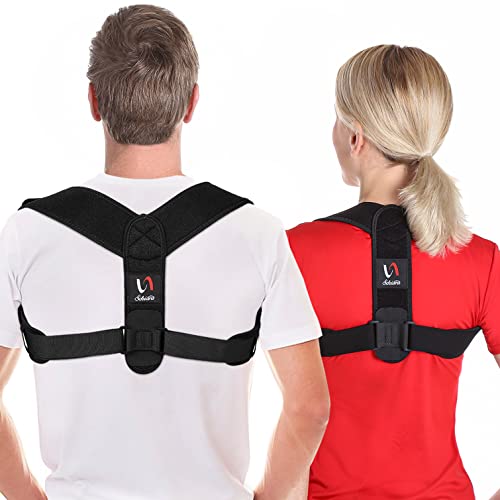
Schiara’s corrector (model D362665) takes the upper-back brace in a slightly different direction: the straps cross in an X across the back and meet at a central buckle, and the shoulder sections are padded. That padding addresses the figure-8 family’s main comfort complaint — straps digging under the arms — and the buckle gives a single, repeatable adjustment point.
The listed fit range is a chest circumference of 30 to 42 inches, and the breathable, washable fabric can be worn over a shirt or underneath one. It is not as invisible as the slimmest mesh braces — the buckle and crossed straps can show through thin, fitted tops — but under ordinary work clothing it stays out of sight. Choose it if you like a strap brace’s simplicity but want more padding and a firmer adjustment than the basic designs offer.
Specs
- Design: upper-back brace with crossing straps and central buckle
- Fit range: chest 30 to 42 inches
- Model: D362665
- Straps: adjustable, with padded shoulder sections
- Fabric: breathable and washable
- Wear: over or under clothing
5. ALIGNMED Posture Shirt 2.0 — The Posture Shirt Option

The AlignMed Posture Shirt 2.0 removes the straps entirely. It is a fitted shirt with the maker’s NeuroBand tension panels mapped across the shoulders and back; when you slouch, the panels load up and cue the muscles underneath to engage, much like a strip of athletic tape. This listing is the men’s zip-front version in white, and the line also includes pullover styles and women’s versions, all sized like athletic clothing.
As a desk option it has one clear advantage: there is nothing to adjust, nothing to hide, and nothing to take off between meetings — it is just your base layer. The honest limitations are that the cue is gentler than a strap brace at full tension, the snug athletic fit is itself the mechanism so it will not suit anyone who dislikes compression clothing, and it needs washing like any shirt, which makes a second one practical if you wear it daily. For drivers and desk workers who would never keep up with a strap routine, it is the design most likely to still be in use a month later.
Specs
- Design: posture shirt with NeuroBand tension panels
- Style: zip-front version; pullover version also offered
- Fit: snug athletic fit, worn as a base layer
- Versions: men’s and women’s lines in multiple sizes
- Model: 43215-7165 (men’s zipper version)
- Fabric: moisture-wicking performance knit, per the maker
FAQ
How long should I wear a posture corrector each day?
Follow the maker’s schedule. The common pattern is to begin with short sessions of about 15 to 45 minutes, then build gradually over one to three weeks toward one to a few hours a day. Wearing one all day works against the goal: your muscles need to do the holding, and the brace is only there to remind them. If you feel sore, you advanced too quickly or tightened the straps too far.
Will a posture corrector fix my back pain or permanently straighten my posture?
No, and you should be skeptical of any product page that says otherwise. A corrector is a reminder cue that works only while you wear it. Lasting change comes from movement breaks, workstation adjustments, and strengthening work. Pain that persists, spreads, or comes with numbness or tingling needs a clinician or physical therapist, not a tighter brace.
How do I choose the right size?
Measure with a soft tape over a thin shirt and use the maker’s own chart. Most strap braces size by chest circumference; belted full-back models size by waist instead. If you fall between sizes, follow the maker’s guidance — most advise sizing up. A correct fit feels snug and noticeable when you slouch; digging or tingling means the size or tension is wrong.
Can I wear a corrector under work clothes or while driving?
Yes — slim figure-8 braces and posture shirts disappear under ordinary work clothing, while belted full-back models can show at the waist under fitted outfits. For driving, put it on and set it before you set off, keep sessions within the maker’s schedule on long trips, and never adjust straps while the vehicle is moving.
Conclusion
Match the design to the habit you will actually keep. Desk workers wanting the simplest discreet reminder should start with the ComfyBrace, the classic figure-8 in breathable mesh. Anyone outside standard size bands, or preferring a softer strap material, should look at the MARAKYM and its 28-to-48-inch range. If your slouch runs the length of your back and you mostly work from home, the Fit Geno adds a belt and removable support rods that no strap-only brace can match. For padded comfort in a strap design, the Schiara is the pick. And if straps would end up forgotten in a drawer, the ALIGNMED Posture Shirt 2.0 builds the reminder into a shirt you already wear. Whichever you choose, keep sessions short, build gradually, and let movement breaks and basic strengthening do the long-term work — the brace just points you in that direction.
More from Amazon
Programs that pair well with the guide above. Offers and eligibility are set by Amazon and may change.
Free shipping on eligible items, Prime Video and more. Eligible new members can start with a free trial.
Start a Prime free trialAd-free music streaming. Eligible new subscribers can start with a free trial.
Try Music Unlimited freeA Prime membership for ages 18-24 with a trial period. Eligibility is set by Amazon.
See Prime for Young AdultsAudiobooks and podcasts to listen to on the go. Eligible new members can start with a free trial.
Try Audible freeAs an Amazon Associate we earn from qualifying purchases.