Key takeaways
- Compare the best rowing machines for smooth, quiet training, with air, magnetic and water resistance picks plus folding storage options included.
As an Amazon Associate we earn from qualifying purchases.
A rowing machine asks more of your body than almost any other single piece of home cardio equipment. Each stroke starts with a leg drive, continues through the hips and back, and finishes with the arms, so legs, glutes, back, shoulders, and core all share the work in one repeating rhythm. Because the motion is seated and low impact, rowing also suits people who find running hard on their knees but still want training that raises the heart rate and holds it there.

The catch is that rowers differ far more than they first appear to. Resistance can come from air, water, magnets, or a computer-controlled electromagnetic system, and each type feels different, sounds different, and asks for different upkeep. Monitors range from a simple counter to the most respected performance computer in the sport. This guide explains those differences honestly, then walks through five machines that cover the main approaches: a benchmark air rower, a wooden water rower, a quiet magnetic model, a connected screen-based machine, and a compact folding air rower for smaller spaces and simpler needs.
Disclosure: This article contains affiliate links. If you make a purchase through these links, we may earn a commission at no extra cost to you.
How to Choose
Resistance type shapes everything. Air rowers use a spinning flywheel fan: pull harder and the drag rises to meet you, which is why air resistance feels natural to experienced rowers and why it gets louder as you work harder. There is no dial that truly sets the load; a damper lever changes how much air enters the housing and alters the feel, but your effort still decides the intensity. Water rowers put paddles in a sealed tank, producing a smooth, swelling resistance and a soft whoosh that many people find pleasant. Magnetic rowers use magnets near a metal flywheel and a numbered resistance dial, so the load stays consistent stroke to stroke and the machine stays quiet enough for early-morning sessions in an apartment. Electromagnetic connected machines let software adjust drag automatically during guided workouts.
Noise and maintenance differ by type. Air rowers need occasional chain oiling and dust removal from the flywheel housing. Water rowers need a purification tablet in the tank a few times a year and protection from direct sunlight. Magnetic machines have the fewest moving parts in the resistance path and generally need the least attention, though their drive belts eventually wear. If you train while others sleep, magnetic is the safest bet; if you want the closest feel to rowing on water, air and water lead.
The monitor decides what you can measure. A serious monitor shows your split — the pace per 500 meters — along with strokes per minute, watts, distance, and time, and saves workouts you can compare month to month. Basic LCD consoles typically show time, stroke count, and estimated calories, which is fine for steady sessions but weak for structured intervals or tracking progress. Connected machines trade the open data approach for a big screen, instructor-led sessions, and scenic rows, usually tied to a membership.
Fit and storage matter more than people expect. Check the rail (monorail) length against your inseam: taller rowers need a longer rail so the seat does not hit the end stop at the catch. Seat height affects how easily you get on and off, and foot stretchers should hold your shoes securely. For storage, some machines fold, some split into two pieces, and water and connected models often stand upright. Measure your space for both the rowing footprint and the stored footprint before choosing.
Drive and comfort details. Chain drives are durable and easy to service; belt drives run quieter and need less lubrication. A contoured, padded seat and an ergonomic handle with a slight bend reduce discomfort on longer rows, and smooth seat rollers keep the slide silent. None of these details is glamorous, but together they decide whether a machine gets used daily or gathers dust.
Concept2 RowErg
The Concept2 RowErg is the machine against which every other rower is measured. It is the standard in boathouses, gyms, and indoor rowing competitions, which means its numbers mean something: a split recorded on its PM5 monitor is directly comparable with results from any other Concept2 anywhere. For a home user who likes measurable progress, that comparability is a genuine advantage rather than a marketing line.
The air flywheel and spiral damper deliver the classic rowing feel — resistance that builds exactly with your effort. The PM5 tracks split, watts, stroke rate, distance, and heart rate, saves workouts to its memory or a USB stick, and connects to apps and heart rate straps over Bluetooth and ANT+. The nickel-plated chain is built for heavy daily use, the 54-inch monorail fits inseams up to roughly 36 inches, and when the session ends the machine separates into two pieces without tools and rolls away on caster wheels. It is not quiet at full effort, and its looks are purely functional, but for training data and durability it remains the reference point. See the Concept2 RowErg on Amazon for the current listing details.
Specs
- Resistance: Air flywheel with adjustable spiral damper (settings 1–10)
- Monitor: PM5 performance monitor with Bluetooth and ANT+, workout memory and USB logbook support
- Rail: 54-inch aluminum monorail; 14-inch seat height on standard legs
- Capacity: Supports users up to 500 lb; machine weight about 57 lb
- Storage: Separates into two pieces without tools; caster wheels on the front legs
- Drive: Nickel-plated steel chain
WaterRower Natural
The WaterRower Natural takes the opposite approach to the Concept2: instead of industrial function, you get a handcrafted frame in solid American ash that looks at home in a living room. Its resistance comes from paddles turning in a sealed polycarbonate water tank, and that produces the defining quality of the machine — a smooth, organic pull with a gentle rushing sound that rises and falls with your effort, much like an oar moving through water.
Because the resistance is self-regulating, there are no settings to adjust; row harder and the water pushes back harder. The S4 monitor covers the basics — stroke rate, distance, time, intensity in meters per second or split, and heart rate with an optional strap — but it does not match the PM5 for data depth or workout storage. The dual-rail design feels stable and the seat glides quietly. When you finish, the machine tips up and stands on its end, taking up roughly the footprint of a dining chair. Upkeep is light: a water purification tablet every few months and a wipe-down of the wood. Check the WaterRower Natural on Amazon for the current listing.
Specs
- Resistance: Water flywheel in a sealed polycarbonate tank; self-regulating drag
- Frame: Solid American ash wood with a honey oak finish applied by hand
- Monitor: S4 performance monitor showing stroke rate, distance, time, and intensity
- Dimensions: About 82 x 22 x 20 inches in use; stores upright on end
- Capacity: Suits inseams up to about 37 inches; machine weight about 66 lb without water
- Drive: Quiet belt and recoil system with dual-rail seat track
Sunny Health & Fitness SF-RW5515 Magnetic Rowing Machine
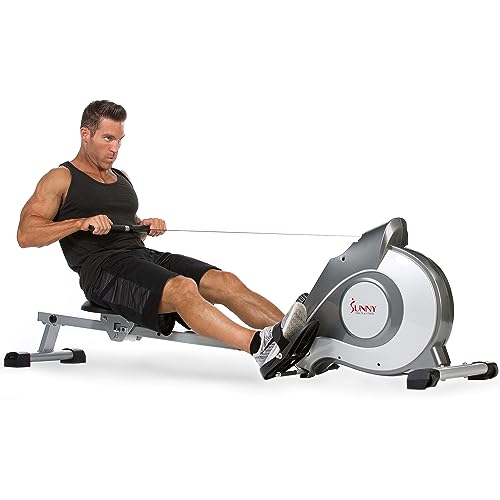
If quiet operation is the priority — shared walls, sleeping children, thin floors — a magnetic rower like the Sunny Health & Fitness SF-RW5515 makes the strongest case. Its magnetic tension system offers eight resistance levels set by a simple dial, and because there is no fan and no water, the loudest sound in the room is usually the seat rolling on the rail. The resistance stays the same regardless of how fast you pull, which some beginners prefer while they learn consistent technique.
This model stands out in its class for its extra-long 53.4-inch slide rail, which gives taller users more room than most compact magnetic machines. The LCD monitor displays time, stroke count, estimated calories, and total count, or scans through them; it will not show a 500-meter split, so structured pace work is harder to follow. The padded seat, large anti-slip foot pedals with straps, and a belt drive keep the experience smooth, and when the workout ends the rail folds up so the machine stores in a corner. Transport wheels make moving its roughly 61 pounds manageable. View the Sunny Health & Fitness SF-RW5515 on Amazon for full listing details.
Specs
- Resistance: Magnetic tension system with 8 adjustable levels
- Monitor: LCD showing time, count, estimated calories, and total count with scan mode
- Rail: 53.4-inch extended slide rail; padded seat and large anti-slip pedals with straps
- Capacity: Supports users up to 250 lb; machine weight about 61 lb
- Storage: Folds upright; folded size about 43 x 19 x 52 inches; built-in transport wheels
- Drive: Belt drive for quiet operation
Hydrow Origin

The Hydrow Origin is built around motivation rather than measurement. Its 22-inch HD touchscreen rotates for off-machine workouts and streams live and on-demand sessions filmed on real waterways, with instructors rowing in frame so you can match their rhythm. An electromagnetic drag mechanism, controlled by computer, adjusts resistance smoothly and quietly, and the machine can vary that drag automatically to follow the workout on screen.
The experience depends on a Hydrow membership, which is sold separately; without it, the screen’s usefulness is limited, so factor that ongoing commitment into the decision honestly. In return you get a quiet, polished machine with a patented electromagnetic drive that feels smooth at any pace, a heavy stable frame, and speakers and Bluetooth for headphones and heart rate monitors. At about 145 pounds it is the heaviest machine here, but it stores upright against a wall, with an optional anchor kit for security. For rowers who know that guided content is what keeps them consistent, it is the most engaging option in this roundup. See the Hydrow Origin on Amazon for the current listing.
Specs
- Resistance: Computer-controlled electromagnetic drag, adjustable on screen
- Display: 22-inch HD touchscreen that rotates for floor workouts; built-in speakers
- Content: Live and on-demand instructor-led rows; membership required and sold separately
- Dimensions: About 86 x 25 x 47 inches; stores upright with an optional wall anchor
- Capacity: Supports users up to 375 lb; machine weight about 145 lb
- Connectivity: Bluetooth for headphones and heart rate monitors; Wi-Fi for streaming
Stamina ATS Air Rower 1405

The Stamina ATS Air Rower 1405 keeps things simple: a fan flywheel for air resistance, a straightforward LCD monitor, and a frame that folds for storage. Like the Concept2, its resistance responds to your effort — pull harder and the fan works against you more — so it can handle both gentle steady rows and hard intervals without any settings to manage beyond your own intensity.
The monitor tracks speed, distance, time, and estimated calories, which covers the essentials for general fitness rowing, though it does not display a 500-meter split or store workout history. The oversized padded seat and textured handle are comfortable enough for sessions of moderate length, and the large footplates with adjustable straps keep feet planted during the drive. When folded, the machine stands in a closet-sized footprint, and at about 54 pounds with transport wheels it is easy to move. It is a sensible choice for someone who wants the air-rowing feel and an uncomplicated setup in a smaller home. Check the Stamina ATS Air Rower 1405 on Amazon for the current listing.
Specs
- Resistance: Fan flywheel air resistance that responds to rowing effort
- Monitor: Multi-function LCD showing speed, distance, time, and estimated calories
- Seat and pedals: Oversized padded seat; large footplates with adjustable straps
- Capacity: Supports users up to 250 lb; machine weight about 54 lb
- Storage: Folds for storage; built-in transport wheels
- Frame: Steel frame with a wind-resistance flywheel housing
FAQ
What is the correct rowing stroke sequence?
Think legs, body, arms on the drive, and the reverse on the recovery. Push with your legs first while keeping your arms straight and your torso angled slightly forward, then swing the hips open, and only then bend the arms to bring the handle to your lower ribs. To return, straighten the arms, hinge the body forward from the hips, and let the knees bend last so the seat slides up. Most beginners pull with their arms too early; letting the legs do the first part of the work makes the stroke stronger and easier on the back.
Which resistance type is best for an apartment?
Magnetic rowers are the quietest, since there is no fan or water noise, and the Sunny SF-RW5515 in this guide also folds away. Air rowers growl at high effort and water rowers make a soft whoosh with each stroke; both are fine in a house or garage but can carry through thin floors. Whichever type you choose, a mat under the machine softens vibration and protects the floor.
How much space does a rowing machine need?
Plan on a rowing footprint of roughly nine feet long by three to four feet wide for full-size machines, including clearance behind the rail for the seat at full extension. For storage, folding magnetic and air models need a tall corner, the Concept2 RowErg splits into two shorter pieces, and the WaterRower and Hydrow stand upright in about two square feet. Measure both the workout space and the storage space before deciding.
Conclusion
Each machine here serves a different kind of rower. Choose the Concept2 RowErg if you want the benchmark training tool with the best monitor, deep workout data, and a frame built for decades of daily use. Choose the WaterRower Natural if the feel and sound of the stroke matter most and you want equipment that blends into a living space. Choose the Sunny Health & Fitness SF-RW5515 for quiet magnetic training with a long rail and easy folding storage. Choose the Hydrow Origin if instructor-led sessions on a big screen are what will keep you showing up, accepting the membership that comes with it. And choose the Stamina ATS Air Rower 1405 for a simple, folding air rower that covers the fundamentals without complication. Match the resistance type and monitor to how you actually plan to train, and any of these five will earn its floor space.
More from Amazon
Programs that pair well with the guide above. Offers and eligibility are set by Amazon and may change.
Free shipping on eligible items, Prime Video and more. Eligible new members can start with a free trial.
Start a Prime free trialAd-free music streaming. Eligible new subscribers can start with a free trial.
Try Music Unlimited freeA Prime membership for ages 18-24 with a trial period. Eligibility is set by Amazon.
See Prime for Young AdultsAudiobooks and podcasts to listen to on the go. Eligible new members can start with a free trial.
Try Audible freeAs an Amazon Associate we earn from qualifying purchases.