Our Short List of 3
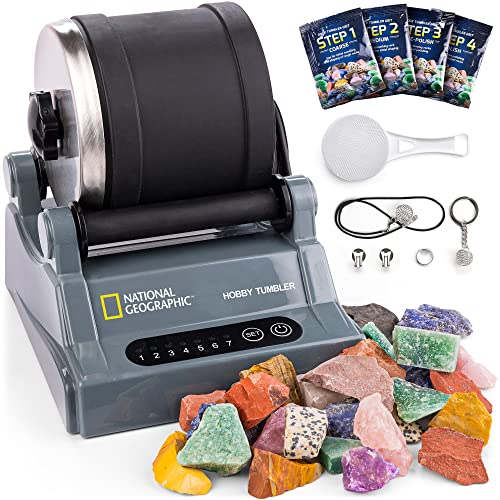
- Model NGHOBBYTUMBLER, made by JMW Sales (Blue Marble)
- Leak-proof rubber barrel with stainless steel lid
- Day timer with LED indicators and automatic shut-off
- Includes 1/2 lb rough gemstones, 4 grit grades, jewelry fastenings, strainer, and learning guide
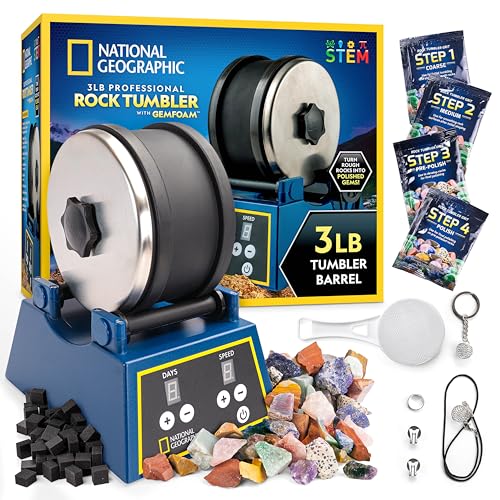
- Model NGTUMBLER3LB, made by JMW Sales (Blue Marble)
- 3 lb capacity barrel; sound-dampening rubber with stainless steel lid
- 3-speed motor with digital control panel
- 9-day timer (1 to 9 days) with automatic shut-off

- Single molded rubber barrel, 3 lb capacity
- 115 V continuous-duty motor with belt drive
- All-steel frame and housing; watertight barrel seal
- Machine only: grit, polish, media, and rough stone sold separately
All 5 Picks at a Glance
| Product | Specs | Action |
|---|---|---|
| 1. National Geographic Hobby Rock Tumbler Kit — Best Starter Kit for Kids and Families |
| Check price on Amazon |
| 2. National Geographic 3 Lb. Rock Tumbler Kit — Best Kit With Speed and Timer Control |
| Check price on Amazon |
| 3. Lortone 3A — Best Hobby Rotary Tumbler |
| Check price on Amazon |
 4. Lortone 33B — Best Double-Barrel Tumbler |
| Check price on Amazon |
 5. Raytech Tumble-Vibe 5 — Best Vibratory Finisher |
| Check price on Amazon |
Key takeaways
- Compare the best rock tumblers by barrel size, motor type, included grit stages and noise level, with step-by-step polishing notes for beginners.
As an Amazon Associate we earn from qualifying purchases.
A rock tumbler turns dull, rough stones into smooth, glossy pieces you can display, give away, or set into jewelry, and it does it with little more than water, grit, and patience. The machines fall into a few clear classes. Small starter kits bundle a compact barrel with rough stones and grit so a family can begin the same day. Hobby rotary tumblers use a 3 lb rubber barrel, run for weeks at a time, and are built to be repaired rather than replaced. Double-barrel models run two batches side by side. Vibratory tumblers shake a bowl instead of rolling a barrel and finish stones much faster, although they shape them far less.
This guide compares five machines, one for each of those roles: two National Geographic kits for beginners and kids, the long-running Lortone 3A and its double-barrel sibling the 33B, and the Raytech Tumble-Vibe 5 vibratory finisher. Read the How to Choose section before picking, because the honest timeline surprises most first-time buyers: a full batch takes weeks, not days.
Disclosure: This article contains affiliate links. If you make a purchase through these links, we may earn a commission at no extra cost to you.
How to Choose
Understand the four stages and the real timeline. Every batch moves through the same sequence: coarse grit shapes the stones and knocks off sharp edges, medium grit smooths the surfaces, pre-polish refines them, and polish brings out the shine. In a rotary barrel each stage usually runs about a week, and stage one often needs a second week for very rough material, so a complete batch takes roughly four to six weeks of near-continuous running. Vibratory machines compress the later stages to a few days each, but they barely round sharp corners, so angular rough still needs rotary time first. Any kit or listing that implies finished gems in a weekend is describing the first stage at best.
Fill the barrel correctly. Rotary barrels work best filled about one-half to three-quarters full with a mix of stone sizes, topped with water to just below the top of the load. An underfilled barrel lets stones crash and chip; an overfilled one barely tumbles at all, and the slurry just slides. Smaller stones and ceramic media fill the gaps between larger pieces, keep the load cushioned, and improve the grinding action, so most hobbyists keep a supply of media permanently in the rotation.
Plan for grit as a consumable. Grit is used up at every stage, and the amount a kit includes is normally enough for one or two batches. Rotary tumbling uses roughly a couple of tablespoons of grit per pound of barrel capacity at each stage, while vibratory machines use far less, often a spoonful at a time. Before buying a machine, confirm that standard silicon carbide grit and aluminum oxide polish fit your plans, and keep each stage’s grit in separate, labeled containers, because a single spoonful of coarse grit carried into the polish stage will scratch a nearly finished batch.
Match stones by hardness. Stones in one load should be of similar hardness, roughly the agate, jasper, and quartz family at Mohs 6.5 to 7 for beginners. Softer stones mixed into a hard load wear down to nothing and muddy the slurry, while one very hard stone can batter the rest. Sorting rough material before loading is the single easiest way to improve results.
Think about noise and placement before you buy. A tumbler runs day and night for weeks, so it lives where its sound bothers nobody: a garage, basement, laundry room, or workshop. Rubber barrels are markedly quieter than plastic ones because the rubber absorbs the clatter of stone on stone, and makers of the kits below quote large reductions compared with plastic barrels. Vibratory bowls make a different sound, a steady buzz that carries through floors, so keep them away from bedrooms.
Rotary versus vibratory, in short. Rotary barrels roll the load slowly, grinding stones against each other, which rounds shapes thoroughly and handles coarse grit well. Vibratory bowls shake the load at thousands of small movements per minute, rubbing grit across surfaces quickly while preserving the stone’s original outline, which suits slabs, cabochons, and stones already rounded in a rotary. Many experienced hobbyists own one of each: the rotary shapes, the vibratory finishes.
Look for repairable drive parts. On rotary machines the motor drives the barrel through a belt, and belts are wear items. A machine with a replaceable belt, an available spare barrel, and a motor built for continuous duty will outlast a sealed toy-grade unit many times over. A day timer with automatic shut-off is worth having on kits, because it ends each stage on schedule even when nobody is home to switch the machine off.
The 5 Best Rock Tumblers
1. National Geographic Hobby Rock Tumbler Kit — Best Starter Kit for Kids and Families
- Model NGHOBBYTUMBLER, made by JMW Sales (Blue Marble)
- Leak-proof rubber barrel with stainless steel lid
- Day timer with LED indicators and automatic shut-off
- Includes 1/2 lb rough gemstones, 4 grit grades, jewelry fastenings, strainer, and learning guide
The Hobby Edition kit is the classic first tumbler: everything needed for a first batch is in the box, including a half pound of rough gemstones in nine types, all four grades of tumbling grit, a strainer for rinsing between stages, jewelry fastenings for finished stones, and a full-color learning guide that walks through the geology as well as the process. The barrel is rubber rather than hard plastic, with a stainless steel lid and a leak-proof seal, and the maker states the rubber construction cuts the operating sound by about 75 percent compared with plastic barrels.
Controls are deliberately simple. A SET button chooses how many days the current stage runs, LED indicators show the setting, and the machine shuts itself off when the time is up, so a stage cannot accidentally run for a month. The belt drive includes a spare belt in the box. For a family testing whether the hobby sticks, this is the lowest-friction way in: set it up on a utility-room counter, load the included stones, and learn the four stages on material that came with the machine.
2. National Geographic 3 Lb. Rock Tumbler Kit — Best Kit With Speed and Timer Control
- Model NGTUMBLER3LB, made by JMW Sales (Blue Marble)
- 3 lb capacity barrel; sound-dampening rubber with stainless steel lid
- 3-speed motor with digital control panel
- 9-day timer (1 to 9 days) with automatic shut-off
This larger National Geographic kit keeps the all-in-one convenience of the Hobby Edition and adds the two controls experienced users ask for: a 3 lb barrel, three motor speeds, and a timer that runs up to nine days. The maker’s own stage chart shows why the speeds matter. Coarse grit runs fastest for three to five days to shape the stones, medium grit runs at the middle speed for six to eight days, and the pre-polish and polish stages run slowest for up to ten days, which is gentler on nearly finished surfaces.
The box is generous: three pounds of assorted rough gems across nine varieties, the full four-stage grit set, a strainer, five jewelry settings, and GemFoam finishing pads for the final shine. The barrel is sound-dampening rubber with a stainless steel lid and a leak-proof seal, driven by a belt, and a spare belt is included. For older kids and adults who want a kit but already suspect they will take the process seriously, this is the version that does not need replacing after the first batch.
3. Lortone 3A — Best Hobby Rotary Tumbler
- Single molded rubber barrel, 3 lb capacity
- 115 V continuous-duty motor with belt drive
- All-steel frame and housing; watertight barrel seal
- Machine only: grit, polish, media, and rough stone sold separately
The Lortone 3A is the machine the kits graduate to. It is a single-barrel rotary tumbler with a 3 lb molded rubber barrel, an all-steel frame and housing, and a 115 V motor driving the barrel through a belt, all built for continuous running measured in weeks per batch and years of service. The molded rubber barrel seals watertight with a knurled nut closure, runs quietly, and is gentle on stones compared with rigid plastic drums.
There are no timers, speeds, or electronics to fail: you load the barrel, set it on the rollers, and let it turn. That simplicity is the point. Belts and barrels are standard replacement parts, and the design has been in production for decades, so a 3A bought today can be kept running with ordinary spares. Note that this is the machine only, with no grit, polish, or rough stone included, so plan on a first supply of coarse grit and polish alongside it. For a kit owner whose interest survived the first batch, it is the standard upgrade.
4. Lortone 33B — Best Double-Barrel Tumbler
- Two molded rubber barrels, 3 lb each; 6 lb total capacity
- Lortone model 004-091
- Single 115 V motor drives both barrels; belt drive
- All-steel frame; each barrel seals independently
The 33B mounts two 3 lb molded rubber barrels on one frame with one motor, giving 6 lb of total capacity split into two independent loads. That layout solves the rotary tumbler’s biggest scheduling problem: instead of waiting for a barrel to finish before beginning the next batch, you can run coarse grit in one barrel and a finer stage in the other, keep delicate stones separate from hard ones, or simply double the amount of rough moving through stage one, which is where most of the waiting happens.
Each barrel seals on its own with the same watertight closure as the 3A, and the drive is the same belt arrangement on an all-steel frame, so maintenance habits and spare parts carry over from the single-barrel machine. The footprint stays modest for the capacity, roughly the size of a small bench vise area rather than a second workstation. If your rough-rock supply keeps growing faster than one barrel can process it, or you want a polish-stage barrel that never touches coarse grit, the 33B is the natural step up from the 3A.
5. Raytech Tumble-Vibe 5 — Best Vibratory Finisher
- Vibratory bowl design; 8-inch bowl diameter, 3-3/4 inch bowl height
- Working capacity 0.05 cu ft (3 pints), about 4 lb including media
- 115 V, 60 Hz motor; 0.9 A, 50 W, 0.07 HP
- Maker lists about 82 dB operating noise for the TV-5 rock kit
The TV-5 takes the opposite approach to the barrels above: an 8-inch bowl vibrates the load in a tight circulation, rubbing a thin film of grit across the stones. The result is that medium, fine, and polish stages that take about a week each in a rotary can finish in a few days each here, and the stones keep more of their original shape, which is exactly what you want for slabs, cabochons, and pieces with detail worth preserving. The trade-off is real: a vibratory bowl does almost no rounding, so angular rough should spend its coarse stage in a rotary barrel first.
Working capacity is about 4 lb including media, in a 0.05 cubic foot (3 pint) bowl, driven by a 115 V, 60 Hz motor drawing 0.9 A. Raytech publishes a noise figure of about 82 dB for its TV-5 rock kit, so this is a garage or basement machine despite its small size. The maker also advises against running steel shot in the bowl. Paired with a 3 lb rotary such as the Lortone 3A, the TV-5 turns a six-week hobby into a routine where finished stones appear every week or so, and keeping its bowl dedicated to later stages protects polish from stray coarse grit.
FAQ
How long does one batch of rocks take from start to finish?
In a rotary tumbler, plan on about four to six weeks: roughly a week each for the coarse, medium, pre-polish, and polish stages, with the coarse stage sometimes repeated. A vibratory finisher shortens the last three stages to a few days each, but angular rough still needs its shaping time in a rotary barrel first.
Can I tumble different kinds of stones together?
Only stones of similar hardness belong in the same load. Agate, jasper, and quartz (about Mohs 6.5 to 7) tumble well together. Softer stones in a hard load wear away quickly and cloud the slurry, and a single much harder stone can chip the rest of the batch.
What should I do with the gray slurry when a stage ends?
Never pour tumbling slurry down a household drain; the fine rock flour settles in pipes and can harden into a blockage. Rinse stones over a bucket or outdoors strainer instead, let the solids settle and dry, and dispose of the dried residue with household trash.
How much grit will I use, and does the kit supply enough?
Kit grit is normally enough for the first batch or two. After that, expect to reorder: rotary barrels use roughly two tablespoons of grit per pound of capacity at each stage, while vibratory bowls use much less, around half an ounce per pound of rock. Keeping spare coarse grit on hand matters most, because stage one is the stage most often repeated.
Conclusion
For a first machine, the choice is about commitment. Families and kids should begin with the National Geographic Hobby Rock Tumbler Kit, which arrives with stones, grit, and a timer that forgives forgetfulness. Buyers who want kit convenience with room to grow should pick the National Geographic 3 Lb. kit for its larger barrel, three speeds, and nine-day timer. Hobbyists ready for a machine that lasts should go straight to the Lortone 3A, and those already feeding a growing pile of rough rock should choose the double-barrel Lortone 33B so two stages or two batches always run at once. Finally, anyone who owns a rotary and dislikes the wait should add the Raytech Tumble-Vibe 5 as a finisher: it will not shape rough stones, but it turns the slow final stages into a matter of days.
More from Amazon
Programs that pair well with the guide above. Offers and eligibility are set by Amazon and may change.
Free shipping on eligible items, Prime Video and more. Eligible new members can start with a free trial.
Start a Prime free trialAd-free music streaming. Eligible new subscribers can start with a free trial.
Try Music Unlimited freeA Prime membership for ages 18-24 with a trial period. Eligibility is set by Amazon.
See Prime for Young AdultsAudiobooks and podcasts to listen to on the go. Eligible new members can start with a free trial.
Try Audible freeAs an Amazon Associate we earn from qualifying purchases.