Key takeaways
- Compare the best box fans by airflow design, speeds and carry handle, with guidance on window and floor fans for bedrooms, garages and workshops.
As an Amazon Associate we earn from qualifying purchases.
A box fan is the simplest air mover in the house: a square frame, one wide blade, and a knob. That simplicity is exactly why the details matter. Depth decides whether a fan actually sits in a window opening, airflow figures decide whether it exchanges the air in a garage or just stirs it, and construction decides whether it survives workshop dust. The five fans below cover the main jobs: an everyday three-speed fan, a model the maker lists for window placement, a commercial-grade fan for workshops, a slim fan marketed around quieter speeds for bedrooms, and a fan built to carry an air filter. Every figure below comes from the makers’ own listings, manuals, and specification sheets, and where a maker publishes no number, this guide says so.
One honesty note before the picks: a fan does not lower the temperature of a room. Moving air speeds evaporation from skin, so people in the airstream feel cooler, and a window fan can swap indoor air for outdoor air. A fan running in an empty room only uses electricity.
Disclosure: This article contains affiliate links. If you make a purchase through these links, we may earn a commission at no extra cost to you.
Our top picks
How to Choose a Box Fan
Match the frame to the opening. Most box fans are built around a 20-inch blade, but frame depth varies from about 3.5 inches to more than 6 inches. A shallow frame seats into a window opening and stays put; a deep frame is steadier on the floor but can wobble in a sash. Measure the window track and the sill before buying, and check whether the maker lists window placement at all.
Decide on intake or exhaust before you place it. A window fan facing inward pulls outdoor air into the room, which helps most in the evening when outside air is cooler than inside air. Turned to face outward, the same fan exhausts warm indoor air, and an open window or door elsewhere in the home becomes the intake. Exhaust works well for kitchens and workshops. Either way, block the gaps around the frame with the sash and any filler panels: air that slips around the sides is air the fan moved for nothing.
Read airflow figures as maker figures. Brands publish airflow in cubic feet per minute (CFM), air speed in feet per second, or both, and there is no single test setup behind every number in this category. Treat CFM as a rough comparison within a maker’s own line and a loose guide across brands. For scale, fans in this guide list between about 2,000 and 2,400 CFM at the top speed.
Weigh the noise claims carefully. A decibel figure only means something when a maker states it for a specific speed, and many listings publish none. Where a maker does state one, this guide repeats it as stated. Low speed on any fan here is the bedroom setting; top speed on a 20-inch fan is audible through a door. If a listing promises silence, be skeptical.
Check the safety label and the plug. Look for ETL or UL listing. Several makers fit a fused plug that cuts power if the motor overheats, worth having on a fan that runs unattended in a window. Keep cords out of walkways, never run a fan with a damaged cord, and vacuum the grilles when dust builds up, because a dust-choked intake makes the motor work harder and move less air.
Check older fans against recall notices. This category has a real recall history. The U.S. Consumer Product Safety Commission announced recalls of Lasko and Galaxy box fans with model numbers including 3720, 3723, and 3733, covering units made in the early 2000s, because an electrical failure in the motor could pose a fire hazard. Before running any older box fan, read the model number on its label and compare it with the notices on the CPSC website. Every fan below was checked by exact model number against those records, and none of the five appears in them.
Be careful with filters. Taping a furnace filter to the back of an ordinary box fan is a popular project, but the added resistance makes a motor pull air through a barrier it was not designed for, and airflow drops. Only one fan in this guide is built to carry a filter. For the others, use them as fans.
1. Genesis 20-Inch Box Fan (G20BOX-BLK) — The Classic Three-Speed
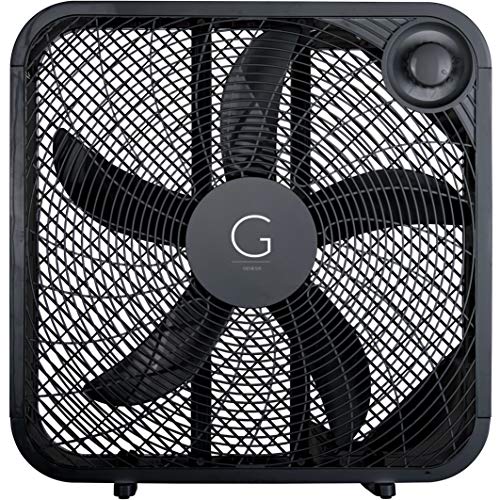
The Genesis is the plain box fan in its most familiar form: a 20-inch blade in a square frame, a rotary knob on top with off and three speeds, and a carry handle molded into the case. It asks for no assembly beyond finding an outlet, which is the entire appeal of the format. The frame is a slim 4.5 inches deep, so it stores flat and sits neatly on a dresser or wide sill.
Genesis fits a copper motor and, more unusually at this end of the category, a fused plug with overload protection: if the motor overheats, the fuse cuts power. The fan is ETL listed. The maker lists a modest 53 watts of draw and a weight of just over 8 pounds. Genesis publishes no CFM figure for this model, so judge it as a general-purpose room fan rather than a measured air exchanger. For a spare bedroom, a dorm, or a first fan for a small apartment, this is the straightforward pick.
Specs
- Model: G20BOX-BLK; 20-inch blade in a frame about 20 x 20 inches
- Speeds: 3, selected by a top-mounted rotary knob
- Motor: copper motor; fused plug with overload safety protection, per the maker
- Frame depth: 4.5 inches; weight 8.13 pounds, per the maker’s specification table
- Power: 120 volts, 53 watts listed; ETL listed
- Carry handle molded into the top of the frame
View the Genesis 20-Inch Box Fan on Amazon
2. PELONIS 20-Inch Box Fan (PSFB50M1WWV) — Listed for Window Placement

PELONIS is one of the few makers that lists window placement directly alongside floor and tabletop use, which makes it the natural pick for a window-first buyer. The frame is about 5.6 inches deep, and the fan is light with a built-in handle, so moving it between a window and the floor as the day changes is a one-hand job.
The listing states up to 2,295 CFM of airflow and an air speed of 25 feet per second from five blades, driven by a copper motor at a listed 55 watts. PELONIS states a noise level of 25 decibels in its listing specifications; treat that as the maker’s figure for its quietest running rather than a promise for all three speeds. In a window, run it facing outward during the hot part of the day to push warm air out, then turn it around in the evening to draw cooler air in, and close the sash down onto the frame so air cannot slip around the edges.
Specs
- Model: PSFB50M1WWV; 20-inch blade, 5 blades
- Placement: floor, tabletop, or window, per the maker
- Airflow: up to 2,295 CFM and 25 feet per second air speed, per the listing
- Speeds: 3, manual controls; copper motor
- Power: 55 watts listed; noise level stated as 25 decibels in the listing specifications
- Dimensions: about 20.6 x 5.6 x 21.3 inches; built-in carry handle
View the PELONIS 20-Inch Box Fan on Amazon
3. Air King 9723 — Commercial Build for Workshops and Garages

Air King sells the 9723 as a commercial fan, and the specification sheet backs that up. The body is steel, the grilles are impact-resistant plastic, and the blade is chemical-resistant polypropylene, a combination aimed at spaces where a fan gets bumped, splashed, and left running. The maker lists compliance with ETL and OSHA requirements, a line that rarely appears on household models.
Output is the highest in this guide on paper: Air King’s sheet lists 2,163 CFM on high, 1,463 CFM on low, with sound levels of 60, 55, and 51 dBA across the three speeds, stated by the maker. The motor is a permanently lubricated 1/25 horsepower unit, so there is no oiling routine to keep up with, and it draws 105 watts on high. The 6-foot, 3-conductor cord is longer and heavier than most household fan cords, which helps when the only outlet is across a bench. At roughly 11 pounds with a deep 6.38-inch frame, this is a floor fan for a garage, basement, or shop rather than a window fan, and it is the pick when a fan has to move dusty air all day, every day.
Specs
- Model: 9723; 20-inch commercial grade box fan
- Airflow: 2,163 CFM on high and 1,463 CFM on low, per the maker’s specification sheet
- Motor: 3-speed, 1/25 HP, permanently lubricated, 120 volts
- Construction: steel body, impact-resistant grilles, chemical-resistant polypropylene blade
- Sound: 60, 55, and 51 dBA by speed, per the maker’s specification sheet; 105 watts on high
- Cord: 6-foot, 3-conductor; ETL listed and OSHA compliant, per the maker; about 11 pounds
View the Air King 9723 on Amazon
4. Hurricane Classic 20-Inch Box Fan (HGC736501) — Slim Frame, Quieter Speeds

The Hurricane Classic is the slim one in this guide: the listing describes a frame about 3.5 inches deep, which helps it sit in a window opening. Hurricane markets the fan around quiet running, describing its three speeds as quiet speeds in the listing itself, which is why it lands in the bedroom slot here.
It is not short on output. The maker lists 2,400 CFM of airflow and a top blade speed of 1,100 RPM, the strongest airflow figure in this guide. A 6-foot cord and a weight of about 7 pounds make it the easiest fan here to relocate, and adjustable feet help it sit level on uneven floors. Hurricane publishes no decibel figure in the material gathered for this guide, so the honest summary is that the maker designs and describes this fan for quieter operation, and low speed at night is how any box fan earns a place in a bedroom. Choose it for a bedroom or any room where the fan needs to sit in a window and stay out of the way.
Specs
- Model: HGC736501; 20-inch box fan with polymer blades
- Airflow: 2,400 CFM listed by the maker; top speed 1,100 RPM
- Speeds: 3, described in the listing as quiet speeds
- Frame: about 3.5 inches deep; about 7 pounds
- Cord: 6-foot power cord; carry handle
- Adjustable stabilizing feet, per the maker
View the Hurricane Classic 20-Inch Box Fan on Amazon
5. Lasko Air Flex FF305 — The Box Fan Built to Carry a Filter
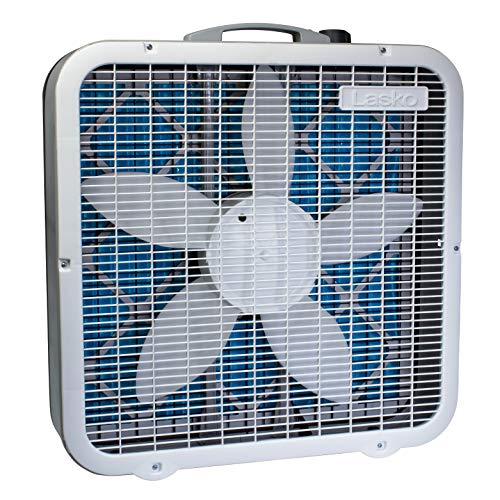
The Air Flex is the extra-features pick, and the feature is filtration done properly. Unlike an ordinary fan with a filter strapped to it, the FF305 is designed by Lasko around a standard 20 x 20 x 1-inch filter: a MERV 10 pleated filter is included, it slides into a slot on the back of the unit, and the maker lists that filter at 42 CADR. Replacements are the same standard filter size sold for home heating and cooling systems. It cleans the air passing through it in one room; it is not a substitute for a home filtration system.
Lasko is specific about limits, and they are worth repeating: the manual recommends MERV 8 to MERV 10 filters, warns that a much higher MERV filter can reduce airflow and strain the motor, and puts filter replacement at every two to four months depending on use. As a fan, the Air Flex lists 2,000 CFM across three speeds from a five-blade design, with a steel body, a weather-resistant motor the maker calls Weather-Shield, and the fused safety plug Lasko fits across its line. Pick it for a workshop corner, a pet room, or anywhere dust hangs in the air and a plain fan would just move the dust around.
Specs
- Model: FF305; 20-inch 2-in-1 box fan and air cleaner, per the maker
- Filter: MERV 10 pleated filter included, listed at 42 CADR by the maker; accepts standard 20 x 20 x 1-inch filters
- Airflow: 2,000 CFM listed; 3 speeds; 5 blades
- Construction: steel body; Weather-Shield motor for window use, per Lasko
- Power: 120 volts, 100 watts; fused safety plug
- Dimensions: about 6.36 x 21.3 x 23.2 inches; about 11 pounds
View the Lasko Air Flex FF305 on Amazon
Frequently Asked Questions
Should a window box fan face inward or outward?
Both directions have a job. Facing outward, the fan exhausts warm indoor air, which suits kitchens, workshops, and the hottest hours of the day. Facing inward, it pulls in outdoor air, which works best in the evening when outside air is cooler than the air inside. Whichever direction you choose, close the sash onto the frame and block side gaps, because leaks around the fan undo much of its work.
Does a box fan actually cool a room?
No. A fan cools people, not rooms: moving air speeds evaporation from skin, which feels like a temperature drop to anyone sitting in the airstream. The exception is a window fan exchanging air, which can bring a room toward the outdoor temperature. A box fan running in an empty closed room changes nothing but the electricity meter, so switch it off when you leave.
Can I attach a furnace filter to any box fan?
Only one fan in this guide is built for that. The Lasko Air Flex has a filter slot and a motor specified by its maker for standard 20 x 20 x 1-inch filters, and even Lasko warns against filters above MERV 10 because they cut airflow and strain the motor. Strapping a filter to an ordinary box fan adds resistance its motor was not designed for and sharply reduces the air it moves.
How can I tell if an old box fan is one of the recalled ones?
Read the model number on the label, then compare it with the recall notices on the CPSC website. The best-known box fan recalls cover Lasko and Galaxy models including 3720, 3723, and 3733 made in the early 2000s, recalled because a motor electrical failure could pose a fire hazard; the remedy offered was a free fused plug adapter from Lasko. If a secondhand fan matches a notice, stop using it and follow the remedy in the notice.
Conclusion
For most households, the Genesis is the box fan to buy first: three speeds, a fused plug, a slim frame, and nothing to figure out. If the fan will live in a window, the PELONIS is the one whose maker lists window placement outright, with strong stated airflow for pulling in evening air. Workshops and garages should go straight to the Air King 9723, whose steel body, sealed motor design, and commercial compliance listing suit dusty, hard-use spaces. Bedrooms are better served by the Hurricane Classic, the slimmest fan here and the one its maker describes around quieter speeds. And if the point is cleaner air in one room rather than just moving air, the Lasko Air Flex FF305 is the only pick designed from the start to carry a filter. Whichever you choose, vacuum its grilles now and then, and check any older fan in the house against the CPSC recall list.
More from Amazon
Programs that pair well with the guide above. Offers and eligibility are set by Amazon and may change.
Free shipping on eligible items, Prime Video and more. Eligible new members can start with a free trial.
Start a Prime free trialAd-free music streaming. Eligible new subscribers can start with a free trial.
Try Music Unlimited freeA Prime membership for ages 18-24 with a trial period. Eligibility is set by Amazon.
See Prime for Young AdultsAudiobooks and podcasts to listen to on the go. Eligible new members can start with a free trial.
Try Audible freeAs an Amazon Associate we earn from qualifying purchases.