Key takeaways
- Compare the best calligraphy pens for hand lettering, with nib styles, ink flow, brush tips, and left-handed options for smooth strokes on practice paper.
As an Amazon Associate we earn from qualifying purchases.
Calligraphy looks complicated from the outside, but the tools fall into a few clear families, and each family suits a different kind of lettering. Broad-edge pens draw the thick-and-thin contrast of Italic and Gothic scripts automatically, because the flat nib makes wide strokes in one direction and hairlines in the other. Pointed pens and brush pens work the opposite way: the line swells when you press down and narrows when you lift, which is how Copperplate and modern brush lettering get their flowing look. Choosing well is mostly about matching the tool to the script you want to write, then picking a nib size that fits the size of lettering you plan to produce.
The five calligraphy pens below cover the main routes into the craft: a classic dip pen set with interchangeable nibs, a refillable broad-edge fountain pen system, a brush pen set for pressure-based lettering, a complete beginner kit with ink and practice materials, and a marker set that needs no ink handling at all. Read the guidance first, then pick the format that matches your goals.
Disclosure: This article contains affiliate links. If you make a purchase through these links, we may earn a commission at no extra cost to you.
Our top picks
How to Choose Calligraphy Pens
Start with the script, because the script dictates the tool. Italic, Foundational, Uncial, and Gothic or Blackletter alphabets are broad-edge styles: they are built from a flat nib held at a consistent angle, usually around 30 to 45 degrees, so the pen creates the contrast between thick downstrokes and thin cross strokes. Dip pens with flat nibs, calligraphy fountain pens with stub or italic nibs, chisel-tip markers, and parallel-plate pens all serve this family. Copperplate and Spencerian are pointed-pen styles: a flexible pointed nib spreads under pressure on the downstroke and closes to a hairline on the upstroke. Modern brush lettering follows the same pressure logic with a flexible brush tip instead of a metal point.
Nib width controls letter size more than most beginners expect. Broad-edge lettering is traditionally scaled to the nib: an Italic x-height of about five nib widths is a common working rule, so a 1.5 mm nib produces small letters suited to cards and journal pages, while a 3.8 mm or 6 mm nib writes large display lettering for posters and envelopes. A set with several widths lets you match the pen to the project instead of forcing every project to fit the pen. Pointed nibs work differently: flexibility matters more than size, and a nib that opens easily under light pressure suits small, delicate script.
Ink systems are the next decision. Dip pens use bottled ink directly, which gives the widest ink choice and the crispest lines, but there is no reservoir, so you dip every few words. Fountain pens carry ink inside, either in disposable cartridges or through a converter that draws from a bottle; cartridges are tidy and travel well, while converters open up the full bottled-ink shelf. Ink chemistry matters too. Dye-based inks flow smoothly and come in many colors, but most are not waterproof and can feather on soft, unsized paper. Pigmented and waterproof inks resist water once dry, which suits finished pieces, but they demand more careful cleaning because dried pigment is harder to flush from a feed or nib. Paper is half the equation either way: smooth, well-sized practice paper with printed guidelines keeps ink on the surface and your letter heights honest, while rough or absorbent stock will wick almost any ink into fuzzy edges.
Left-handed writers should look for two specific things. For pointed-pen work, an oblique holder angles the nib so the point aims up the page without forcing the wrist into a hook, and many left-handers find it far more comfortable than a straight holder. For broad-edge work, left-oblique nibs, ground so the edge slants the other way, let an underwriting left-hander keep the standard nib angle; turning the paper sharply also works with ordinary nibs and is worth trying first.
Finally, plan for practice realities. Calligraphy is a slow-stroke skill: letters are drawn at a pace that lets you watch the nib, not written at note-taking speed, and short daily sessions on guideline paper build consistency faster than occasional long ones. Nibs and feeds need rinsing after sessions, because dried ink is the main cause of scratchy, skipping strokes.
1. Speedball Basic Calligraphy Set — The Classic Dip Pen Route

The Speedball Basic Calligraphy Set is the traditional entry point to dip pen lettering, built around one holder and six interchangeable nibs. Four of the nibs are C-style broad-edge nibs in sizes C1 through C4, the flat, chisel-shaped points used for Italic, Roman, and Gothic alphabets, with the smaller numbers writing the wider lines. The remaining two are pointed pen points, the No. 101 and No. 512, which flex under pressure for finer script work and ornamental detail. Swapping nibs is a simple pull-and-push job, so one holder covers both lettering families.
Because it is a dip pen, there is no cartridge or reservoir: you dip the nib into bottled ink, and the nib’s reservoir holds enough for a few words at a time. That rhythm slows you down in a good way, and the set works with any dip-safe bottled ink. The honest trade-off is that ink is not included, so a bottle of calligraphy ink is a necessary companion purchase, and the setup is desk-bound rather than portable.
Specs
- Set contents: 6 nibs plus 1 pen holder, 7 pieces total
- Broad-edge nibs: C-style C1, C2, C3, and C4 for Italic, Roman, and Gothic lettering
- Pointed nibs: No. 101 and No. 512 pen points for fine script and ornament
- Model number: 2961
- Ink: bottled dip ink required, not included
2. Pilot Parallel Calligraphy Pen Set — Broad-Edge Fountain Pens in Four Widths

The Pilot Parallel set takes a different approach to broad-edge lettering. Instead of a single flat nib, each pen uses two parallel plates, a design that keeps both corners of the stroke sharp and lets the pen write cleanly even at the very edge of the nib, which is useful for decorative touches and precise serifs. The set includes all four nib widths in the range — 1.5 mm, 2.4 mm, 3.8 mm, and 6.0 mm — so it spans everything from small, neat Italic for cards to bold display strokes for titles and signage.
Each pen fills with Pilot ink cartridges, and the set includes a bonus ink cartridge pack, so the pens arrive ready to write. A distinctive feature of the parallel plate design is color blending: touching the nib of a pen loaded with one color to the nib of a pen loaded with another transfers ink, producing gradient strokes as the colors work through. The pens are refillable and cleanable, and because they are capped fountain-pen-style tools, they travel far better than an open ink bottle and dip holder.
Specs
- Set contents: 4 calligraphy pens plus bonus ink cartridge pack
- Nib widths: 1.5 mm, 2.4 mm, 3.8 mm, and 6.0 mm
- Nib design: parallel plate nib for sharp-edged broad strokes
- Fill system: Pilot ink cartridges, refillable
- Model number: P9005SET
3. Tombow Dual Brush Pen Art Markers, Bright 10-Pack — Brush Lettering Without Ink Bottles
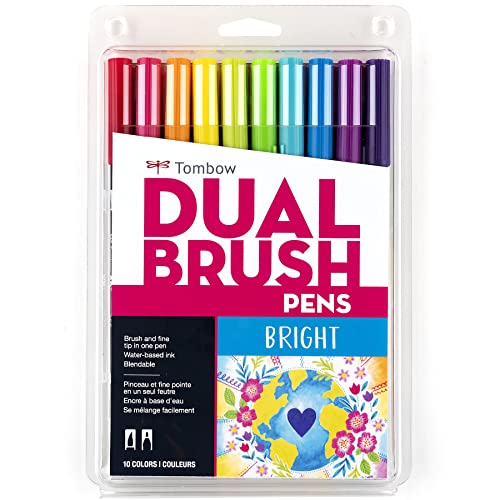
Brush lettering gets its thick-and-thin contrast from pressure rather than from a flat edge, and the Tombow Dual Brush Pens are the most widely used tool for learning it. Each pen pairs a flexible nylon brush tip, which lays down a fine line on the upstroke and a broad stroke when you press on the downstroke, with a firm fine tip at the other end for monoline lettering and detail work. One barrel therefore handles a headline and its supporting text.
The Bright set includes ten pens: nine colors plus a colorless blender that softens edges and merges shades where strokes overlap. The ink is water-based and blendable, so colors can be mixed directly on the tip or on a palette for gradient lettering, and the nylon brush tip is resilient, springing back to its point after strokes instead of splaying. There is no dipping, filling, or cleaning, which makes these pens easy to use at a desk, in a journal, or away from home. The limitation is scope: brush pens write brush scripts only, so they will not produce true broad-edge Italic or Gothic forms, and the large brush tip suits medium-to-large lettering better than tiny script.
Specs:
– Set contents: 10 dual-tip pens, 9 colors plus 1 colorless blender
– Tips: flexible nylon brush tip and fine tip in each pen
– Ink: water-based, blendable, odorless
– Model number: 56185
– Use: hand lettering, journaling, illustration, and coloring
4. Staedtler Calligraphy Pen Set, 33-Piece — The Complete Beginner Kit

The Staedtler Calligraphy Pen Set is the pick for a beginner who wants everything in one tin: pens, nibs, ink, guidance, and practice paper. It contains four fountain pens with comfort grips and five interchangeable nibs graded Extra Fine, Fine, Medium, Broad, and Extra Broad, and any nib fits any of the four pen bodies, so you can keep several widths loaded and ready. The nibs are broad-edge in character, aimed at Italic-style and decorative alphabets rather than pointed-pen scripts.
Ink is covered generously. Twenty water-based dye ink cartridges come in seven colors — black, blue, brown, pink, green, orange, and yellow — and a metal pump converter is included for anyone who wants to move on to bottled ink later. The structured learning materials set this kit apart: an instruction book walks through the letterforms, and a practice paper pad gives you the guided lines that make early progress measurable. Everything stores in a fitted metal tin. The dye inks are not waterproof, so finished pieces should be kept dry, but as a guided, self-contained first setup it is the most complete option here.
Specs
- Set contents: 33 pieces in a metal storage tin
- Pens and nibs: 4 fountain pens, 5 interchangeable nibs from Extra Fine to Extra Broad
- Ink: 20 water-based dye cartridges in 7 colors, plus a metal pump converter for bottled ink
- Learning materials: instruction book and practice paper pad included
- Dimensions and weight: 9.2 x 1.3 x 6.6 inches, 1.01 pounds
5. Speedball Elegant Writer Calligraphy Marker Set — No-Mess Chisel Tips

The Elegant Writer set strips calligraphy down to the simplest possible form: four markers with chisel tips in graduated sizes, covering fine, medium, and broad points plus a scroll tip that draws a double line. You uncap a marker and write, with no ink bottle, no nib fitting, and nothing to rinse afterward, which makes the set practical for classroom practice, quick envelope addressing, and place cards.
The ink is black, water-based, acid-free, and non-toxic, and an instruction booklet is included to introduce the basic strokes and letterforms. The chisel tips hold a consistent edge, so the thick-and-thin structure of Italic-style lettering appears as long as you keep the marker at a steady angle, exactly the habit a beginner needs to build. The trade-offs are the fixed ones of any marker: the tips wear with heavy use, the pens are not refillable, and black is the only color in the set.
Specs
- Set contents: 4 chisel-tip calligraphy markers, black
- Tip sizes: assorted fine, medium, broad, and scroll points
- Ink: water-based, acid-free, non-toxic
- Extras: calligraphy instruction booklet included
- Format: disposable markers, no filling or cleaning required
Frequently Asked Questions
Which type of calligraphy pen is easiest for a complete beginner?
Broad-edge tools are the most forgiving place to begin, because the flat nib creates thick and thin strokes automatically once you hold a steady angle; you focus on letter shapes instead of pressure control. A chisel-tip marker set or a guided fountain pen kit removes ink handling from the equation as well. Pointed-pen and brush lettering are equally learnable, but they add pressure control as a second skill from day one, so expect a slower first few weeks.
What nib size should I choose for Italic lettering?
Match the nib to the size of lettering you want. Italic is usually written with an x-height near five nib widths, so a 1.5 mm nib suits cards, journals, and envelope addresses, a 2.4 mm nib is a versatile middle for everyday practice, and 3.8 mm or wider nibs are for titles and display work. If you are unsure, a mid-width nib around 2 mm to 2.5 mm is the most flexible single choice, and sets with several widths remove the guesswork entirely.
Can left-handed writers do calligraphy comfortably?
Yes, with the right setup. For pointed-pen scripts, an oblique holder angles the nib toward the top of the page so a left-hander can write with a straighter wrist. For broad-edge scripts, left-oblique nibs exist for underwriters, and many left-handed writers simply rotate the paper and use standard nibs. The one approach that usually fails is copying a right-handed grip exactly, so expect to experiment with paper angle during the first sessions.
How do I stop ink from bleeding or feathering on the page?
Feathering is usually a paper problem before it is an ink problem. Smooth, well-sized paper made for fountain pens or calligraphy practice keeps dye ink sitting on the surface with crisp edges, while soft notebook paper and cardstock with loose fibers wick ink outward. Writing more slowly with less pressure also reduces the ink load per stroke. If you need waterproof lines for finished pieces, choose pigmented ink and clean the pen promptly after each session, since dried pigment is stubborn to remove.
Conclusion
Each format here serves a different writer. Choose the Speedball Basic Calligraphy Set if you want the traditional dip pen experience with a full spread of broad-edge and pointed nibs. Choose the Pilot Parallel set if broad-edge scripts are your focus and you want four precise widths in clean, cartridge-fed pens. Choose the Tombow Dual Brush Pens for modern brush lettering and journal work with zero ink management. Choose the Staedtler 33-piece set if you are starting from nothing and want pens, nibs, ink, and guided practice in one tin. And choose the Speedball Elegant Writer markers for the simplest possible practice tool, at a desk or in a classroom, with nothing to fill or clean. Whichever route you take, pair it with smooth guideline paper and short, regular practice sessions.
More from Amazon
Programs that pair well with the guide above. Offers and eligibility are set by Amazon and may change.
Free shipping on eligible items, Prime Video and more. Eligible new members can start with a free trial.
Start a Prime free trialAd-free music streaming. Eligible new subscribers can start with a free trial.
Try Music Unlimited freeA Prime membership for ages 18-24 with a trial period. Eligibility is set by Amazon.
See Prime for Young AdultsAudiobooks and podcasts to listen to on the go. Eligible new members can start with a free trial.
Try Audible freeAs an Amazon Associate we earn from qualifying purchases.