Key takeaways
- Compare the best keyboard stands for digital pianos and synths, with X, Z, and table styles plus height ranges and capacities explained in detail.
As an Amazon Associate we earn from qualifying purchases.
A keyboard stand does more than hold an instrument off the floor. It sets the height your wrists work at, decides whether your knees and pedals have room underneath, and determines how steady a heavy stage piano feels when you play hard. A stand that flexes or creeps sideways turns practice into a distraction, and one that only adjusts in tall steps can leave you hunched or reaching. Each of the main frame styles suits a different kind of player and instrument.
The five picks below cover the main shapes musicians choose between: a pre-assembled double-X frame, a classic single-X from a major instrument maker, a Z-style frame with independent height and width adjustment, a flat platform table for heavy instruments, and a two-tier Z frame for players running a pair of keyboards. Every figure quoted comes from what the maker publishes about its own stand, and load capacities are always credited to the maker rather than treated as a promise. Match your instrument’s weight and key count against those figures first, and the right frame usually becomes clear.
Disclosure: This article contains affiliate links. If you make a purchase through these links, we may earn a commission at no extra cost to you.
Our top picks
How to Choose
Start with the frame style. A single-X stand uses one pair of crossed legs, which keeps it light, narrow when folded, and quick to carry, but the single pivot can feel less planted under a heavy instrument. A double-X stand adds a second pair of crossed legs, spreading the load across a wider, steadier base at the expense of extra weight and bulk. Z-style stands move the support to two upright legs at the sides, leaving the middle open for your knees, a sustain pedal, or a full pedal unit, and they usually let you set height and width independently. A platform or table stand replaces crossed legs with a flat top on four legs, which suits very heavy instruments and doubles as a surface for mixers or other gear.
Height range is the second check. Most seated players want the top of the white keys somewhere around the height of a piano keyboard, and standing players need considerably more. X-style stands tie height and width together: as the stand goes lower it gets wider, and as it rises it narrows, so a very tall setting can leave the support arms close together under a wide instrument. Z and platform stands adjust height without changing their footprint, which is why they often feel steadier at extremes. Check the stated range against both your seated and standing positions if you play both ways.
Load capacity comes third, and it deserves a careful read. Makers state these figures themselves, and they vary widely even between stands that look similar. Weigh your instrument or find its weight in its own manual, then leave a comfortable margin under the maker’s stated limit, especially if you play with force or lean on the keys. A stand run near its limit is also more likely to feel springy at tall settings.
Finally, look at the details that differ between listings: whether the arms carry padding or straps to keep the instrument from sliding, whether the feet adjust for uneven floors, whether the frame folds flat or breaks into pieces for transport, and whether a second tier is included, optional, or unavailable. Key count matters here too, since a stand listed for 54 to 88 keys sets its arms wider than one built around 61-key portables.
1. RockJam Xfinity Double-X Keyboard Stand (XX-363)
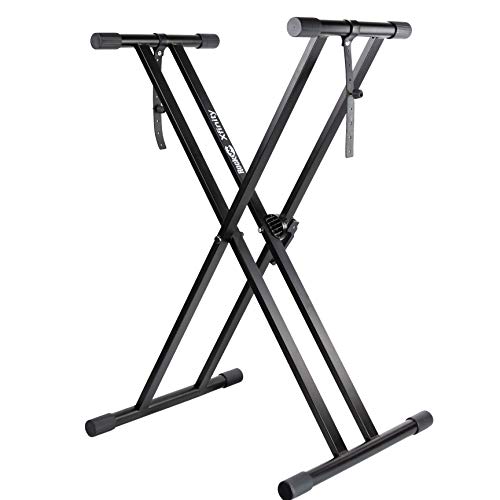
The Xfinity is the double-brace entry in this group, built around a double-X steel alloy frame that RockJam ships pre-assembled and pre-welded, so there is nothing to bolt together before the first session. Its headline feature is the adjustment mechanism: instead of a row of fixed notches, it moves through a continuous range, and RockJam states the height can be set anywhere between 4 and 38 inches. That spread covers a child seated at a first keyboard through an adult playing standing, and the fine adjustment makes it easier to match a bench you already own. A quick-release mechanism handles setup and takedown, and the frame folds for storage.
RockJam positions the Xfinity for digital keyboards from 54 to 88 keys, and locking straps are included to secure the instrument to the support arms, with non-slip rubber end caps at the contact points. One figure needs stating plainly: RockJam puts the load capacity at 45 pounds. That is a maker-stated figure, and it means this stand suits the many 88-key digital pianos that fall under that weight, but it is not the pick for the heaviest weighted stage pianos, which can exceed it. Within its stated limit, the double-X base gives a wider, calmer footprint than a single-brace frame, and at just over eight pounds the stand itself stays easy to carry between rooms.
Specs
- Style: Double-X (double-braced) frame, single tier
- Height adjustment: Continuous, 4 to 38 inches, per RockJam
- Maker-stated load capacity: 45 lb
- Supported instruments: 54 to 88 keys, per RockJam
- Construction: Steel alloy frame, pre-assembled; locking straps and non-slip rubber end caps included
- Item weight: 8.38 lb; folds flat for storage
2. Yamaha PKBS1 Adjustable X-Style Keyboard Stand

The PKBS1 is the traditional single-X option, and it comes from the instrument maker itself. Yamaha builds it as a single pair of crossed metal legs with a circular locking disc at the center pivot: you pull the knob, move the frame to one of six height positions, and let the pin settle into the disc to lock it. Height runs from 25.63 to 38.75 inches, and because an X frame trades height against width, the support spread moves from 31.5 inches wide at the lowest setting down to 11 inches at the tallest. That relationship is worth understanding before you buy any X stand, since a tall setting narrows the base under your instrument.
The support arms carry non-slip rubber pads and small pegs that help keep a keyboard from creeping forward, and the feet wear rubber caps for grip on hard floors. Assembly is minimal but real: the upper arms and lower feet bolt onto the frame with the included Allen wrench. Yamaha’s published specifications put the capacity at 130 pounds, which comfortably covers the 61-key portables and lighter home keyboards this stand is aimed at, and the whole stand weighs 6.15 pounds, making it the easiest carry in this group. For a student or a gigging player with a lightweight board, it is the straightforward, maker-matched choice.
Specs
- Style: Single-X frame, single tier
- Height adjustment: 25.63 to 38.75 inches in six locking positions
- Width: Adjusts from 31.5 inches down to 11 inches as height rises
- Maker-stated load capacity: 130 lb
- Construction: Metal frame with circular locking disc; non-slip arm pads and pegs; rubber foot caps
- Item weight: 6.15 lb; minimal assembly with included Allen wrench
3. Liquid Stands MS1078 Z-Style Keyboard Stand

The MS1078 takes the Z-style approach: two upright legs at the sides joined by a crossbar, which leaves the space under the keys completely open for knees, a sustain pedal, or a three-pedal unit. Its biggest practical advantage is that height and width adjust independently. Liquid Stands sets the height from 22.5 to 33.5 inches in 1.5-inch increments and the width from 22.5 to 33.5 inches in 2-inch increments, so a wide 88-key piano can sit low with its supports spread toward the ends of the instrument, something an X frame cannot do without narrowing. The maker lists the stand for 54 to 88 key electric pianos.
Liquid Stands states a weight limit of 250 pounds, the highest among the single-tier X and Z picks here, and backs the frame with details aimed at keeping an instrument in place: anchoring straps that fasten the keyboard to the stand, anti-skid foam pads on the arms, and four adjustable feet for leveling on uneven floors. A headphone hook is included as a small convenience. Rather than folding in one motion, the frame breaks down into pieces that pack flat, which suits a permanent home station that occasionally needs to move more than a nightly gigging rig. For a heavy slab piano played seated, this layout is the natural fit.
Specs
- Style: Z-style frame, single tier
- Height adjustment: 22.5 to 33.5 inches in 1.5-inch increments
- Width adjustment: 22.5 to 33.5 inches in 2-inch increments, independent of height
- Maker-stated load capacity: 250 lb
- Supported instruments: 54 to 88 keys, per Liquid Stands
- Extras: Anchoring straps, anti-skid foam pads, headphone hook, four adjustable feet; breaks down flat
4. On-Stage KS7150 Platform-Style Keyboard Stand

The KS7150 abandons crossed legs entirely. It is a platform stand: a flat, telescoping tabletop carried on four legs, built from welded and bolted metal. On-Stage adjusts the height from 26 to 43 inches and the width from 29 to 43.5 inches, with a platform depth of 12.5 inches, and states a weight capacity of 230 pounds. That combination makes it the pick here for genuinely heavy instruments, including the vintage electric pianos On-Stage names in its own description, and the flat surface also works for mixers and other tabletop gear in a way that two support arms never can. Rubber feet keep the legs planted.
Because the support is a continuous surface rather than two arms, there is no concern about an instrument’s underside clearing arm pegs or sitting between supports, and the width adjustment happens without the footprint trade-off of an X frame. When the session ends, the stand folds flat to roughly 12.6 by 29 by 3.5 inches for storage against a wall or under a bed. On-Stage also offers its KSA7500 universal second tier as an add-on for this stand, sold separately, if a two-keyboard setup is in your future. Players who sit at one heavy instrument in one place will appreciate a table that simply does not move.
Specs
- Style: Platform/table stand, single tier (optional second tier sold separately)
- Height adjustment: 26 to 43 inches
- Width adjustment: 29 to 43.5 inches; platform depth 12.5 inches
- Maker-stated load capacity: 230 lb
- Construction: Welded and bolted metal; rubber feet
- Folded dimensions: About 12.6 x 29 x 3.5 inches
5. Pyle PKST2TZ Two-Tier Z-Style Keyboard Stand
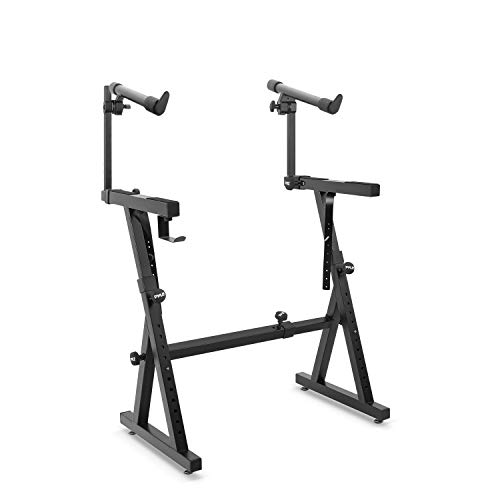
The PKST2TZ is the two-keyboard entry, from Pyle, a maker not represented elsewhere in this list. The base is an all-welded Z-style frame, and a removable second tier rides above it for a synthesizer or a second board. Pyle adjusts the main stand from 24 to 36 inches high and from 21 to 37 inches wide, with a first-tier depth of 16.5 inches, and lists the frame for keyboards from 55 to 88 keys at its maximum width. The second tier adjusts from 5 to 12 inches above the first, tilts in 10-degree increments so the upper instrument angles toward you, and carries a depth of 16.25 inches. Front bumpers rotate to accommodate different keyboard heights, and the feet adjust independently for uneven surfaces.
Pyle states a weight capacity of 400 pounds for the stand, the largest figure in this group, and builds the frame from structural tubing with a welded center box section. The width uses a sliding lock that Pyle describes as infinitely adjustable, so the arms land where your instrument’s body actually sits rather than at the nearest hole. The whole stand folds flat for storage and travel. If your setup has grown to two instruments and a single tier no longer cuts it, this is the frame here that was designed for exactly that rig from the start.
Specs
- Style: Z-style frame with removable second tier
- Height adjustment: 24 to 36 inches; width 21 to 37 inches with sliding lock
- Second tier: 5 to 12 inches above the first tier; tilt in 10-degree increments; 16.25-inch depth
- Maker-stated load capacity: 400 lb
- Supported instruments: 55 to 88 keys at maximum width, per Pyle
- Construction: All-welded steel tubing; adjustable feet; folds flat
FAQ
What is the difference between a single-X and a double-X keyboard stand?
Both use crossed legs that fold flat, but a double-X stand adds a second pair of crossed legs, which widens the base and usually raises the maker’s stated load capacity. A single-X stand is lighter and simpler to carry. Remember that on either design, raising the height narrows the width, so check the width figure at the height you actually plan to use.
Which stand style suits an 88-key digital piano best?
It depends on the piano’s weight. Compare its weight against each maker’s stated capacity first. Z-style and platform stands tend to suit full-size pianos well because their width and height adjust independently, so the supports can sit wide under a long instrument even at a low playing height. Lighter 88-key digital pianos also work on a double-X stand, provided the weight stays within the stated limit.
How do I choose the right playing height?
Sit or stand at the stand as you plan to play, with your forearms roughly level as they reach the keys and your wrists relaxed rather than bent sharply up or down. Measure the distance from the floor to where the key tops should sit, then confirm that figure falls inside the stand’s stated height range, keeping in mind that the instrument’s own body adds a little height above the support arms.
Can I add a second keyboard to a single-tier stand later?
Sometimes. Some makers sell a second-tier attachment for specific stands, such as the optional tier On-Stage offers for its platform stand, while other stands have no add-on path at all. If a two-keyboard setup is likely, a stand that already includes a second tier, like the Pyle above, avoids compatibility questions later.
Conclusion
For most home players, the frame decision follows the instrument. The RockJam Xfinity is the pick for a lighter 54 to 88 key digital piano when you want a double-X base, continuous height adjustment, and zero assembly. The Yamaha PKBS1 suits students and portable setups built around a 61-key board, where its light weight and six locking heights keep things simple. Players with a heavy 88-key slab piano played seated should look at the Liquid Stands MS1078, whose independent width and height adjustment and open Z frame fit that station best. The On-Stage KS7150 is the choice for the heaviest instruments and for anyone who prefers a flat table surface that folds away. And for a two-keyboard rig, the Pyle PKST2TZ builds the second tier in from the start. Weigh your instrument, count its keys, and match both numbers to the maker’s stated figures, and any of these five will hold your setup steady.
More from Amazon
Programs that pair well with the guide above. Offers and eligibility are set by Amazon and may change.
Free shipping on eligible items, Prime Video and more. Eligible new members can start with a free trial.
Start a Prime free trialAd-free music streaming. Eligible new subscribers can start with a free trial.
Try Music Unlimited freeA Prime membership for ages 18-24 with a trial period. Eligibility is set by Amazon.
See Prime for Young AdultsAudiobooks and podcasts to listen to on the go. Eligible new members can start with a free trial.
Try Audible freeAs an Amazon Associate we earn from qualifying purchases.