Key takeaways
- Compare the best bike pedals for road, mountain, and city riding, with platform and clipless designs, axle materials, and weights checked per listing.
As an Amazon Associate we earn from qualifying purchases.
Pedals are the smallest moving parts on a bicycle and the ones your feet touch on every stroke, so the design you choose shapes the whole ride. A flat platform pedal lets you put a foot down instantly and works with ordinary shoes. A clipless pedal locks a cleated shoe to the bike until you twist your heel to release. Between those poles sits the hybrid pedal, flat on one side and clipless on the other, for riders who do both kinds of trip on one bike.
This guide compares five pedals across those designs: a composite flat pedal for mountain bikes, an SPD-SL road pedal, an SPD mountain pedal, a dual-sided hybrid, and a wide flat pedal Shimano describes as multi-purpose, from commuting to e-MTB riding. Every cleat system, weight, and axle detail below is quoted from the maker’s listing, because the details that matter here — which cleat a pedal takes, and whether cleats come in the box — are exactly the ones that are easy to get wrong. If you are new to clipless pedals, read How to Choose first: road and mountain cleats are not interchangeable.
Disclosure: This article contains affiliate links. If you make a purchase through these links, we may earn a commission at no extra cost to you.
How to Choose
Flat or clipless is the first decision
A flat pedal is a platform your shoe rests on, held by friction and, on mountain bike models, by small metal pins that bite into the sole. Nothing attaches you to the bike, so starting, stopping, and dabbing a foot on a trail need no new skill. A clipless pedal works the opposite way: a cleat bolted to the shoe clicks into a spring-loaded binding, and a twist of the heel releases it. Riders choose clipless for the secure connection on climbs and rough ground, and flats for simplicity and ordinary footwear.
Road and mountain cleats are not interchangeable
This is the point the whole guide turns on, stated plainly: the two clipless systems here use different cleats, different bolt patterns, and different shoes. Road pedals in the SPD-SL style take a large three-bolt cleat that fixes to the three holes in a road shoe’s sole. Mountain pedals in the SPD style take a small two-bolt cleat recessed in the lugged sole of a mountain or touring shoe, so you can walk in it. An SPD-SL cleat cannot clip into an SPD pedal, an SPD cleat cannot clip into an SPD-SL pedal, and the shoes are drilled differently to match. Before ordering any clipless pedal, check which bolt pattern your shoes have, or plan to buy shoes from the same system.
Check whether cleats are included
Most pedals in this guide include cleats in the box, and each product section states exactly what its listing says is included, because it varies by model. Cleats are wear parts: a road cleat’s walking surface and a mountain cleat’s engagement edges both wear down over seasons of use, and makers sell replacements under the same cleat model name printed in the listing. Knowing that name — SM-SH11, SM-SH51, SM-SH56 — is what lets you find the right replacement set later.
Float and release tension
Float is the small amount your heel can rotate while still clipped in, measured in degrees and set by the cleat model rather than the pedal. Shimano’s SPD-SL cleats come in fixed and floating versions; the SM-SH11 cleats included with the road pedal below are the floating type. Release tension is the spring force you must overcome to twist out, and every clipless pedal here has an adjustment bolt to set it lighter or firmer. New clipless riders should set tension to its lightest, as makers advise, and practise clipping in and out against a wall before joining traffic.
Axles, bearings, and threads
The axle — also called the spindle — screws into the crank arm and carries the bearings the pedal body spins on. Chromoly steel is the standard axle material across this guide. Bearings are usually sealed cartridge units, sometimes paired with a bushing at the inner end; sealed units keep water and grit out and are the low-maintenance option for wet-weather riding. Nearly all adult pedals, including every model here whose listing states a thread size, use a 9/16-inch thread, which fits standard crank arms; the exceptions are a few children’s and older designs with 1/2-inch threads, so confirm the figure in the listing if your cranks are unusual.
Platform size and pins on flat pedals
On a flat pedal, platform size decides how much support your foot gets. Mountain flats run large, around 100 mm in each direction, with a slightly concave shape that centres the shoe, and traction comes from replaceable pins — when a pin bends in a rock strike, you unscrew it and fit a new one rather than replacing the pedal. City and comfort flats run wide too, because a rider in soft-soled everyday shoes spreads weight across the whole platform. Check in the listing whether the pins are replaceable; that detail separates a pedal you can maintain from one you cannot.
The 5 Best Bike Pedals for Road, Mountain, and City Riding
1. Race Face Chester — Flat Platform Pedal for Mountain Bikes

The Chester is Race Face’s composite flat pedal, and its design is the template most nylon mountain pedals follow: a tough nylon composite body instead of aluminium, which shrugs off rock strikes that would gouge a metal pedal, on a chromoly steel axle. The platform carries eight bottom-loading hex traction pins per side, each replaceable with a hex key when it bends or wears, plus moulded traction treads in the body itself. The shape is slightly concave, so the shoe settles into the middle of the platform. Sealed cartridge bearings paired with DU bushings keep the internals running through wet trail seasons, and the pedal is listed in a black, one-size version with a 9/16-inch thread. At a listed 340 g for the pair it is light for this platform size, part of why it has become the default upgrade from the basic flats a bike arrives with. There are no cleats and no binding to learn: any flat-soled shoe works, which is exactly the point of the design.
Specs
- Body: nylon composite, concave platform
- Axle: chromoly steel, 9/16 in thread
- Pins: 8 replaceable hex traction pins per side
- Bearings: sealed cartridge bearings with DU bushings
- Weight: 340 g per pair, per Race Face
ASIN: B07V4TG4Z7
2. Shimano PD-RS500 — Clipless Road Pedal, SPD-SL Style

The PD-RS500 is Shimano’s recreational road pedal, built around the SPD-SL three-bolt cleat system. Its body is resin with a stainless steel plate where the cleat contacts it, and the platform is extra wide for a pedal at this level, spreading the shoe’s contact patch. Shimano describes the spring tension as lighter than its racing pedals, aimed at riders clipping in for the first time: entry and release take less force, and tension is adjustable at the back of each pedal. The listing includes SM-SH11 cleats, the floating SPD-SL cleat type, so a road shoe with the three-bolt pattern is the only other purchase the system needs. The axle is chromoly steel turning on a sealed cartridge bearing unit, and Shimano lists the pair at 361 g. One caution belongs with every SPD-SL pedal, repeated here because it decides compatibility: these cleats fit three-bolt road shoes only, and cannot be used with two-bolt SPD pedals or shoes.
Specs
- System: SPD-SL, three-bolt road cleat
- Cleats included: SM-SH11, per the listing
- Body: resin with stainless steel contact plate
- Axle: chromoly steel; sealed cartridge bearings
- Weight: 361 g per pair, per Shimano
ASIN: B0BZS7YLXR
3. Shimano PD-M520 — Clipless Mountain Pedal, SPD Style

The PD-M520 is the longest-running design in this guide: a compact, dual-sided SPD pedal that has been the default first clipless pedal for mountain bikers for years. Both faces carry the same binding, so there is no wrong side to clip into, and the open binding design sheds mud rather than packing it around the mechanism — the reason the small two-bolt SPD system suits off-road use. The body is aluminium, the axle is chromoly steel with a 9/16-inch thread, and the bearings are a sealed cartridge unit Shimano describes as low maintenance. The listing includes SM-SH51 cleats, the single-release SPD type: twist your heel outward and the shoe comes free. Release tension adjusts with a small bolt on each binding. At a listed 380 g for the pair it is not the lightest SPD pedal Shimano makes; its argument is a proven mechanism, cleats in the box, and parts any bike shop recognises. It pairs with any two-bolt mountain, touring, or indoor-cycling shoe.
Specs
- System: SPD, two-bolt mountain cleat, dual-sided entry
- Cleats included: SM-SH51, per the listing
- Body: aluminium, open mud-shedding binding design
- Axle: chromoly steel, 9/16 in thread; sealed cartridge bearings
- Weight: 380 g per pair, per Shimano
ASIN: B0787RCHM9
4. Shimano PD-EH500 — Dual-Sided Hybrid, Flat One Side and SPD the Other
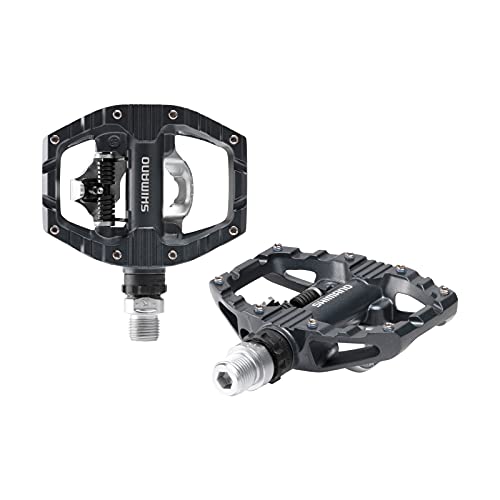
The PD-EH500 answers the one-bike problem directly: one face is a flat platform with traction pins for ordinary shoes, and the other face is an SPD binding for cleated cycling shoes. Shimano positions it for urban riding and touring, where the same bike does a commute in trainers on Monday and a long cleated ride on Saturday. The flat side uses a grippy platform surface intended to hold a shoe sole in wet weather, while the SPD side uses what Shimano calls a light-action binding — a spring set for easy entry and release, suited to stop-and-start city riding. The listing includes SM-SH56 cleats, the multi-release SPD type that can free the shoe with an upward or outward movement, which many new clipless riders find more forgiving. The axle is chromoly steel with sealed cartridge bearings, and Shimano lists the pair at 383 g — close to the plain SPD pedal above, so the flat side adds versatility rather than much weight. It takes the same two-bolt shoes as the PD-M520, not three-bolt road shoes.
Specs
- System: SPD on one side, flat platform on the other
- Cleats included: SM-SH56 multi-release, per the listing
- Binding: light-action SPD, adjustable release tension
- Axle: chromoly steel; sealed cartridge bearings
- Weight: 383 g per pair, per Shimano
ASIN: B07FTB9MCW
5. Shimano PD-GR500 — Wide Flat Pedal for City and Comfort Riding

The PD-GR500 is the wide platform in this guide, and Shimano’s own description frames it as a multi-purpose flat pedal for flat-soled shoes, for all types of riding from commuting to e-MTB use. That breadth is why it fills the city and comfort slot: the aluminium body is broad and concave, giving a soft-soled everyday shoe a large, stable surface, and the traction pins around the platform are replaceable when they wear. There is no cleat, no binding, and nothing to set up — the pedal suits riders who ride in whatever shoes they are already wearing, including the heavier footwear of a winter commute. The axle is chromoly steel, and the sealed bearing unit is built for low maintenance on a bike that lives outdoors. At a listed 535 g for the pair it is the heaviest pedal here, a fair trade for the platform size. For a dedicated city, comfort, or hybrid bike, the wide and simple design is the point.
Specs
- Body: aluminium, wide concave platform
- Axle: chromoly steel
- Pins: replaceable traction pins around the platform
- Bearings: sealed cartridge bearing unit, per Shimano
- Weight: 535 g per pair, per Shimano
ASIN: B079SKGJR4
FAQ
Can I use road cleats with mountain bike pedals, or the other way round?
No. SPD-SL road cleats are large, three-bolt cleats made for road shoes, and SPD mountain cleats are small, two-bolt cleats made for mountain and touring shoes. The bolt patterns, the shoe soles, and the pedal bindings are all different. Choose the pedal system first, then match the shoes and cleats to it: the PD-RS500 above is SPD-SL, while the PD-M520 and PD-EH500 are SPD.
Do these pedals come with cleats?
Three of the five listings state that cleats are included: the PD-RS500 includes SM-SH11 SPD-SL cleats, the PD-M520 includes SM-SH51 SPD cleats, and the PD-EH500 includes SM-SH56 SPD cleats. The two flat pedals — the Race Face Chester and the Shimano PD-GR500 — use no cleats at all and work with ordinary flat-soled shoes.
What thread size do I need, and will these fit my bike?
Every pedal in this guide whose listing states a thread size uses the 9/16-inch standard, which fits the crank arms on nearly all adult road, mountain, and city bikes. The main exceptions anywhere are some children’s bikes and older designs with 1/2-inch threads. Pedals are also handed: the left pedal has a reverse thread and is marked L, the right is marked R, and fitting each to the correct crank matters more than any other installation step.
How do I set release tension as a new clipless rider?
Use the adjustment bolt on each binding to set the spring to its lightest position, as the makers advise, and practise before riding in traffic: lean against a wall, clip each foot in and twist it out several times, then try slow starts and stops somewhere soft. Increase tension gradually only when releases feel too easy. The PD-EH500’s light-action binding and multi-release SM-SH56 cleats are the most forgiving combination here.
Conclusion
Match the pedal to the shoes and the riding, and the choice here is straightforward. Trail riders who want grip with ordinary shoes should start with the Race Face Chester, with its replaceable pins and composite body. Road riders moving to clipless belong on the Shimano PD-RS500 and its included SM-SH11 cleats. Mountain bikers clipping in for the first time have the proven Shimano PD-M520, while riders whose one bike must do everything should choose the dual-sided Shimano PD-EH500. City and comfort riders who want the widest platform and no cleats at all are best served by the Shimano PD-GR500. Whichever you pick, confirm the cleat system against your shoes before ordering.
More from Amazon
Programs that pair well with the guide above. Offers and eligibility are set by Amazon and may change.
Free shipping on eligible items, Prime Video and more. Eligible new members can start with a free trial.
Start a Prime free trialAd-free music streaming. Eligible new subscribers can start with a free trial.
Try Music Unlimited freeA Prime membership for ages 18-24 with a trial period. Eligibility is set by Amazon.
See Prime for Young AdultsAudiobooks and podcasts to listen to on the go. Eligible new members can start with a free trial.
Try Audible freeAs an Amazon Associate we earn from qualifying purchases.