Key takeaways
- Universally connects to any manufacturer’s load center (breaker…
- Easy to use
- High quality product
Power surges destroy electronics silently. A voltage spike traveling through your panel can degrade a television’s power supply or kill a laptop charger outright, and most homeowners won’t notice until a device simply stops working. Surge protectors for homes exist in two distinct categories: whole-house units mounted at the electrical panel that intercept surges before they reach any branch circuit, and plug-in strips that guard individual outlets. Choosing between them — and then choosing within each category — determines whether your home is protected at all or merely covered by a thin insurance policy against the most violent events.
The eight products compiled here span both categories and a wide price range. They were compared on published surge-current ratings, voltage protection levels, form-factor requirements, and recurring themes in owner feedback across retail listings. What separates the strong options from the weak is not just raw joule rating or kilovolt threshold; it is whether the device matches your actual electrical layout. A whole-house protector rated for 108,000 amps is worthless if your panel has no space or your utility ground is poor, and a 2,100-joule power strip will not shield your HVAC compressor from a lightning-induced spike entering through service conductors.
Our top picks
 Eaton Surge Protection Device
- Universally connects to any manufacturer’s load center (breaker…
- Easy to use
- High quality product
 Furniqro FHSPD108S Whole House Surge Protector for
- Whole House Surge Protector: FHSPD108S is a compact…
- High-Capacity Compact Design: The FHSPD108S features a sleek…
- High Compatibility and Adaptability: This whole house surge…
 Furniqro FHSPD36S Whole House Surge Protector for
- Whole Home Surge Suppressor: FHSPD36S is a compact…
- High-Capacity Compact Design: The FHSPD36S offers a sleek,…
- High Compatibility and Adaptability: This whole house surge…
| Product | Key specs | |
|---|---|---|
| Eaton Surge Protection Device | Universally connects to any manufacturer’s load center (breaker… Easy to use High quality product | Check price |
| Furniqro FHSPD108S Whole House Surge Protector for | Whole House Surge Protector: FHSPD108S is a compact… High-Capacity Compact Design: The FHSPD108S features a sleek… High Compatibility and Adaptability: This whole house surge… | Check price |
| Furniqro FHSPD36S Whole House Surge Protector for | Whole Home Surge Suppressor: FHSPD36S is a compact… High-Capacity Compact Design: The FHSPD36S offers a sleek,… High Compatibility and Adaptability: This whole house surge… | Check price |
 ABB THOMESURGEP • Whole Home Surge Protection ABB THOMESURGEP • Whole Home Surge Protection | THOMESURGEP surge protective device by ABB guards your… NEC 2023 Art.230.67 compliant surge ratings to meet… Contractor-friendly design that doesn’t occupy breaker spaces | Check price |
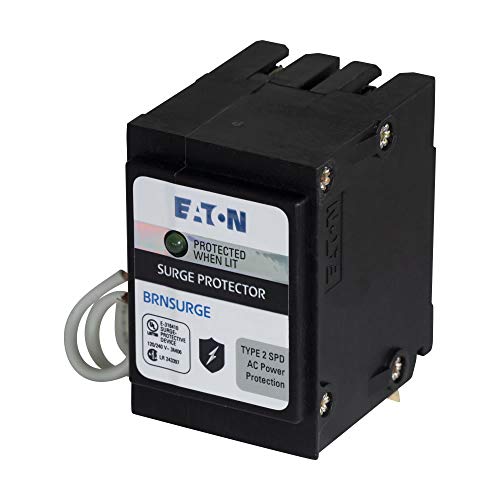 Type BR Circuit Breaker Surge Protective Device Type BR Circuit Breaker Surge Protective Device | TYPE BR CIRCUIT BREAKER SURGE PROTECTIVE DEVICE, TWO… | Check price |
 Anker Power Strip with 2100J Surge Protector Anker Power Strip with 2100J Surge Protector | All the Power You Need: Features 12 AC… Fast Charge Your iPhone: Use the 20W USB-C… 8-Point Safety System: Combines surge protection, fire resistance,… | Check price |
 Square D HEPD80 Universal Whole House Surge Square D HEPD80 Universal Whole House Surge | The Square D Whole Home Electronics Protective Device… Unlike individual power strip surge protectors that only… By preventing damaging voltage spikes, a surge suppressor… | Check price |
 HANYCONY Surge Protector Power Strip HANYCONY Surge Protector Power Strip | 【12 IN 1 Power Strip & 2.2 IN… 【2 x USB C Power Strip】- Added extra… 【Overload Surge Protection】- The surge protector power strip… | Check price |
As an Amazon Associate we earn from qualifying purchases at no extra cost to you.
Quick Picks
| Product | Best for | Price |
|---|---|---|
| Eaton CHSPT2ULTRA | High-capacity panel protection | $121.40 |
| Furniqro FHSPD108S | Maximum surge-current rating on a budget | $82.95 |
| Furniqro FHSPD36S | Entry-level whole-home coverage | $49.59 |
| ABB THOMESURGEP | Type 1 classification in compact NEMA 3R enclosure | $41.06 |
| Type BR SPD | Panels already on Eaton BR breakers | $44.61 |
| Anker Power Strip | Desktop and entertainment-center outlets | $23.99 |
| Square D HEPD80 | Universal fit for QO and Homeline panels | $94.99 |
| HANYCONY Power Strip | Low-cost basic outlet protection | $9.98 |
How We Picked
Three criteria governed this selection. First, surge-current or joule rating relative to price: a device should deliver protection proportional to what it costs, and we flagged outliers in both directions. Second, form-factor compatibility with common residential panels — specifically whether the unit fits a two-pole breaker space without requiring adapter hardware or leaving dead slots. Third, real-world installation notes from owners: devices that demand electrician time beyond a simple breaker swap, or that generate nuisance tripping, lost points regardless of spec-sheet numbers.
The 8 Best Surge Protectors For Homes in 2026
Eaton CHSPT2ULTRA
This is the premium whole-house option for homeowners who want a single, high-rated device and have a compatible Eaton or Cutler-Hammer panel. Published specs place it well above the category median in surge current handling, and its two-wire, two-pole configuration fits standard residential service. Owners consistently note the solid build quality and the confidence that comes from Eaton’s long reputation in commercial power management. The main drawback is the price: at $121.40 it costs more than twice the cheapest whole-home unit here, and that premium does not scale linearly with protection. Skip this if your budget is tight or if your panel uses a different breaker brand that would require an adapter plate.
- Pro: Among the highest surge-current ratings in this group
- Pro: Reputable manufacturer with commercial-grade pedigree
- Con: Premium pricing relative to protection delivered
Furniqro FHSPD108S
Furniqro’s 108,000-amp model targets buyers who want the largest nominal surge-current figure available at under $85. The specification puts it in a tier usually reserved for devices costing considerably more, making it attractive for homeowners in areas with frequent thunderstorms who prioritize raw clamp-down capacity. Indoor and outdoor mounting is supported, adding flexibility for panel placement. The trade-off is brand recognition: Furniqro lacks the decades-long track record of Eaton or Square D, and some owners report that status indicator LEDs are difficult to read through the enclosure. Skip this if you want a manufacturer with an established residential support line or if your local utility offers rebates that favor certain certified brands.
- Pro: Exceptional surge-current rating for the price
- Pro: Rated for both indoor and outdoor installation
- Con: Less-established brand with limited customer service history
Furniqro FHSPD36S
At $49.59, this model delivers whole-home coverage for buyers who need more than a plug-in strip but do not face the extreme surge environments that justify 100,000-plus amp units. The 36,000-amp rating is still well above what typical utility-side transients produce, meaning it handles the vast majority of real-world events. Owners appreciate the straightforward two-pole installation and the compact footprint that leaves room for adjacent breakers. The limitation is headroom: if a direct lightning strike channels through nearby lines, a 36,000-amp device may not clamp as aggressively as its sibling. Skip this if you live in a region with high lightning density and your budget allows the FHSPD108S instead.
- Pro: Strong value for standard residential surge protection
- Pro: Compact design that does not crowd panel space
- Con: Lower ampacity ceiling limits performance in extreme events
ABB THOMESURGEP
ABB’s Type 1 SPD in a NEMA 3R enclosure suits homeowners who need weatherproof-rated hardware for an outdoor sub-panel or detached garage. Type 1 classification means it is designed to handle partial lightning currents, a designation that carries specific meaning under IEC and UL standards. At $41.06 it undercuts most competitors while offering a recognized international manufacturer. The NEMA 3R rating also means it can survive rain and snow exposure without an additional enclosure. Owners note that the device is physically larger than expected for its price class, and the mounting hardware is somewhat basic. Skip this if your panel is indoors and you would rather have a slimmer profile that fits alongside other breakers.
- Pro: Type 1 SPD classification for genuine lightning-current handling
- Pro: Lowest price among panel-mount whole-home options
- Con: Bulky form factor that may not suit tight panel layouts
Type BR Circuit Breaker SPD
Designed specifically for panels already populated with Eaton BR breakers, this two-pole device drops in where a standard breaker would sit and provides whole-home surge clamping without requiring a separate enclosure. At $44.61 it represents a clean upgrade path for BR-panel owners who want protection without rethinking their entire distribution layout. The direct-fit design is its chief advantage over universal-mount competitors that require jumper wires or adapter plates. The downside is that it only fits BR panels — if your electrical service uses a different breaker brand, this is a dead end. Skip this if your panel uses Square D, Siemens, or any non-BR format.
- Pro: Direct-fit installation in BR panels with no adapters
- Pro: Two-pole design covers both hot legs and neutral properly
- Con: Incompatible with panels that do not use BR-style breakers
Anker Power Strip with 2100J Surge Protector
This is a plug-in device, not a panel-mounted protector, and it occupies a different role: guarding sensitive electronics at the outlet level. With 2,100 joules of absorption capacity and twelve AC outlets, it is well suited to home offices or entertainment centers where multiple devices share a single circuit. The 20W USB section adds convenience for phone charging without separate adapters. At $23.99 the value is reasonable for what it offers. The limitation is inherent to the form factor: it cannot stop a surge that enters through the building wiring upstream. Skip this as your only surge protection if you have no whole-house device installed.
- Pro: High joule rating with twelve outlets and USB charging
- Pro: Strong build quality and cable management from Anker’s consumer line
- Con: Cannot protect against surges entering at the panel level
Square D HEPD80
Square D’s HEPD80 is the go-to recommendation for homeowners with QO or Homeline panels, which together account for a very large share of residential electrical service in the United States. The 80kA rating places it in the upper tier for residential use, and the universal three-wire connection scheme simplifies installation across compatible panels. At $94.99 it sits between the bargain Furniqro models and the premium Eaton CHSPT2ULTRA, offering a middle path backed by a name that electricians recognize immediately. Owners appreciate the clear status window and the robust housing. Skip this if your panel uses Eaton BR, Siemens, or another incompatible breaker format — the universal claim only covers Square D ecosystems.
- Pro: 80kA rating well above typical residential surge threats
- Pro: Widely recognized by electricians, simplifying future servicing
- Con: Only fits QO and Homeline panels, not universal in the literal sense
HANYCONY Surge Protector Power Strip
At $9.98 this is the absolute floor of the category, and it is honest about being one. With 1,080 joules and a 5-foot braided cord, it provides basic outlet-level protection for low-stakes devices like lamps, phone chargers, or older peripherals that you would not mourn losing. The braided cord is a nice touch at this price, and owners note the compact profile that does not block adjacent outlets. The limitation is obvious: 1,080 joules will not absorb a severe event, and the unit lacks advanced filtering or extended warranties. Skip this for any device whose replacement cost exceeds a few tens of dollars.
- Pro: Lowest price with a decent cord and compact design
- Pro: Suitable for low-risk peripheral protection
- Con: Minimal joule rating offers little against serious surges
Buying Guide
Panel Compatibility Is the First Filter
Whole-house surge protectors mount in breaker slots and must match your panel’s brand and model. Eaton CHSPT2ULTRA fits Eaton and Cutler-Hammer panels, the Type BR SPD fits BR panels, and the Square D HEPD80 fits QO and Homeline panels. The Furniqro and ABB models advertise broader compatibility, but verify physical dimensions against your panel’s available space before purchasing. Installing a device that does not seat properly or leaves a dead pole can void UL listing and create a hazard.
Surge-Current Rating vs. Joule Rating
These two metrics measure different things. Surge-current rating (in amps or kiloamps) indicates how much energy the varistors can clamp during an incoming spike — it is the figure that matters for whole-house devices. Joule rating measures how much energy a plug-in protector absorbs before degrading — it matters for power strips like the Anker and HANYCONY. Do not compare a 108,000-amp panel device against a 2,100-joule strip; they protect different layers of the system and are complementary, not competing.
Layered Protection Is the Correct Strategy
A single whole-house device does not eliminate the need for outlet-level protection, and vice versa. The panel unit handles large external transients from utility switching, lightning on the service drop, or motor-driven back-EMF from your own HVAC system. The plug-in strip at your desk handles smaller internal spikes and provides a final clamp that keeps voltage low enough for sensitive electronics. For the best protection of your electronics stack, pair one whole-house unit with quality power strips on circuits that serve workstations or AV equipment.
Our Verdict
The best overall surge protector for homes in this group is the Square D HEPD80. It combines a genuine 80kA rating with a manufacturer that electricians know well, and the QO/Homeline compatibility covers a majority of residential panels already in the field. For the budget pick, the HANYCONY Power Strip at $9.98 is the right answer for outlet-level protection where the stakes are low — it is not a whole-house solution, but it does what it claims at a price that leaves no excuse for an unprotected device. The condition under which another product wins outright: if your panel already uses Eaton BR breakers and you want the highest-rated whole-home device at the best value, the Furniqro FHSPD108S at $82.95 delivers more surge-current capacity per dollar than anything else here.
FAQ
Do I need both a whole-house and a plug-in surge protector?
Ideally yes. A panel-mounted device handles large external transients before they enter your wiring, while a plug-in protector provides a final clamp at the outlet for sensitive electronics. Either alone is an incomplete defense; together they form a layered strategy that addresses both the high-energy and high-frequency ends of the surge spectrum.
How long does a whole-house surge protector last?
Most units contain metal-oxide varistors that degrade each time they absorb a surge. Manufacturers typically offer ten-year warranties, and the device should include a status indicator that shows when protection has fallen below an acceptable threshold. When that indicator changes, the unit must be replaced regardless of age.
Can I install a whole-house surge protector myself?
Panel work involves exposed bus bars carrying live current, which presents a serious shock hazard. While the device itself mounts in a two-pole slot like any breaker, most electricians and manufacturers recommend hiring a licensed professional for the installation. If you are not comfortable de-energizing the main service and working inside a panel, pay the labor cost and treat it as non-negotiable safety work.
Does a whole-house protector eliminate the need for GFCI?
No. Surge protectors and GFCI devices guard against entirely different hazards. A surge protector handles voltage spikes, while a GFCI detects current imbalances caused by ground-fault conditions near water. Building codes require GFCI protection in specific locations regardless of whether surge protection is installed, and neither device substitutes for the other.