Key takeaways
- Choose USB if: you use a laptop, console-only setup, or need portability.
- Choose PCIe if: you have a dedicated streaming or editing PC and want maximum quality with minimal compression.
The best capture cards for streaming and recording in 2026 are the Elgato HD60 X for most console and PC streamers, the AVerMedia Live Gamer Ultra 2.1 GC553G2 and Elgato 4K X for 4K60 creators who need HDMI 2.1 passthrough over USB, and the Elgato 4K60 Pro MK.2 or AVerMedia Live Gamer 4K 2.1 GC575 for PCIe-based 4K60 HDR or 4K144 recording with the lowest latency.
Our top picks


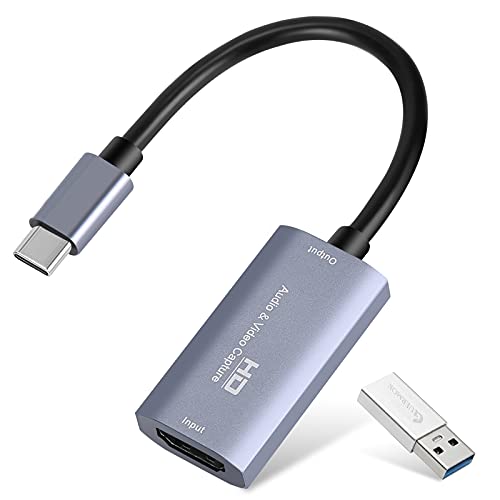

As an Amazon Associate we earn from qualifying purchases at no extra cost to you. Ratings are shown as listed on Amazon.
Best Capture Cards at a Glance: Spec Comparison
Capture resolution is not the same as passthrough resolution. You can play at 4K120 while capturing at 1080p60 if your card supports that passthrough. This table separates what you record from what you see on your gaming monitor.
| Capture Card | Max Capture Resolution | Max Passthrough | HDR Capture / Passthrough | Connection | VRR / ALLM Passthrough | Dimensions / Weight |
|---|---|---|---|---|---|---|
| Elgato HD60 X | 2160p30, 1440p60, 1080p60 HDR10 | 2160p60, 1440p120, 1080p240 | Capture HDR10 up to 1080p60; Passthrough HDR10 up to 4K60 | USB 3.2 Gen 1 Type-C (UVC) | Yes, VRR + ALLM | 112 x 75 x 19 mm / 91 g |
| Elgato 4K X | 2160p60 HDR10, 1440p144, 1080p240 HDR10 | 2160p120, 1440p240, 1080p240 | Yes / Yes | USB 3.2 Gen 2 Type-C (UVC) | Yes, VRR + ALLM | 112 x 75 x 19 mm / 95 g |
| AVerMedia Live Gamer Ultra 2.1 GC553G2 | 2160p60 HDR, 1440p144, 1080p240 | 2160p120, 1440p240, 1080p240 | Yes / Yes | USB 3.2 Gen 2×1 Type-C (UVC) | Yes, VRR + ALLM | 112 x 66 x 26 mm / 115 g |
| Elgato 4K60 Pro MK.2 | 2160p60 HDR10, 1440p144, 1080p240 | 2160p60 HDR10 | Yes / Yes (no 4K120 passthrough) | PCIe x4 | No | 143 x 121 mm single-slot / 155 g |
| AVerMedia Live Gamer 4K 2.1 GC575 | 2160p60 HDR, 2160p144, 1440p240 | 2160p144, 1440p240 | Yes / Yes | PCIe x4 Gen 3 | Yes, VRR + ALLM | 155 x 110 mm single-slot / 165 g |
| NZXT Signal 4K30 | 2160p30, 1440p60, 1080p60 HDR10 | 2160p60 HDR10 | Capture up to 1080p60 HDR; Passthrough up to 4K60 HDR | USB 3.2 Gen 1 Type-C (UVC) | No | 108 x 66 x 20 mm / 88 g |
General market ranges in 2026: USB 1080p60 cards like the HD60 X and NZXT Signal 4K30 sit in the $120-$200 range, USB HDMI 2.1 cards like the Elgato 4K X and GC553G2 are $200-$300, and PCIe HDMI 2.1 cards like the GC575 are $250-$350. 4K60 Pro MK.2 stock varies as it is an older HDMI 2.0 design but remains widely available.
The 5 Specs That Actually Decide Your Purchase
1. Input vs. Passthrough Resolution and Refresh Rate
Input is what the card can record. Passthrough is what it sends to your TV or monitor so you can still play at full quality. A common mistake is buying a 4K30 capture card for a PS5 or Xbox Series X and losing 120Hz. If you play competitive shooters at 1440p120 or 4K120, you need a HDMI 2.1 card with 4K120 passthrough like the Elgato 4K X, GC553G2, or GC575. If you only need 4K60 for single-player or 1080p240 for esports, the HD60 X is sufficient and costs less.
2. HDR Support
There are two levels of HDR handling. Passthrough HDR means your gameplay still looks correct on an HDR TV while capturing. Capture HDR means the recording itself retains HDR metadata. Most affordable USB cards tone-map HDR to SDR or capture HDR only at 1080p60. The Elgato 4K X, GC553G2, and GC575 capture HDR10 at 4K60, which matters if you produce HDR content for YouTube. If you stream to Twitch, which is still SDR-first, SDR capture with HDR passthrough is usually better to avoid washed-out colors for viewers.
3. Connection Type: USB vs. PCIe
USB 3.2 cards are plug-and-play, work with laptops, desktops, and even some handhelds via UVC, and are ideal for console setups where the gaming PC or laptop is separate. PCIe cards require a desktop with a free x4 slot but offer more stable bandwidth, lower CPU overhead, and support for higher capture rates like 4K60 4:4:4 or 4K144. For dual-PC streaming, PCIe is cleaner because it does not share USB controller bandwidth with webcams and microphones.
- Choose USB if: you use a laptop, console-only setup, or need portability.
- Choose PCIe if: you have a dedicated streaming or editing PC and want maximum quality with minimal compression.
4. Latency and How You Monitor Gameplay
All external capture cards add 40-120ms of capture latency to the preview window in OBS Studio or other software. That is fine for recording but unplayable if you watch the preview to play. Always play from the passthrough output on your main monitor, not the OBS preview. PCIe cards and USB cards with instant gameview have similar passthrough latency (near zero), but PCIe cards show slightly lower preview latency. Look for cards that support ultra-low latency passthrough and do not force you through their preview.
5. Software Compatibility
Most modern cards are UVC compliant, meaning they work without a custom driver in OBS Studio, Streamlabs, XSplit, Zoom, Discord, and on Windows, macOS, and iPadOS. Elgato 4K Capture Utility and AVerMedia RECentral / Gaming Utility still offer firmware updates, HDR tone-mapping controls, and party chat splitting for consoles, but you do not need them to get a picture in OBS. Avoid cards that require proprietary drivers if you plan to use a MacBook or Chromebook. For 4K60 HDR recording, make sure your editing software (DaVinci Resolve, Premiere Pro, Final Cut Pro) supports HEVC/H.265 HDR10 ingest or you will need to transcode.
Best Capture Cards by Situation: Decision Matrix
Use your primary source device and target output to pick, not just the highest numbers.
| Your Situation | Recommended Type | Specific Pick | Why |
|---|---|---|---|
| PS5 / Xbox Series X on 4K60 TV, streaming at 1080p60 | USB HDMI 2.0 | Elgato HD60 X | Lowest cost with 4K60 HDR passthrough and 1080p60 HDR capture, VRR support |
| PS5 / Xbox at 4K120 or 1440p120 on 120Hz monitor | USB HDMI 2.1 | AVerMedia GC553G2 or Elgato 4K X | Preserves 120Hz VRR passthrough while capturing 4K60 HDR or 1440p60 |
| PC gamer capturing PC gameplay at 4K144 / high refresh | PCIe HDMI 2.1 | AVerMedia GC575 | Only PCIe 2.1 cards capture above 4K60 without chroma subsampling compromise |
| Laptop streamer, needs simple setup, SDR Twitch stream | USB compact | Elgato HD60 X or NZXT Signal 4K30 | Driverless UVC, low power draw, no PCIe slot needed |
| Retro console / Nintendo Switch / 1080p capture only | USB budget | NZXT Signal HD60 or Elgato HD60 S+ | 1080p60 capture is enough; do not pay for unused HDMI 2.1 bandwidth |
| Archival-quality 4K60 HDR YouTube recording | PCIe or USB 2.1 | Elgato 4K60 Pro MK.2 (4K60 HDR) or GC575 | Higher bitrate 4:4:4 capture, less compression than USB 3.0 |
How to Set Up Without Losing Quality or Adding Lag
Connection order matters more than settings. Follow this sequence for any console or second PC:
- 1. Connect console/PC HDMI OUT to capture card HDMI IN. Use the HDMI cable included with the card or an Ultra High Speed certified cable for 4K120. Older High Speed cables will black-screen at 120Hz.
- 2. Connect capture card HDMI OUT to your gaming monitor/TV HDMI IN. This is your zero-latency play view.
- 3. Connect capture card USB to your streaming PC. Use a direct USB 3.2 port on the motherboard or laptop, not a USB hub. USB 2.0 ports will limit capture to 1080p or cause stutter.
- 4. In console video settings, set resolution to match your passthrough target (e.g., 2160p 120Hz) and enable VRR/ALLM if your card supports it. In OBS Studio, add the card as a Video Capture Device, set resolution to Custom 3840×2160 and FPS to 60, and set Color Space to Rec. 2100 / PQ for HDR if you intend to record HDR.
- 5. For party chat on PS5 or Xbox, enable chat splitting: Elgato’s Sound Capture or AVerMedia’s party chat link cable routes chat audio to a separate OBS track so viewers hear teammates without echo.
Bitrate tip: Uncompressed 4K60 8-bit 4:2:0 requires about 12 Gbps over HDMI but USB capture compresses it. In OBS, recording at 4K60 with CQP 18-22 (NVENC/AMF) or ProRes LT on Mac retains HDR detail without 500 MB/minute files. Streaming should still be downscaled to 1080p60 at 6000-8000 kbps, which is the platform limit for most services.
Ownership Realities: What Wears Out and What Goes Wrong
Capture cards do not have consumables, but they fail in predictable ways. The most common failure point is the HDMI port solder joint from frequent cable swaps. Leave cables connected and use a short HDMI pigtail if you move the card between systems. The second issue is heat: passive PCIe cards like the 4K60 Pro MK.2 run hot at 4K60 HDR (65-75C inside a case). Keep airflow over the card and do not cover it with a GPU backplate.
Firmware is the other maintenance task. HDMI 2.1 cards shipped before 2024 needed updates to fix VRR flicker and 1440p120 EDID handshake issues with LG and Samsung TVs. Check Elgato or AVerMedia support pages twice a year, even if the card seems fine. Dust the USB-C port and keep drivers on UVC mode if you switch between Windows and macOS to avoid driver conflicts.
Common mistakes to avoid: enabling HDR capture when streaming to an SDR platform (colors look washed out to viewers), plugging a USB 3.2 Gen 2 card into a USB 2.0 hub, and setting OBS canvas to 4K while streaming (downscale in Output settings, not by resizing the source, to save encoder load). If you see a black screen with audio, it is usually HDCP. Disable HDCP on PS5 in System settings when capturing gameplay, or use a card with HDCP passthrough off.
FAQ
Do I need a capture card if I stream PC games from the same PC?
No. Use software capture like OBS Game Capture or NVENC. A capture card only helps for a second PC, a console, or a camera. Internal screen capture has lower latency and no extra hardware cost.
Can these cards capture 120fps or 240fps?
They can passthrough 120Hz and 240Hz so you can play at that refresh rate, but most capture at 60fps max at 4K and 120fps only at 1080p. The Elgato 4K X and GC553G2 capture 1080p240, and the GC575 captures 1440p240. For true 4K120 capture you need a GC575 and a PCIe system with HEVC encoding.
Will a capture card lower my game FPS or add input lag?
No, if you use passthrough to your monitor. Your console or GPU renders directly to the display. The card clones the signal. Input lag only increases if you play from the OBS preview window.
Are USB capture cards compatible with Macs and laptops?
UVC cards like the HD60 X, 4K X, GC553G2, and NZXT Signal series work with macOS 12+ and most Windows laptops with USB 3.0 or better without extra drivers. PCIe cards require a desktop. Check that your laptop USB-C port supports data, not just charging.