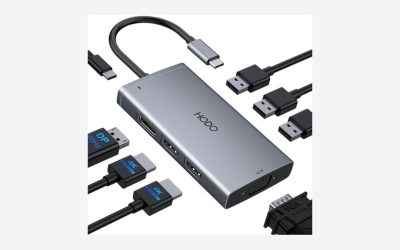
The problem every laptop owner eventually hits is simple: the machine has two or three ports, and your peripherals number twice that. You want a second monitor, a wired keyboard, an external drive, and a charger that does not live on a separate brick. An Anker USB hub is one of the most common answers, but the range spans from a four-port plastic splitter to an eleven-in-one docking station, and picking wrong means either dead ports on your desk or a dock gathering dust because you only needed two extra connections.
What separates a good pick from a bad one here is not build quality alone — Anker’s hub line is consistently well-finished — but whether the port mix matches your actual workflow. A 4K HDMI output is useless if your monitor only runs 1080p, and a twelve-watt USB-C power delivery passthrough will not charge a gaming laptop under load. Below we compare eight options using published specs, current pricing, and recurring themes from owner feedback to help you match the right hub to your setup.
Our top picks
 Anker USB C Hub
- Sleek 7-in-1 USB-C Hub: Features an HDMI port,…
- Flawless 4K@60Hz Video with HDMI: Delivers exceptional clarity…
- Double Up on Efficiency: The two USB-A 3.0…
 Anker USB Hub
- The Anker Advantage: Join the 80 million+ powered…
- SuperSpeed Data: Sync data at blazing speeds up…
- Big Expansion: Transform one of your computer's USB…
 Anker USB C Hub
- 5-in-1 Connectivity: Equipped with a 4K HDMI port,…
- Powerful Pass-Through Charging: Supports up to 85W pass-through…
- Transfer Files in Seconds: Move files to and…
| Product | Key specs | |
|---|---|---|
| Anker USB C Hub | Sleek 7-in-1 USB-C Hub: Features an HDMI port,… Flawless 4K@60Hz Video with HDMI: Delivers exceptional clarity… Double Up on Efficiency: The two USB-A 3.0… | Check price |
| Anker USB Hub | The Anker Advantage: Join the 80 million+ powered… SuperSpeed Data: Sync data at blazing speeds up… Big Expansion: Transform one of your computer's USB… | Check price |
| Anker USB C Hub | 5-in-1 Connectivity: Equipped with a 4K HDMI port,… Powerful Pass-Through Charging: Supports up to 85W pass-through… Transfer Files in Seconds: Move files to and… | Check price |
 Anker USB Hub Anker USB Hub | The Anker Advantage: Join the 65 million+ powered… SuperSpeed Data: Sync data at blazing speeds up… Big Expansion: Transform one of your computer's USB… | Check price |
 Anker Desktop Charger Anker Desktop Charger | 6-in-1 Charger for All: Designed for modern needs,… Maximum Power, Minimum Time: Efficiently power your MacBook… 112W Multi-Device Charger: Equipped with 3 USB-C and… | Check price |
 Anker USB-C Hub Anker USB-C Hub | Flawless 4K Video via HDMI: Enjoy crystal-clear visuals… Massive Expansion: Equipped with a USB-C Power Delivery… High-Speed, High-Def: USB-C and USB-A data ports provide… | Check price |
 Anker USB-C Hub Anker USB-C Hub | Massive Expansion: Turn one of your laptop’s USB-C… Move Files Faster: With a 10 Gbps USB-C… Multi-Monitor Display: Connect to the DisplayPort and HDMI… | Check price |
 Anker Desktop Charger Anker Desktop Charger | Join the Anker Family: Step into our expansive… Superior Charging Technology: Experience the potency of PowerIQ… Streamlined Power Supply: Our 6-port charging station dispenses… | Check price |
As an Amazon Associate we earn from qualifying purchases at no extra cost to you.
Quick Picks
| Product | Best For | Price |
|---|---|---|
| Anker 7-in-1 USB C Hub | Laptop users needing HDMI plus USB expansion | $19.99 |
| Anker 4-in-1 USB Hub (first pick) | Adding USB-A ports to older desktops | $14.99 |
| Anker 5-in-1 USB C Hub | Single-monitor 4K output on a tight budget | $19.99 |
| Anker 4-in-1 USB Hub (value pick) | Bulk USB-A expansion at the lowest price | $14.99 |
| Anker 112W Desktop Charger | Charging multiple high-power devices at once | $39.99 |
| Anker 8-in-1 USB-C Hub | Desk setups needing wired Ethernet and 4K video | $35.99 |
| Anker 11-in-1 Docking Station | Dual-monitor workstations from a single cable | $50.99 |
| Anker 60W Desktop Charger | Low-power multi-device charging on a desk | $29.99 |
How We Picked
We evaluated each option against four criteria: port mix relevance (does the hub solve the problem you actually have?), video output quality (4K@60Hz matters for high-refresh monitors; 4K@30Hz does not), power delivery headroom (whether the hub passes enough wattage to keep a laptop topped up while running peripherals), and price-to-feature ratio relative to competing Anker models. Owner feedback on reliability, connector wobble, and thermal behavior rounded out the picture where specs alone were not decisive.
The 8 Best Anker Usb Hub in 2026
Anker 7-in-1 USB C Hub
This is the hub for someone who connects and disconnects from a laptop daily and needs one dongle that handles video, data, and a card reader. The 4K@60Hz HDMI output is the headline spec here — it supports high-refresh external monitors without the 30Hz ceiling that cheaper hubs impose. Owners consistently praise its compact profile and the fact that it does not require a separate driver on macOS or Windows.
- 4K@60Hz HDMI handles modern monitors without compromise
- Seven ports in a pocketable body that stays cool under light loads
- USB-A ports run at USB 2.0 speeds, so fast external drives bottleneck
Skip it if your primary need is charging a high-wattage laptop; the passthrough here is modest.
Anker 4-in-1 USB Hub (First Pick)
Sometimes the best hub is the one that does exactly one thing. This four-port USB-A splitter exists for the desktop or older laptop where the case ports have failed or you simply need more connections for a mouse, keyboard, printer, and flash drive. At 5Gbps per port, it handles everyday peripherals without fuss.
- Plug-and-play with no driver or external power needed
- Compact and unobtrusive behind a monitor stand or on a desk edge
- No video or power passthrough — strictly a data port multiplier
Skip it if your machine only has USB-C ports and no adapters on hand; this requires a USB-A host.
Anker 5-in-1 USB C Hub
The 5-in-1 sits below the 7-in-1 in port count but still delivers 4K HDMI output, making it a sensible pick for anyone with a single external monitor and two or three USB-A peripherals. Owners note it runs slightly cooler than the 7-in-1 under sustained video use, likely because fewer active controllers draw power simultaneously.
- 4K display output at a lower price than multi-monitor docks
- Simple enough that there is nothing to configure after plugging in
- Fewer ports means you will still need a separate hub for a crowded desk
Skip it if you need Ethernet or a second display; the 8-in-1 and 11-in-1 cover those gaps.
Anker 4-in-1 USB Hub (Value Pick)
Spec-for-spec this is identical to the first 4-in-1 listed above, and that is the point. Buying two of them for a shared office or a workstation with peripherals clustered on opposite sides costs less than a single powered hub. Five gigabits per second covers keyboards, mice, webcams, and USB flash drives without a single dropped frame or lag spike.
- Lowest entry price in this roundup for expanding USB-A connectivity
- Broad compatibility across Windows, macOS, and Linux without drivers
- No individual port power switching means a high-draw device can affect others
Skip it if any connected device needs more than the bus-supplied power; a powered hub is the better answer.
Anker 112W Desktop Charger
Not a hub in the traditional sense, but Anker labels it as a charging hub and it solves the same desk-clutter problem. Six ports deliver up to 112W total, which means you can charge a laptop, phone, earbuds, and a tablet simultaneously without four separate bricks. Owners highlight the compact footprint relative to the wattage on offer.
- Highest single-unit charging capacity in this list by a wide margin
- Six ports eliminate cable spaghetti behind the monitor
- Provides zero data connectivity — it is strictly a power device
Skip it if you need port expansion for data peripherals; pair it with a USB hub instead.
Anker 8-in-1 USB-C Hub
The built-in Ethernet port makes this the pick for anyone who works from coffee shops, co-working spaces, or apartments with spotty Wi-Fi. Combined with 4K@60Hz HDMI, it covers the two most common laptop shortcomings: no wired network jack and no second display output. Owners report stable connections with gigabit routers and minimal latency.
- Gigabit Ethernet provides reliable, low-latency networking without adapters
- 4K@60Hz HDMI supports high-refresh external monitors
- Runs warm during simultaneous video and network use on thin laptops
Skip it if you already have reliable Wi-Fi and a single screen; the 5-in-1 is cheaper for that setup.
Anker 11-in-1 Docking Station
This is the most capable option in the lineup and the only one designed for dual-monitor desk setups. It combines HDMI and DisplayPort outputs alongside Ethernet, USB-A, SD card slots, and audio — all fed by a single USB-C cable to the laptop. Owners transitioning from expensive brand-name docks note comparable functionality at a fraction of the cost.
- Dual monitor support via HDMI and DP without a discrete GPU
- Eleven ports eliminate nearly every dongle from a laptop-centric desk
- Requires a laptop with full USB-C DisplayPort Alt Mode to use both video outputs
Skip it if your laptop only supports video output over HDMI natively; the 7-in-1 may serve you better.
Anker 60W Desktop Charger
The 60W option fills the gap between phone-only chargers and the 112W model. Six ports at 60W total is enough to top up a thin-and-light laptop while still feeding two or three phones and a pair of earbuds. Its smaller power draw makes it a reasonable travel companion without a heavy brick.
- Charges a laptop plus multiple small devices without exceeding a single outlet
- Lower price and footprint than the 112W sibling for lighter workloads
- Absolutely zero data pass-through or video output
Skip it if you need to transfer files over USB; this is a power-only device despite the “hub” label.
Buying Guide
Match the Port Mix to Your Actual Workflow
Count the peripherals you connect on a typical day. If the answer is a monitor, a keyboard, and a mouse, a five or seven-port hub covers you. If you also need a wired network connection, a second display, and card reading for a camera, you are in docking station territory. Buying more ports than you use is not a disaster, but it costs extra and adds bulk.
Check Your Laptop for DisplayPort Alt Mode
Most USB-C video outputs rely on DisplayPort Alt Mode routed through the USB-C connector. Without it, an HDMI port on a hub simply will not activate. Verify your laptop’s USB-C port supports video out before purchasing any hub with an HDMI or DP connector; this is the single most common reason owner reviews mention a hub “not working.”
Understand Power Delivery Headroom
A hub that claims sixty watts of passthrough charging will deliver less if it is simultaneously powering peripherals. If your laptop needs sixty-five watts to charge properly, look for hubs advertising passthrough above that number or accept that the battery will slowly drain during heavy use. Owner feedback consistently flags this gap between advertised and real-world charging wattage.
Our Verdict
The Anker 8-in-1 USB-C Hub is our top pick because it covers the widest range of real user needs — video, Ethernet, and data — in a single cable, and its 4K@60Hz output is the spec that most buyers actually require for a modern external monitor. The budget pick is the Anker 4-in-1 USB Hub at $14.99, which remains the cheapest path to expanding USB-A connectivity when video and power passthrough are irrelevant. However, if you run a dual-monitor workstation and your laptop supports DisplayPort Alt Mode, the 11-in-1 Docking Station wins decisively despite the highest price in the group.
FAQ
Do Anker USB hubs work with MacBooks?
Yes, Anker’s USB-C hubs are broadly compatible with Intel and Apple Silicon MacBooks without third-party drivers. The main caveat is that some older M1 Air models support only a single external display regardless of how many video outputs the hub provides.
Why does my hub make my laptop run hot?
Multi-port hubs with active controllers generate heat, especially during simultaneous 4K output and high-speed data transfer. Thinner laptops have less thermal headroom, so the hub’s own heat plus the laptop’s internal dissipation can raise fan speeds noticeably. Using a shorter cable or placing the hub on a hard surface helps marginally.
Can I daisy-chain two Anker USB hubs?
Technically you can plug one hub into another, but total bandwidth and power share across both. Performance on downstream devices will degrade, and most owner reports warn against chaining hubs that each draw bus power from the same upstream port.
Is a desktop charger the same as a USB hub?
No. A desktop charger like the 112W or 60W model provides power through USB-C and USB-A ports but transfers no data and outputs no video signal. They solve a different problem — outlet and brick clutter — and are sometimes confused in listings because Anker labels them as “charging hubs.”