If you own a desktop computer, a monitor, a gaming console, or any device with sensitive circuitry, you already know that a sudden voltage spike can end a component’s life in milliseconds. The question “what is a surge protector” matters because the answer determines whether your five-hundred-dollar graphics card survives a storm-season power fluctuation or becomes an expensive paperweight. A surge protector is a device that sits between your wall outlet and your electronics, absorbing excess voltage above a safe threshold and redirecting it to the grounding wire before it reaches your gear.
What separates a good surge protector from a mediocre one is not brand recognition but measured protection capacity, practical outlet spacing, and whether the design matches your actual load. A unit rated at two thousand seven hundred joules offers materially different peace of mind than one at a thousand eighty joules. Widely spaced outlets prevent bulky adapters from stealing plugs. Integrated USB ports reduce brick clutter. The products below vary across all of these dimensions, and we compared them on published specifications, listed pricing, and aggregated owner feedback to identify which models deliver the best protection per dollar in 2026.
Our top picks
 Anker Power Strip with 2100J Surge Protector
- All the Power You Need: Features 12 AC…
- Fast Charge Your iPhone: Use the 20W USB-C…
- 8-Point Safety System: Combines surge protection, fire resistance,…
 YISHU 6Ft Surge Protector Power Strip with
- 【4+4 Outlets Power Strip with 4 USB Ports】-…
- 【Surge Protector Power Strip with 3 Side Design…
- 【Multi Safety Protection】- ETL Certificates
 Surge Protector Power Strip
- 【Power Strip with 8AC outlets & 4 USB】-…
- 【USB- C Fast & Smart Charge】- 4 USB…
- 【8AC Surge Protector Outlets】- This power Strip provides…
| Product | Key specs | |
|---|---|---|
| Anker Power Strip with 2100J Surge Protector | All the Power You Need: Features 12 AC… Fast Charge Your iPhone: Use the 20W USB-C… 8-Point Safety System: Combines surge protection, fire resistance,… | Check price |
| YISHU 6Ft Surge Protector Power Strip with | 【4+4 Outlets Power Strip with 4 USB Ports】-… 【Surge Protector Power Strip with 3 Side Design… 【Multi Safety Protection】- ETL Certificates | Check price |
| Surge Protector Power Strip | 【Power Strip with 8AC outlets & 4 USB】-… 【USB- C Fast & Smart Charge】- 4 USB… 【8AC Surge Protector Outlets】- This power Strip provides… | Check price |
 Wall Charger Wall Charger | 【 Multi Function USB Outlet】- Securing onto the… 【The Groove Design on The Back and Wide… 【 Smart Charge with USB A & USB… | Check price |
 ALESTOR 6 Ft Surge Protector Power Strip ALESTOR 6 Ft Surge Protector Power Strip | ★Multi Function Power Strip: Power strip surge protector… ★Surge Protector Power Strip with usb: 2 Special… ★12 AC Surge Protector Outlets: This power Strip… | Check price |
 HANYCONY Surge Protector Power Strip HANYCONY Surge Protector Power Strip | 【12 IN 1 Power Strip & 2.2 IN… 【2 x USB C Power Strip】- Added extra… 【Overload Surge Protection】- The surge protector power strip… | Check price |
 Surge Protector Power Strip Surge Protector Power Strip | 【12 IN 1 Surge Protector Power Strip】- The… 【4 USB Fast & Smart Charge】- 4 USB… 【5 Ft Braided extension cord with Flat Plug】-… | Check price |
 Yintar 6Ft Surge Protector Power Strip with Yintar 6Ft Surge Protector Power Strip with | Power Strip with 6 Outlets & 3USB Ports:… Smart Charging USB Ports: Build in smart charging… Surge Protector outlet: The 6 AC outlets provide… | Check price |
As an Amazon Associate we earn from qualifying purchases at no extra cost to you.
Quick Picks
| Product | Best for | Price |
|---|---|---|
| Anker 2100J 12-AC Strip | High-density desks needing 20W USB-C | $23.99 |
| YISHU 8-Outlet Strip | Lowest-cost entry with decent USB spread | $9.98 |
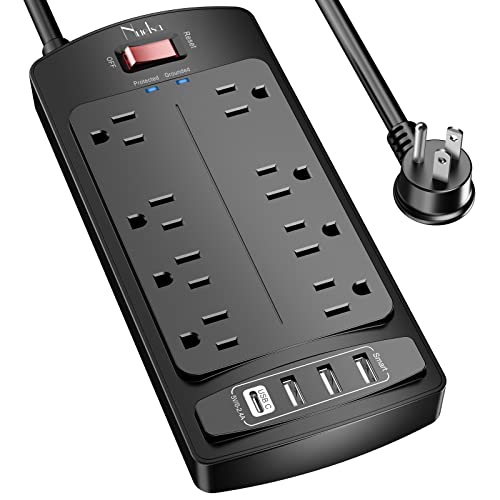
| Nuetsa 2700J Flat Plug | Maximum joule protection under $20 | $15.99 |
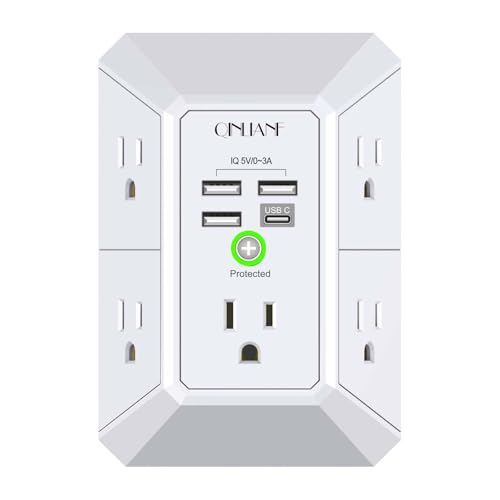
| QINLIANF Wall Charger | Tight spaces with wall-mount only | $9.99 |
| ALESTOR 12-Outlet Strip | Office desks with many AC adapters | $16.99 |
| HANYCONY 1080J Braided | Minimalist setups wanting a short, clean cord | $9.98 |
| CHCORE USB-C Flat Plug | Dual USB-C fast charging at under ten dollars | $9.99 |
| Yintar 6-Outlet Strip | Bedside or entertainment-center use | $12.99 |
How We Picked
Four criteria drove this roundup. First, joule rating: the single most direct measure of how much cumulative surge energy a protector can absorb before its internal varistors fail. Second, outlet layout: wide-spacing designs and flat plugs that avoid blocking the second wall socket are practical advantages that spec sheets sometimes bury. Third, integrated USB power: in a category where every device needs a transformer brick, built-in USB-A or USB-C ports reduce cable spaghetti and free wall sockets. Fourth, price-to-protection ratio: a unit offering over two thousand joules under sixteen dollars shifts the value calculus noticeably compared to one barely clearing a thousand at the same cost.
The 8 Best What Is A Surge Protector in 2026
Anker Power Strip with 2100J Surge Protector, 12 AC, 20W
This is the pick for anyone whose desk hosts more than eight AC adapters at once. Twelve outlets plus a 20-watt USB-C port means you can consolidate an entire workstation into one protected hub without stacking power bars. The 2100-joule rating sits comfortably above the midrange and provides meaningful headroom for repeated moderate spikes.
- Pro: Twelve AC outlets eliminate the need for a secondary strip in most home-office setups.
- Pro: 20W USB-C delivers phone-tablet fast charging without a separate adapter.
- Con: Priced well above every other model here; the premium buys capacity and convenience, not raw joules.
Skip it if you only need four to six outlets or if your budget caps below twenty dollars.
YISHU 6Ft Surge Protector Power Strip, 8 Widely-Spaced Outlets, 4 USB
At under ten dollars, the YISHU is the cheapest way to get surge protection with four USB ports and a six-foot cord. The “widely spaced” outlet layout is the selling point: owners confirm that two-prong and three-prong adapters fit side by side without fighting for real estate.
- Pro: Aggressive price undercuts most competitors while retaining four USB-A outputs.
- Pro: Six-foot cord reaches behind furniture without requiring an extension.
- Con: Joule rating is not prominently published, leaving buyers unable to compare protection headroom against listed-spec rivals.
Skip it if transparent joule rating is non-negotiable for your decision.
Nuetsa Flat Plug Extension Cord, 8 Outlets, 4 USB, 2700 Joules, ETL Listed
Two thousand seven hundred joules makes this the highest-rated protector in the lineup, and the ETL certification adds a verifiable safety layer that some budget strips omit. The flat plug design keeps the strip flush against the wall when plugged into a two-socket outlet.
- Pro: Highest joule rating here by a wide margin, meaning longer usable life under repeated surge exposure.
- Pro: ETL listing gives inspectors and insurance reviewers a third-party safety confirmation.
- Con: USB output wattage is modest; fast-charging enthusiasts will still rely on their own bricks for laptops.
Skip it if you need 20W-plus USB-C and can afford the Anker above.
QINLIANF Wall Charger Surge Protector, 5 Outlets, 4 USB
This is a wall-mount design, not a power strip. Five outlets and four USB ports occupy a single wall socket footprint, making it ideal behind a TV, a nightstand, or a cramped dorm-room desk where floor space matters more than cord length.
- Pro: Wall-mount form factor leaves zero footprint on the floor or desk surface.
- Pro: Under ten dollars for a protected five-outlet hub with four USB ports is hard to argue with.
- Con: Only five outlets limits it to lightweight applications; larger workstations will still need a strip.
Skip it if you regularly plug in more than five devices at once.
ALESTOR 6 Ft Surge Protector Power Strip, 12 Outlets, 4 USB
Twelve AC outlets match the Anker’s capacity at roughly seven dollars less, though the Anker wins on USB-C wattage. For households or small offices that need many traditional plug-in devices, the ALESTOR covers the spread without the premium.
- Pro: Twelve outlets rival far more expensive strips, making it a consolidation king.
- Pro: Six-foot braided-style cord is durable enough for frequent repositioning.
- Con: USB ports are USB-A only; no USB-C means slower charging for newer phones and tablets.
Skip it if you rely on USB-C fast charging and want everything in one box.
HANYCONY Surge Protector Power Strip, 1080J, 5 Ft Braided
The HANYCONY is the minimalist’s choice. A five-foot braided cord, ten-outlet capacity, and a 1080-joule rating target users who want a tidy desk with moderate protection and zero clutter. It is not the strongest protector here, but it is among the best-looking.
- Pro: Braided cord resists tangling and fraying better than standard PVC jackets.
- Pro: Low profile and understated design suit visible desk setups without looking industrial.
- Con: 1080 joules is the lowest rating in this group, so it has less surge absorption headroom before protection degrades.
Skip it if your area experiences frequent or severe grid fluctuations.
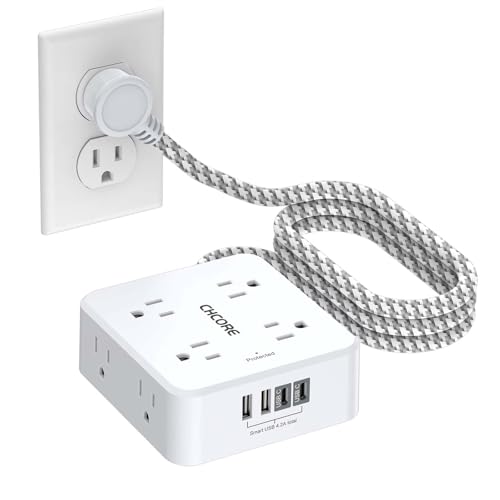
CHCORE 5Ft Braided Surge Protector, 8 Outlets, 4 USB (2 USB-C), Flat Plug, ETL
Two USB-C ports on a sub-ten-dollar strip make the CHCORE the value leader for USB-C fast charging. Combined with a flat plug, ETL listing, and a braided five-foot cord, it checks more boxes per dollar than anything else in the lineup.
- Pro: Dual USB-C output at under ten dollars is rare and immediately useful for modern device owners.
- Pro: Flat plug plus ETL certification add practical and safety polish at the budget tier.
- Con: Joule rating is unspecified in key marketing materials, so you cannot confirm protection headroom against the Nuetsa or Anker.
Skip it if published joule specs are essential to your comparison shopping.
Yintar 6Ft Surge Protector Power Strip, 6 Outlets, 3 USB
Six outlets and three USB ports at thirteen dollars hits a middle note: more capacity than a wall-mount, less than a twelve-outlet monster. The six-foot cord and black finish blend into entertainment centers and bedside tables without drawing attention.
- Pro: Balanced outlet-to-USB ratio suits mixed-device setups like a living-room media shelf.
- Pro: Compact enough to tuck behind furniture while still covering six plug-in devices.
- Con: Joule rating is not prominently stated, leaving protection capacity ambiguous relative to listed-spec competitors.
Skip it if you need more than six AC outlets or a verified high joule rating.
Buying Guide
Joule Rating: The Single Most Important Number
Joules represent the total surge energy the metal-oxide varistors inside the unit can absorb before degrading. Below 1000 joules, you have basic protection suitable for low-risk environments. Between 1000 and 2000 joules, you get moderate coverage for typical urban homes. Above 2500 joules, as the Nuetsa’s 2700-joule rating demonstrates, you have meaningful headroom for repeated spikes in storm-prone or unstable-grid areas. A higher joule rating does not make the protector respond faster; it makes it last longer before needing replacement.
Outlet Spacing and Form Factor
A strip with twelve outlets is useless if three of them are blocked by a single brick adapter. Look for terms like “widely spaced,” “rotating outlets,” or “flat plug” in the listing. The flat plug design on the Nuetsa and CHCORE means the strip lies flush against the wall without covering the second outlet on a duplex receptacle. For entertainment centers, a wall-mount like the QINLIANF eliminates dangling cords entirely.
Integrated USB: Wattage Matters More Than Port Count
Four USB-A ports sharing two point four amps total will not fast-charge a modern laptop. If you want USB charging to genuinely replace separate bricks, look for at least fifteen watts on a single port or explicit USB-C output ratings like the Anker’s twenty watts. The CHCORE’s dual USB-C at nine ninety-nine is the standout value signal here.
Our Verdict
The Nuetsa 2700-joule ETL-listed strip is our top pick for anyone who prioritizes actual protection capacity over extras. It delivers the highest joule rating in the group, a certified safety listing, a flat plug, and eight outlets for under sixteen dollars. The budget pick is the CHCORE: at nine ninety-nine, you get dual USB-C, ETL certification, a flat plug, and a braided cord, making it the most feature-dense option at the lowest price tier. However, if you need twelve AC outlets on a busy desk, the ALESTOR wins that role cleanly, since it matches the Anker’s outlet count at a substantially lower price.
FAQ
What is a surge protector and how is it different from a power strip?
A power strip simply adds more outlets from a single wall plug. A surge protector contains internal components called metal-oxide varistors that clamp voltage above a safe threshold and shunt the excess to ground. Some products are both, but not every power strip includes surge protection; the distinction is the presence of a joule rating.
How often should I replace a surge protector?
Replace it after a major surge event (lightning nearby, transformer failure) or when the built-in protection indicator light turns off. In normal use, a high-joule unit like the Nuetsa can last several years before its varistors absorb enough cumulative energy to degrade protection.
Does a higher joule rating mean better response time?
No. Response time is determined by the clamping voltage and the varistor material, not the total joule capacity. A higher joule rating means the protector can absorb more total energy over its lifespan before failing, not that it reacts faster to any single spike.
Can a surge protector protect a whole house?
No. Point-of-use surge protectors like every product in this roundup guard individual devices or a cluster of them. Whole-house protection requires a panel-mounted or meter-based surge suppressor installed by an electrician at the main service panel.